49 works in this view — arrow keys or swipe to move between them.
Dance in Art
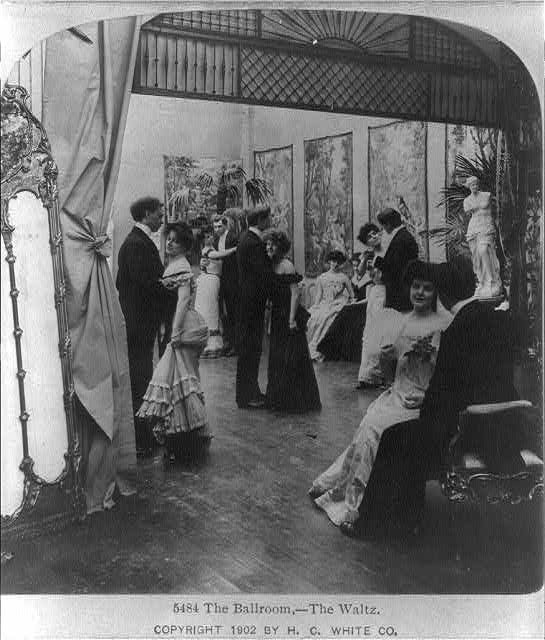
The ballroom, - the waltz
Unknown artist
- Collection:
- Prints & Photographs
- Source:
- Library of Congress
- Rights:
- Rights vary by item — check the source record before reusing this image. Source record ↗
- Recorded as:
- Library of Congress — no known restrictions (verify per item)
This image shows the waltz at its historical peak, not as a taught technique but as the dominant social dance of its era, embedded in a specific visual culture of fashion, architecture, and gender performance. For historians of dance, fashion, and the Edwardian period, it is primary documentation of how ballroom dancing actually looked in practice rather than in instruction manuals. The stereograph itself is a significant artifact of early mass-market photography and the distribution of visual culture to middle-class households.
What you are looking at
This stereograph captures an elegant ballroom scene from the Edwardian era, likely from a social dance event or formal gathering. The photograph shows a crowded interior space with high ceilings and decorative wall panels—some appear to be painted or printed with landscape scenes. A large ornamental fan or decorative screen dominates the upper portion of the composition. The room is filled with formally dressed figures: men in dark suits and women in floor-length white or light-colored gowns with the characteristic high necklines, cinched waists, and abundant skirt volume of the 1900s. Some women are seated along the sides of the room, while others stand or move through the space in conversation and dance. The lighting is even and bright, typical of daylight photography, which illuminates the pale gowns and creates a sense of formal, leisurely refinement. The composition is characteristically stereoscopic, with depth cues leading the eye from the foreground through the crowded room toward the far wall.
The dancing
Most figures are upright and composed, suggesting the formal posture of Edwardian ballroom etiquette. Several couples are visible in close proximity, though their specific holds are difficult to discern at this resolution and distance. The women's skirts are voluminous and floor-length, creating the visual signature of the period. One woman in the foreground left appears to be turning or moving in her skirt, the fabric catching the light. The seated women hold the upright carriage typical of period ballroom decorum. The overall impression is of restrained, formal movement constrained by dress rather than dynamic physical exertion.
The dance depicted
The title identifies this as a waltz, and the composition—crowded couples in a ballroom setting circa 1902—strongly supports that attribution. The waltz was the dominant social dance of the European and North American ballroom throughout the Gilded Age and Edwardian period. The formal dress, the height and volume of the women's skirts, and the architectural setting (a private or public ballroom) are all consistent with the waltz as a respectable, even prestigious, social practice at this date. The photograph shows not a performance but a social event, which was the primary context for the waltz in this era. The image tells us little about specific technique—footwork and frame are not clearly visible—but it confirms the waltz's status as the centerpiece of formal social dancing for the urban middle and upper classes.
How it was made
This is a stereograph, a photographic medium that was mass-produced and widely circulated for home viewing through a stereoscope, creating the illusion of three-dimensional depth. The stereograph format consists of two nearly identical images side by side, printed on card stock. The clarity and tonal range suggest gelatin silver print technology, which dominated commercial stereograph production by 1902. Stereographs were among the most popular photographic products of the late 19th and early 20th centuries, reaching millions of middle-class households. The medium's popularity and the commercial publisher's mark ('H. C. WHITE CO.') indicate this was a mass-market product documenting contemporary leisure—ballroom scenes were popular stereograph subjects because they combined novelty, glamour, and social interest.
About this work
This stereograph documents the waltz as a Gilded Age social institution, frozen at the moment of its cultural dominance in urban ballroom culture. Made by a commercial stereograph publisher around 1902, it depicts not a theatrical performance or instruction in technique, but the lived social practice of ballroom dancing among the formally dressed middle and upper classes of the Edwardian era. The work matters as evidence of how the waltz was actually danced in its period of greatest popularity—not in a concert hall or dancing master's studio, but in crowded, decorated rooms where respectability and fashion were on display.
The stereograph as a medium tells us who valued this image: the middle-class households that purchased stereographs by the millions for evening entertainment and armchair tourism. A ballroom scene was a form of aspiration—a view into refined leisure, into spaces and clothes and social practices that the purchaser could consume visually and perhaps imitate. The waltz in this photograph is not art; it is life—the fashionable life of a specific moment and class.
How to look at it
Attend to the density and formality of the scene: this is not a performance for an audience, but a closed social event where bodies are constrained by elaborate dress and codes of decorum. The photograph captures the moment not of movement but of pause—women seated, groups in conversation, the overall impression static despite the title's promise of dancing. Look at the skirts: the volume and weight visible in even the most stillest figures suggest that the waltz of 1902 was a dance confined by fashion to small, controlled rotations rather than the large traveling steps of earlier waltz aesthetics. Notice the segregation of activity: men and women, seated and standing, clustered and dispersed, suggest the gendered choreography of the ballroom, where men initiated movement and women received it.
The artist
This stereograph was published by H. C. White Company, a major American stereograph manufacturer founded in 1889 in Geneva, New York. White's company was one of the largest and most prolific stereograph publishers of the period, producing thousands of subjects ranging from travel scenes to literary illustrations to contemporary social events. The photographer remains unidentified in the catalogue record, as was typical for commercial stereographs, which were sold as consumable products rather than signed artworks. White Company stereographs were widely circulated and affordable, making them significant documents of how commercial photography shaped visual knowledge of the contemporary world.
The period
In 1902, the waltz was at the height of its cultural prestige in Western ballroom culture, having dominated social dancing for nearly a century. The Edwardian era (1901–1910) was marked by formal, elaborate codes of social conduct, and ballroom dancing was a central arena for their performance. The dress shown in this photograph—the Gibson Girl silhouette with its exaggerated S-bend corset, high neckline, and voluminous skirts—represents the peak of turn-of-the-century fashion. Stereographs themselves were at the height of their popularity as a medium; millions were sold annually before declining in the 1920s with the rise of cinema and cheap pictorial magazines. The subject of a ballroom scene was commercially viable precisely because ballroom dancing was a significant leisure activity for the urban middle class, and the stereograph medium made views of fashionable life available to households that might never attend such an event.
Where it lives
This stereograph is held in the Library of Congress Prints & Photographs collection. The H. C. White Company mark and the catalogue number (6484) indicate it was part of a commercially published series. Stereographs were produced in large quantities and sold through retailers and mail order, making them among the first mass-produced photographs. The Library of Congress holds thousands of White Company stereographs, many of which document American social life, tourism, and culture at the turn of the 20th century.
Dance in this work
Questions about this work
Is this actually showing people dancing?
Not clearly. The photograph captures a ballroom event, but most figures are standing in conversation or seated. The freeze-frame of photography makes the waltz's continuous rotation invisible. The title identifies it as a waltz, and the setting and dress confirm the ballroom context, but the static image does not show the characteristic rotational movement of the dance itself.
Why do the women's skirts look so big?
This is the height of Edwardian fashion (around 1902), when women wore heavily boned corsets that created an exaggerated S-bend silhouette, combined with full skirts often trained or weighted at the hem. This silhouette required considerable physical constraint and affected how women could move. The visible weight and volume of the skirts in the photograph reflect the era's aesthetic of elaborate, restrictive fashion.
What is a stereograph?
A stereograph is a photographic card containing two nearly identical side-by-side images. When viewed through a handheld stereoscope, the images fuse to create a convincing illusion of three-dimensional depth. Stereographs were an enormously popular mass-market product from the 1850s through the 1920s, allowing middle-class households to view distant places, historical events, and scenes of contemporary life. They were affordable, widely available, and a major form of domestic entertainment before cinema and mass-circulation magazines took over.
Why would someone in 1902 want to look at a picture of people ballroom dancing?
Stereographs of ballroom scenes offered viewers a window into fashionable leisure and refined social practice. For those who attended ballrooms, the stereograph was a souvenir or a form of visual nostalgia. For those who did not, it was aspirational—a view of an elegant, formal world available through optical technology and affordable mass production. The stereograph made visible the material culture and spatial reality of ballroom dancing, which written descriptions or even still paintings could not convey in the same way.
More dance artwork





