49 works in this view — arrow keys or swipe to move between them.
Dance in Art
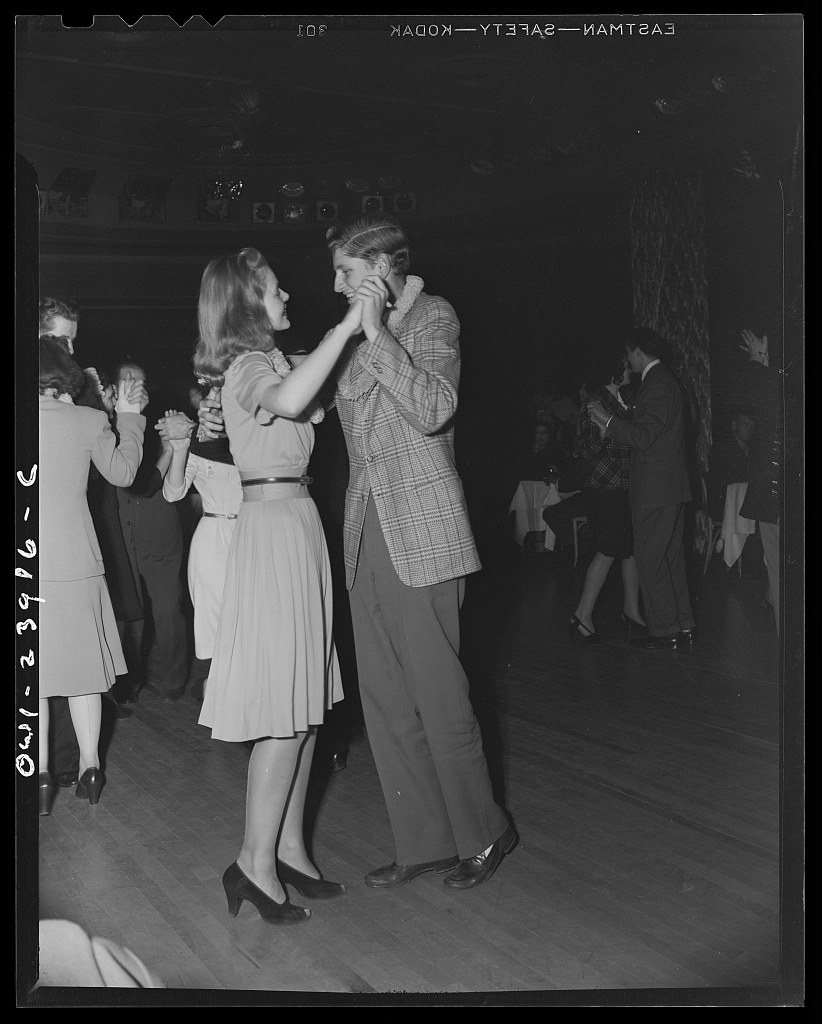
New York, New York. Young dancers at the Hurricane Ballroom
Unknown artist
- Collection:
- Prints & Photographs
- Source:
- Library of Congress
- Rights:
- Rights vary by item — check the source record before reusing this image. Source record ↗
- Recorded as:
- Library of Congress — no known restrictions (verify per item)
This photograph is a rare documentary record of African American swing culture during the 1940s, capturing both the physical technique and the emotional experience of social ballroom dancing. For dancers and historians, it provides evidence of how swing was actually embodied and felt in its moment, beyond choreography or competition—showing the intimacy, the joy, and the social function of the dance.
What you are looking at
A photograph captures a moment of social dancing at the Hurricane Ballroom in New York, circa 1943. The scene is crowded with couples and onlookers in a dimly lit interior space. In the foreground, a couple dances in close embrace: the woman wears a light-colored dress with a full skirt and dark heels, her head tilted back in a moment of joy or abandon, while her partner in a checked sport jacket holds her securely, their bodies pressed close together. Around them, other dancers and spectators populate the floor in various states of motion and repose. The photograph is taken from a low vantage point that emphasizes the intimacy of the dancing couple while showing the social context of the ballroom—this is not a staged performance but a genuine moment of wartime leisure and community.
The dancing
The primary couple is in a tight closed ballroom hold, with the man's right arm around the woman's back and her left arm raised to his shoulder; her right arm is lifted near her face in a gesture of uninhibited pleasure. Her body is arched backward in an expression of abandon, while his posture is grounded and supportive. The woman's weight appears to be on her heels as her skirt swings, suggesting active rotation or a turning motion. Other couples visible in the background maintain similar closed holds, establishing this as a social ballroom dance context where partners move in physical contact.
The dance depicted
This is almost certainly swing dancing, specifically the Lindy Hop or a related East Coast Swing variant popular in American ballrooms of the 1940s. The Hurricane Ballroom was a well-known African American venue in Harlem, and swing dancing was the dominant social dance of the era, especially in urban ballrooms during World War II. The close embrace, the woman's exuberant arch and expression, and the energetic body movement visible in the background all point to the social swing tradition rather than a formal waltz or foxtrot. The photograph documents the lived practice of swing as communal, ecstatic social dance rather than competitive performance.
How it was made
This is a black-and-white photograph, likely taken with available light or flash photography given the dim ballroom setting. The low angle and close framing suggest a documentary or photojournalistic approach rather than a posed studio shot. The grainy quality and lighting are consistent with 1940s press photography. The photograph was made by an unnamed photographer and entered the Library of Congress Prints & Photographs collection, suggesting it may have been commissioned for journalistic or archival purposes during the wartime period when documenting American social life was a cultural priority.
About this work
This is a documentary photograph of wartime social dancing at a Harlem ballroom, capturing an unguarded moment of joy and physical connection in swing dance. The image shows swing not as a choreographed or competitive form but as lived social practice—a place where working-class New Yorkers gathered to dance together in close embrace. The photograph is significant precisely because it documents the everyday, spontaneous pleasure of ballroom dancing at a moment when such venues were central to urban African American social and cultural life. The woman's abandoned expression and the man's secure hold convey the emotional and physical immediacy of the dance, making visible what the historical record often overlooks: the actual feeling of swing as it was danced.
How to look at it
Attend to the woman's expression and body position: her head thrown back, her arched spine, her lifted arm. This is not the composed posture of formal ballroom dance (waltz or foxtrot) but a moment of release and pleasure. Notice the secure, grounded stance of her partner and how his body supports and responds to hers—this is the essence of social swing dancing, where one partner leads and the other follows in intimate physical conversation. The photograph is taken at the moment of maximum expression, catching a turn or rotation where the couple's bodies are most dramatically engaged.
The period
Swing dancing reached its peak popularity in American ballrooms during the 1930s and 1940s. The Hurricane Ballroom on 48th Street in Manhattan was a celebrated venue where Black and, increasingly, interracial audiences danced to live swing orchestras. During World War II, ballroom dancing became a significant site of leisure, romance, and community formation for both service members and civilians. The close embrace visible in this photograph—the man and woman in sustained physical contact—was characteristic of swing dancing as a couple's dance, distinct from the novelty swinging out and aerials that would later define competitive Lindy Hop. The photograph captures swing at a moment when it was the dominant vernacular dance of urban American culture, before it was codified into competitive forms or archived as historical style.
Where it lives
This photograph is held by the Library of Congress Prints & Photographs Online Catalog (loc.gov), catalogued as a documentary photograph of New York social life. It was likely taken by a staff or freelance photographer for journalistic or archival documentation purposes during the 1940s. The photograph is identified by its location (Hurricane Ballroom, New York) but the photographer's name is not recorded in the catalogue.
Dance in this work
Questions about this work
Is this the Lindy Hop?
The dance is most likely swing dancing in the Lindy Hop family, though the close embrace and ballroom context suggest it may be labeled East Coast Swing in modern taxonomy. The key distinction is that this is social swing—partner dancing in a close hold—rather than the aerials and separated positions that define competitive Lindy Hop. Both are swing, but the photograph documents the everyday ballroom version.
Where was the Hurricane Ballroom?
The Hurricane Ballroom was located on 48th Street in Manhattan (Harlem area) and was one of the most popular African American ballrooms of the 1930s and 1940s. It was known for its live swing orchestras and as a gathering place for dancers of all backgrounds, especially during World War II.
Why is the woman's posture so exaggerated?
The arched-back, head-thrown-back posture was a characteristic expression of abandon and pleasure in swing dancing, especially in partner dancing. It signals both the follower's trust in her partner's lead and the emotional release that swing dancing provided. This was not unusual in the 1940s ballroom context and reflects the uninhibited social function of the dance.
Who danced swing in the 1940s?
Swing was danced across racial and class lines, though the Hurricane Ballroom was a specifically Black venue in Harlem. Service members on leave, office workers, factory workers, and students all populated ballrooms during the war years. Swing was the dominant social dance of the era for young adults seeking community and romance.
More dance artwork





