49 works in this view — arrow keys or swipe to move between them.
Dance in Art
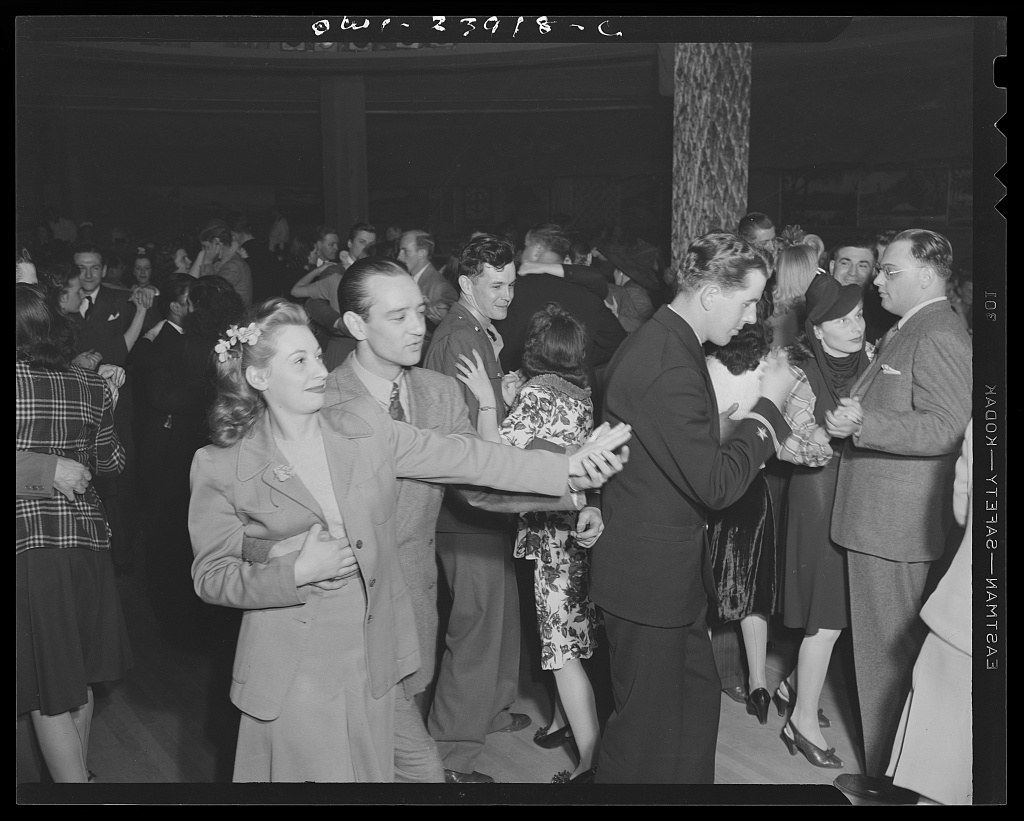
New York, New York. Dance floor scene at the Hurricane Ballroom
Unknown artist
- Collection:
- Prints & Photographs
- Source:
- Library of Congress
- Rights:
- Rights vary by item — check the source record before reusing this image. Source record ↗
- Recorded as:
- Library of Congress — no known restrictions (verify per item)
This photograph is documentary evidence of American social ballroom dancing at a specific moment and place—the Hurricane Ballroom in 1943. It shows how middle-class urban Americans actually danced together in public, the dress codes, the venue design, and the social context of ballroom dancing during the wartime period. For dance historians, it is valuable precisely because it is not a performance photograph; it shows vernacular practice.
What you are looking at
A crowded ballroom scene filled with couples and clusters of dancers on what appears to be a sprung dance floor. The photograph captures the Hurricane Ballroom in full swing, with dozens of patrons in 1940s dress—men in suits and fedoras, women in dresses with fitted bodices and patterned fabrics—distributed throughout the frame in various states of social dance and conversation. The lighting is artificial and relatively even across the space, illuminating a tall support column in the center-right of the composition. The crowd density suggests a popular venue at capacity, with some couples actively dancing in closed position while others stand talking or watching. The photograph has the documentary quality of press or archival photography, capturing a moment of wartime or early postwar urban leisure.
The dancing
The dancers visible are predominantly in closed ballroom position—man and woman facing each other with the man's right hand on the woman's back and her right hand on his shoulder, their other hands joined. Several couples show clear frame and upright carriage characteristic of formal ballroom dancing. The dancers' bodies show varying degrees of engagement: some couples are actively stepping while others are stationary or swaying. Most figures are dressed formally, with women in day dresses or dancing dresses (many featuring printed patterns) and men in suits with visible neckties. The overall posture suggests social dancing rather than performance—relaxed but structured.
The dance depicted
This is a social ballroom scene, most likely featuring American smooth dances—principally waltz, foxtrot, or tango—as these were the standard social dances in American ballrooms of the 1940s. The Hurricane Ballroom was a known venue in New York City, and the photograph documents the popular social dancing culture of the wartime and immediate postwar period. The closed positions visible and the formal attire suggest this was a respectable ballroom establishment catering to middle-class dancers. No performance dancing is evident; this is vernacular social dance captured as documentary evidence of how urban Americans danced together in public spaces.
How it was made
This is a black-and-white photograph, likely taken by a press or archival photographer. The exposure and depth of field suggest professional documentary photography equipment and technique, with sufficient light to capture detail across the crowded floor. The photograph's source in the Library of Congress Prints & Photographs collection indicates it may have been taken for news documentation or archival record of the era's entertainment venues. The technical quality and composition suggest a photographer comfortable with indoor event photography and crowd documentation.
About this work
This photograph documents a moment in the Hurricane Ballroom in New York City in 1943, capturing the social ballroom dancing that defined American urban leisure culture during the wartime period. It shows dozens of ordinary dancers—not professionals or performers—in the closed positions and formal dress of 1940s social dancing, most likely waltzing or doing foxtrot. The image is valuable not because it captures spectacular dancing but because it records how social ballroom dancing actually looked in practice: crowded, informal in manner despite formal in style, and embedded in the social and leisure rhythms of wartime America. The photograph sits at the intersection of dance history and social history, documenting a form of recreation and courtship that has now largely disappeared from American urban culture.
How to look at it
Attend to the variety of postures and engagement levels across the floor: some couples are actively dancing with visible weight transfer and frame, while others are essentially still, swaying or talking. Note the consistency of closed position and formal dress across the room—this was the uniform of American social ballroom dancing. The tall column in the center of the frame is part of the ballroom's actual architecture, visible because of the photographer's documentary approach. Look at the density and positioning of couples to understand the spatial management of a crowded public dance floor. The photograph captures the ballroom not as a performance space but as a social space where dancing is one activity among several (talking, watching, courtship).
The period
In 1943, the United States was in the midst of World War II, and urban ballrooms remained important sites of civilian leisure, courtship, and escape. The Hurricane Ballroom was one of many commercial dance venues operating in New York City during this era. The 1940s represented the height of social ballroom dancing in American culture before jazz and other genres began to displace the dominance of formal ballroom in the 1950s and 1960s. The closed positions, formal dress, and gender conventions visible in this photograph were the standard for respectable public dancing in this period. Ballroom dancing in commercial venues was a form of entertainment accessible to working- and middle-class dancers, not the exclusive domain of the wealthy.
Where it lives
The photograph is held by the Library of Congress Prints & Photographs Collection, catalogued as a documentary image. Its notation on the original photograph suggests it was part of a systematic documentation project, possibly New Deal-era or wartime press photography. The cataloguing reference visible on the image indicates it was accessioned into the Library's collections as a record of American social life.
Dance in this work
Questions about this work
What ballroom dances would have been danced at the Hurricane in 1943?
The closed positions visible in this photograph suggest waltz, foxtrot, or tango—the three dominant American smooth ballroom dances of the 1940s. Swing dancing was also popular in 1943, though it typically used open positions and would show different body angles. The formality of dress and setting points toward the American smooth tradition rather than the looser, more athletic swing style.
Why is this photograph valuable to dance historians?
It is valuable precisely because it documents ordinary social dancing by non-professionals in a real ballroom, not a staged performance or a posed studio portrait. It shows the actual clothing, spacing, frame, and social context of American ballroom dancing in the 1940s. Most dance documentation from this era focuses on theatrical or professional performance; this photograph records the vernacular practice that occupied the leisure time of millions of Americans.
Was the Hurricane Ballroom a prestigious venue?
Based on the crowd size, the maintained facility, and the respectability of the dress and behavior visible, the Hurricane appears to have been a commercial ballroom of middling to good standing in New York City. It was not an elite club, but neither was it a working-class dive; it catered to the broad middle market of urban dancers seeking public ballroom venues.
More dance artwork





