49 works in this view — arrow keys or swipe to move between them.
Dance in Art
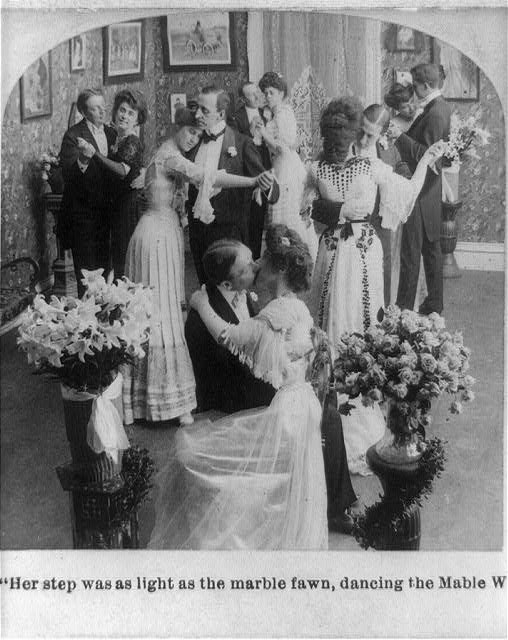
"Her step was as light as the marble fawn, dancing the Mable Waltz"
Unknown artist
- Collection:
- Prints & Photographs
- Source:
- Library of Congress
- Rights:
- Rights vary by item — check the source record before reusing this image. Source record ↗
- Recorded as:
- Library of Congress — no known restrictions (verify per item)
The photograph preserves evidence of how the waltz was performed, staged, and publicly displayed in the early 20th century—including the specific body aesthetic ('light as marble,' lifted and ethereal) that was prized in the period. It also documents the social ritual of private performance for an audience of guests, showing that ballroom dancing was not only social participation but also spectacle worthy of professional documentation and circulation.
What you are looking at
A parlor or drawing room is arranged for an elegant social gathering, with seated and standing figures arranged in two zones: a performance space in the center-foreground and an audience of onlookers around the perimeter. In the center, a young woman in a white or pale gauze gown dances while a man in dark dress suit maintains a formal position nearby. Large floral arrangements in tall vases frame the scene at left and right. The walls are papered and hung with framed pictures. The composition suggests a private dance demonstration or performance for an assembled company of well-dressed guests—some seated in chairs, others standing in clusters. The lighting is soft and even, and the photograph captures an instant of graceful movement frozen in the moment of the waltz.
The dancing
The dancer at center has her body in an elegant upright frame, her weight appears to be on one foot in a lifted, balletic posture. Her arms are positioned with poise. The male figure stands at formal attention in closed-position dance hold or near-hold. The surrounding guests are arranged informally but attentively—some seated, others clustered in conversation or observation. The overall frame suggests social ballroom decorum: upright carriage, restrained gesture, and the presence of witnesses arranged as an audience rather than as participants.
The dance depicted
The title explicitly identifies this as the 'Mable Waltz' (likely a specific popular waltz of the period, though the spelling may indicate a variant or personal name). The image documents a parlor waltz—a social ballroom dance of the late 19th and early 20th centuries. The dancer's lifted, light-footed posture aligns with the title's emphasis on steps 'as light as the marble fawn.' This appears to be a demonstration or exhibition waltz, not a working ballroom scene, staged for an assembled company. The waltz was already a century old in 1907 but remained the dominant social partner dance of the period.
How it was made
This is a photographic print, likely a halftone reproduction in a publication or a gelatin silver print. The soft focus, posed composition, and studio-like arrangement with carefully placed floral elements and arranged spectators suggests professional theatrical or entertainment photography rather than documentary capture. The medium allowed wide reproduction and distribution, and the formal staging implies this was meant for newspaper, magazine, or promotional circulation—making it a record of performed rather than spontaneous dance.
About this work
This photograph documents a parlor performance of a popular named waltz, the 'Mable Waltz,' during the Edwardian era. It captures the aesthetic and social practice of elite ballroom dancing in a domestic setting arranged as a performance. The image stands at the intersection of social dance, theatrical presentation, and turn-of-the-century photographic practice, showing how the waltz was displayed, spectated, and circulated through visual media. The carefully composed scene and explicit title suggest this was a known work, likely appearing in newspapers or magazines, that helped establish conventions for how ballroom dancing was to be visualized and admired.
How to look at it
Note the dancer's upright frame and the lift in her body—the photographer has caught not a heavy step but a moment of suspension and grace, illustrating the period ideal of weightlessness. Observe how the audience is arranged: they are not dancing, but witnessing and validating. The composition is carefully balanced around the central pair, with the floral arrangements framing them as the focal point. The title's emphasis on the step being 'light as the marble fawn' is embodied in the dancer's posture and the photographer's choice to capture an elevated moment rather than a grounded one.
The period
In 1907, the waltz had dominated European and American social dancing for nearly a century. The early 20th century saw the rise of new social dances (foxtrot, one-step, tango), but the waltz remained the prestige partner dance. This period coincided with the popularization of half-tone photographic reproduction in periodicals, making it possible to distribute images of dance performance widely. The Edwardian era (1901–1910) was marked by formal social protocols and a continuing investment in ballroom dancing as a marker of refinement and class. The theatrical staging of this 'Mable Waltz'—with audience, formal dress, and floral décor—reflects the period's habit of framing social dances as performances.
Where it lives
This print is held by the Library of Congress Prints & Photographs Online Collection. The catalogue record provides no artist attribution. The title and 1907 date are the only certain identifying information; the print likely comes from a periodical or promotional source of that era.
Dance in this work
Questions about this work
What is the 'Mable Waltz'?
The 'Mable Waltz' was a named waltz popular in the early 20th century. The spelling suggests it may have been named after a person (Mabel/Mable) or a popular performer. Named waltzes were common in the period—they functioned much like popular songs, circulated in sheet music, dance manuals, and photographs. This image is likely promotional documentation of a performance of this specific waltz, suggesting it was well-known enough to merit professional photography and publication.
Who is dancing?
The catalogue record does not identify the dancers by name. The formal staging and professional photography suggest they were likely known performers or members of a prominent social circle, but this cannot be confirmed from the image alone.
Where was this taken?
The setting is a private parlor or drawing room, not a public ballroom. The arrangement of guests, the domestic furnishings, and the careful staging suggest this was a performance staged in a wealthy household for an assembled audience of invited guests.
Why are there floral arrangements?
The large floral arrangements in tall vases are part of the theatrical staging. They frame the dancers and indicate that this is a special, formal performance rather than ordinary social dancing. The flowers also reflect Edwardian decorative taste and help construct the scene as an elegant social occasion worthy of photography and display.
More dance artwork





