49 works in this view — arrow keys or swipe to move between them.
Dance in Art
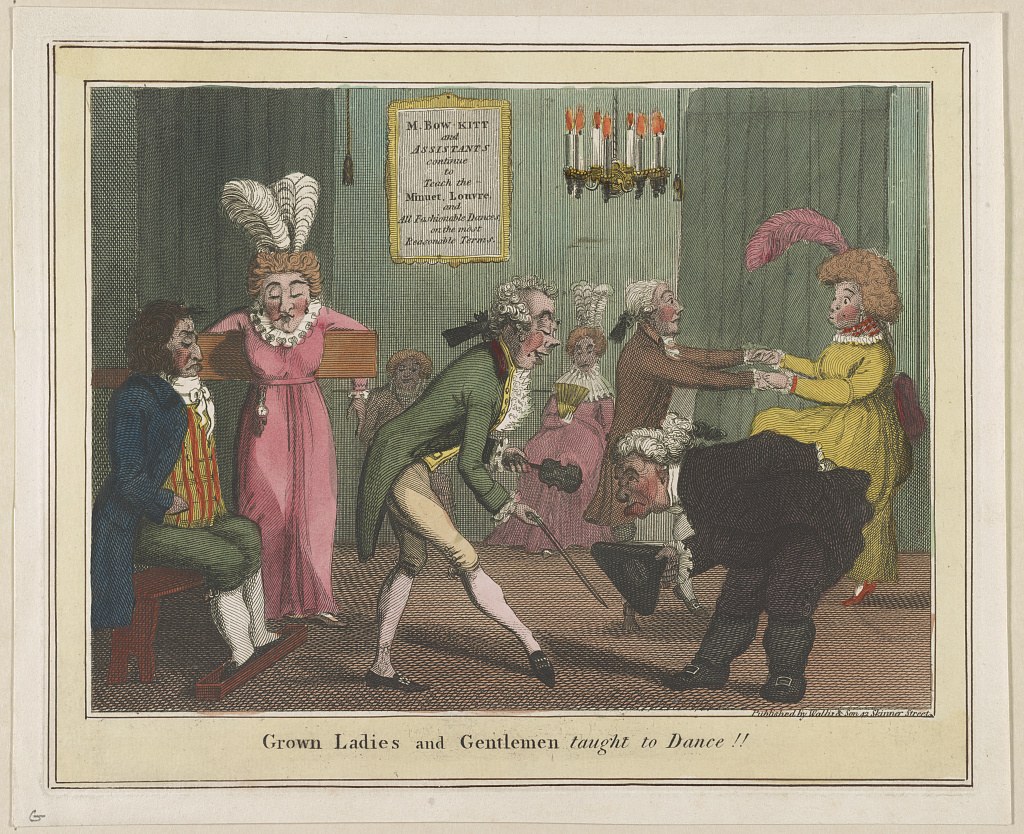
Grown ladies and gentlemen taught to dance!!
Unknown artist
- Collection:
- Prints & Photographs
- Source:
- Library of Congress
- Rights:
- Rights vary by item — check the source record before reusing this image. Source record ↗
- Recorded as:
- Library of Congress — no known restrictions (verify per item)
This print offers a rare glimpse into how dance instruction and dancers themselves were perceived in 1800, revealing that even fashionable ballroom dancing was subject to ridicule and satire. For historians and dancers alike, it documents not the dance itself but the anxieties around social dancing and the body that surrounded it in the early nineteenth century—the fear of ridicule, the difficulty of acquiring grace, and the comic potential of the uncontrolled adult body.
What you are looking at
A satirical engraving depicting a crowded drawing room where fashionably dressed adults are being taught to dance by two instructors. The scene is set in an elegant interior with a chandelier and tall windows, indicated by the formal architectural details and hanging candelabra. At the center, a man in green breeches and coat performs an exaggerated dance posture with one leg raised high and arms extended, while a woman in a yellow dress gestures emphatically at him from the right. To the left, a second instructor in pink stands beside a diminutive male student, and scattered throughout the room are other elegantly dressed figures—men in striped coats and women in fashionable gowns with high feathers and elaborate hair—observing or participating awkwardly. The composition is crowded and chaotic, with figures at various stages of confusion and discomfort, suggesting the comedy of adults attempting graceful movement. A framed certificate or notice hangs on the wall above, and the overall mood is one of ridicule and satire directed at the pretensions of fashionable society.
The dancing
The figures display exaggerated, ungainly postures that mock rather than demonstrate proper dance form. The central male dancer has adopted an extreme attitude position with his leg thrust upward in an uncontrolled manner, his torso rigid, embodying physical awkwardness rather than grace. The female instructor on the right leans forward with an emphatic pointing gesture, her posture indicating frustration or correction. The other students crowd the room in stiff, uncertain stances—some watching anxiously, others attempting poses they visibly do not understand. None of the figures show the relaxed control or fluidity associated with accomplished dancing; instead, their bodies convey strain, confusion, and physical ineptitude.
The dance depicted
This is a satirical commentary on fashionable dancing instruction of the period, likely depicting the teaching of cotillon, quadrille, or similar ballroom dances of the era. The image is not meant to document proper technique but to ridicule the pretensions of adult learners attempting to acquire fashionable accomplishments. The exaggerated postures, the crowded classroom setting, and the emphatic gestures of the instructors all work to suggest that these respectable people are hopelessly clumsy and that the very idea of teaching grown women and gentlemen to dance is inherently comic. The title 'Grown Ladies and Gentlemen taught to Dance!!' makes clear that the humor lies in the absurdity of adults attempting what should come naturally to the young.
How it was made
This is a hand-colored engraving, indicated by the fine parallel lines that create tone and shadow, the precise linear definition of forms, and the areas of flat color wash applied over the printed image. The technique of engraving allowed for sharp detail and the subtle modeling of faces and fabrics, and the hand-coloring—visible in the pink, yellow, blue, and brown garments—was typical of popular satirical prints of this period. The combination of engraving's precision with hand-coloring's immediacy made such prints affordable and distributable to a broad audience, which was essential for satirical commentary meant to circulate widely among the literate middle and upper classes.
About this work
This is a satirical hand-colored engraving from around 1800 that uses the figure of the dancing master and his struggling students to mock the affectations of fashionable society. Rather than documenting any actual dance form or teaching method, the image presents a caricature of adult pretension, where respectable ladies and gentlemen are shown in grotesque and uncoordinated poses as they attempt to master the steps of ballroom dancing. The work belongs to a long tradition of satirical prints that used dance and other markers of gentility as vehicles for social commentary. The print likely reflects the period's ambivalence about dancing: valued as a necessary accomplishment for social participation, yet also viewed with suspicion as an unseemly activity prone to vanity and excess.
How to look at it
Pay attention to the exaggerated contortions of the central male dancer's body—the unnaturally high leg, the rigid torso, the awkward arm position—which are designed to be laughable. Notice how the female instructor's emphatic gesture and leaning posture suggest her frustration or disgust at her pupil's incompetence. Observe the range of reactions in the other figures: some watch anxiously, others attempt poses they clearly do not understand, still others seem bemused or skeptical. The satire works precisely through the contrast between the pretensions suggested by the elegant clothing and setting and the physical ineptitude displayed by the figures themselves.
The period
In 1800, ballroom dancing was central to respectable social life, particularly among the aristocracy and rising middle class. The cotillon and quadrille were the fashionable dances of the Regency era, and the ability to dance well was considered essential to social success and marriage prospects. At the same time, dancing and dancing masters were frequently subjects of satire and moral suspicion. This engraving emerges from a well-established British tradition of satirical prints (flourishing through the eighteenth and nineteenth centuries) that used dance, dress, and manners as vehicles for social commentary. The tradition of satirizing the dancing master and his pupils can be traced back through the work of Hogarth and his contemporaries.
Where it lives
This work is held in the Prints & Photographs collection at the Library of Congress and is part of that institution's holdings of satirical prints and social commentary from the period around 1800.
Dance in this work
Questions about this work
What dances are being taught in this image?
The specific dance form is not identifiable from the image, which is not the point of the satire. The print is mocking the very idea of teaching adults to dance at all, rather than documenting a particular technique. The fashionable ballroom dances of 1800—cotillon and quadrille—would have been the most likely candidates, but the exaggerated, ungainly postures are intentionally unrealistic and comic rather than instructional.
Why is this funny?
The humor lies in the gap between the pretension and the reality. These are respectable, well-dressed adults in an elegant room, clearly concerned with appearing fashionable and accomplished. Yet they are depicted as physically clumsy, awkward, and inept—their bodies utterly failing to match their aspirations. The satire suggests that the desire to master fashionable dance is itself ridiculous, particularly in adults, and that the human body is inherently unsuited to graceful movement.
Is this a reliable record of how people actually danced in 1800?
No. This is satire, not documentation. The exaggerated postures and expressions are intentionally distorted for comic effect. However, the image does tell us something true: that dance instruction was common, that there was anxiety around performing dance correctly, and that dancing was taken seriously as a marker of social status—serious enough to be worth mocking.
More dance artwork





