49 works in this view — arrow keys or swipe to move between them.
Dance in Art
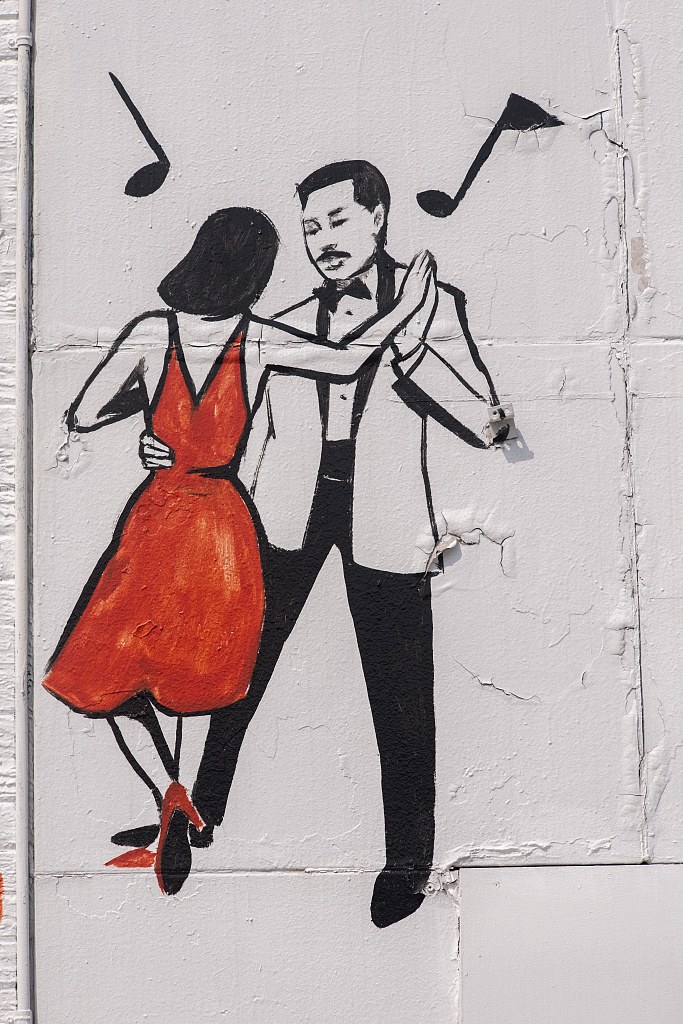
Above the image, the sign reads: "Dancing, I Choose You Presents Ballroom Classes." 7631 W. McNichols Rd., 2015
Unknown artist
- Collection:
- Prints & Photographs
- Source:
- Library of Congress
- Rights:
- Rights vary by item — check the source record before reusing this image. Source record ↗
- Recorded as:
- Library of Congress — no known restrictions (verify per item)
This mural documents the persistence of ballroom dance as a living social practice in American urban communities in the 2010s, and demonstrates how dance studios used public art to recruit students and claim space in their neighborhoods. The work is a direct historical document of vernacular dance culture and the visual language used to market it.
What you are looking at
A black and white mural with color accent depicts a couple in formal evening wear engaged in ballroom dance. The woman wears a striking red dress with a full skirt caught mid-swirl, her face turned away from the viewer; the man is dressed in a black tuxedo with bow tie and light-colored shirt. They are shown in an energetic, lifted pose suggesting upward momentum, with the man's body angled and the woman appearing nearly airborne. Musical notes—rendered as stylized black symbols—float above them, emphasizing the rhythmic, joyful character of the moment. The setting is a painted wall surface, and the composition is flat and graphic, executed in bold black outlines with minimal shading, the red dress providing the only chromatic element beyond black and white.
The dancing
The pair are locked in what appears to be a closed or semi-closed ballroom hold, with the man's right hand on the woman's back and her left hand on his shoulder. Both figures lean into the movement with forward-tilted upper bodies; the woman's right arm is raised and slightly extended, and her legs suggest a step or spin in progress. The man's posture is upright and controlling, supporting the woman's dynamic action. Their relative positions and the angle of the composition suggest a moment of lift or rise, characteristic of certain ballroom styles. The graphic flatness of the line work emphasizes the geometric and rhythmic qualities of the pose rather than anatomical detail.
The dance depicted
This mural advertises ballroom dance classes and depicts a generic ballroom couple at an energetic moment. The lifted, spiraling quality of the pose—particularly the woman's near-weightlessness and the upward tilt of both figures—is consistent with Waltz, Viennese Waltz, or Foxtrot, all of which feature rise-and-fall action and traveling movement. The formal evening wear (tuxedo and floor-length dress) confirms this is social ballroom rather than Latin or other competitive styles. The image captures the aspirational, joyful essence that ballroom instruction marketed to the public, and the floating musical notes reinforce the connection between music, movement, and social pleasure. Without the artist's signature or detailed period documentation, the specific ballroom style cannot be narrowed further, but the visual language is unambiguously that of American Smooth or International Standard ballroom.
How it was made
This is a mural painted directly onto a wall surface, executed in black paint with a single red accent. The technique is straightforward representational drawing in a modern graphic style: bold black outlines define all forms, with minimal internal shading or modeling. The flatness and bold line suggest influence from commercial art, advertising design, and possibly social realist mural traditions popular in American cities. The simplicity of execution and the public location suggest this was created quickly and inexpensively, designed to catch the eye of passersby and advertise the dance studio's offerings to a broad audience.
About this work
This is a street mural from Detroit (or another American city) created in 2015 to advertise 'Dancing, I Choose You Presents Ballroom Classes.' It depicts a joyful moment between two ballroom dancers at the peak of a turn or rise, the woman's red dress a visual anchor against the graphic black-and-white composition. The work belongs to the tradition of public art used to promote dance instruction and community engagement. It represents a specific moment in early-21st-century American urban culture: the use of local murals as both public beautification and small-business marketing, and the continued presence of ballroom dancing as a recreational and social practice in American cities. The image captures the aspirational message that ballroom classes conveyed—elegance, partnership, joy, and transformation through dance.
How to look at it
Notice the suspended moment the artist chose: the woman is nearly airborne, her body light and lifted, while the man's frame is steady and controlled. This captures the characteristic rise-and-fall action of smooth ballroom styles, where the couple ascends and descends as they travel across the floor. The musical notes floating overhead are not decorative alone—they anchor the image in the idea that ballroom is fundamentally about responding to music, about the fusion of sound and movement. The red dress is the visual keystone; its movement and flow suggest the woman's momentum through space. The formality of the evening wear signals that this is social dance for adults, aspirational and pleasurable rather than competitive or theatrical.
The period
By 2015, ballroom dance had experienced a significant revival in American popular culture, driven partly by television shows like 'Dancing with the Stars' (which began in 2005). This mural dates to a moment when ballroom instruction was actively marketed to diverse urban audiences as a leisure activity, social skill, and form of self-improvement. The graphic style of the mural reflects early-21st-century street art and public design conventions, in which bold outlines, minimal color, and commercial clarity were standard. The use of a public wall for business advertising was common in American cities, particularly in neighborhoods with active small-business corridors.
Where it lives
The mural is located at 7631 W. McNichols Rd. and was documented in the Library of Congress Prints & Photographs collection. It is a public artwork, part of the street-level visual culture of an American urban neighborhood.
Dance in this work
Questions about this work
What style of ballroom is shown?
The lifted, traveling quality and the couple's formal evening wear suggest Waltz, Viennese Waltz, or Foxtrot—all smooth ballroom styles characterized by rise-and-fall action. The mural does not show a specific competitive routine, but rather a moment intended to communicate joy and elegance to potential dance students.
Who painted this mural?
The artist is not identified in the catalogue record or visible in the image. This was likely a commissioned or semi-commissioned public artwork, created to advertise a local ballroom dance studio.
Why is ballroom dance important to document?
Ballroom dancing is a living social and recreational practice in American communities, particularly in urban areas. Artworks like this mural show how dance studios marketed themselves, how ballroom was perceived by the public, and what role dance played in neighborhood life and identity-formation.
More dance artwork





