49 works in this view — arrow keys or swipe to move between them.
Dance in Art
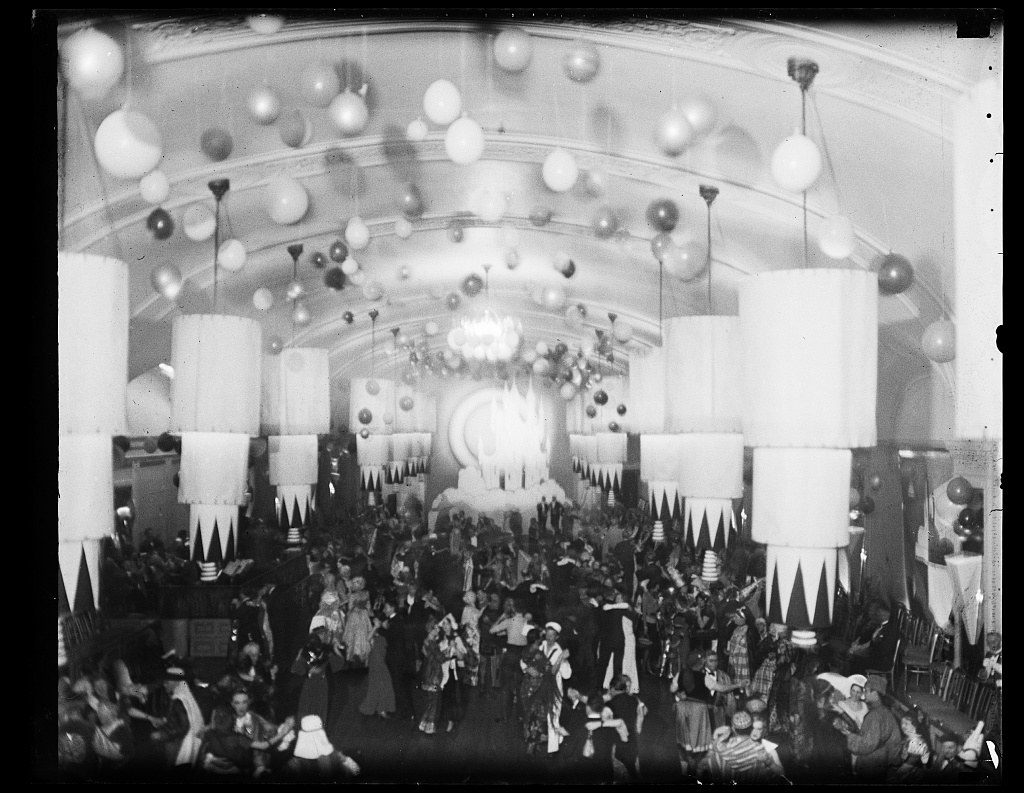
[Dance in the ballroom of the Willard Hotel, 1401-1409 Pennsylvania Avenue, N.W., Washington, D.C.]
Unknown artist
- Collection:
- Prints & Photographs
- Source:
- Library of Congress
- Rights:
- Rights vary by item — check the source record before reusing this image. Source record ↗
- Recorded as:
- Library of Congress — no known restrictions (verify per item)
This image provides rare visual documentation of mass social ballroom dancing in an institutional setting during the 1930s. It shows how ballroom dancing functioned as formal ritual in elite American society, and how photographers and event designers used scale and theatrical framing to amplify the importance of the occasion. For historians of American social dance, it captures a moment when ballroom culture was reaching its peak in public prestige.
What you are looking at
A grand ballroom filled with hundreds of dancers in formal evening wear, photographed from an elevated vantage point. The ceiling is hung with suspended spheres—some white, some dark—creating a dramatic geometric canopy above the crowd. Tall cylindrical columns wrapped in white material with pointed base sections (resembling icicles or stage drapery) frame the perimeter of the hall. The dancers fill the floor in clustered groups, many in pairs, suggesting social ballroom dancing in progress. The lighting is theatrical and bright, illuminating the white ceiling and architectural elements while casting the crowd below in shadow, creating strong depth and drama. This appears to be a major formal event, likely a gala or society dance, with elaborate decoration suggesting a special occasion rather than routine dancing.
The dancing
Individual dancers are small and indistinct at this distance, but the overall composition suggests couples in loose social formation scattered across the floor. The scale indicates hundreds of participants. Despite the distance, the pairing and positioning suggest closed or semi-closed ballroom holds typical of 1930s social dancing. The architectural framing draws focus upward to the suspended elements rather than isolating individual dancers' technique or frame.
The dance depicted
This is social ballroom dancing in a structured, formal setting. The 1932 date and Willard Hotel location point to established ballroom culture in Washington, D.C.—likely a society ball or gala event where standard American smooth and waltz patterns would have dominated. The mixed couples, formal dress, and grand scale suggest this is demonstration or documentation of elite social dancing rather than performance dancing. The specific steps and style cannot be discerned from this overhead perspective, but the setting and formality indicate American smooth dancing (foxtrot, waltz, or both) of the early Depression era.
How it was made
This is a black-and-white photograph, likely taken from a balcony or overhead position to capture the full ballroom scene. The elevated angle, sharp focus on ceiling and decor, and blurred crowd below suggest deliberate compositional choice to emphasize the theatrical architectural setting over individual dancers. The photographic medium allows documentary capture of a mass social event in progress, suggesting this was made for press, architectural, or society documentation rather than dance instruction or choreographic analysis.
About this work
This photograph documents a high-society ballroom dance at the Willard Hotel in Washington, D.C., circa 1932. It captures the scale, formality, and theatrical production values of elite American social dancing during the early Depression, when grand hotels hosted major public and private balls. The image emphasizes architectural and atmospheric spectacle as much as the dancing itself—the real subject is the event as a total social and visual experience. The elevated perspective transforms the crowd of individual dancers into a pattern, subordinating gesture and technique to setting.
How to look at it
Look at the ceiling and architecture first: the photograph is composed to make the ballroom's theatrical design the primary subject, not the dancers' bodies or technique. Notice how the spheres and columnar drapes create a sense of enclosure and grandeur despite the enormous scale. The crowd below exists partly in shadow, unified as a pattern of movement rather than individualized. The photographer chose documentation and spectacle over dance analysis—the work celebrates the event as a total social occasion, not the dancing as a technical practice.
The artist
The photographer is not recorded. The image comes from the Library of Congress Prints & Photographs collection, suggesting it was made for journalistic, architectural, or institutional documentation rather than as fine art. The Willard Hotel was a major venue for Washington society events, and such photographs likely served press or archival purposes.
The period
By 1932, American ballroom dancing had become formalized around five standard dances (foxtrot, waltz, tango, quickstep, and slow foxtrot), often danced in hotel ballrooms and at society balls. The grand hotel ballroom was the institutional center of American social dancing, particularly in Washington, D.C. This photograph captures ballroom culture at its height, before the economic collapse of the Depression and the later rise of swing and jazz dancing would shift the center of American social dancing away from formal, segregated ballroom venues toward more democratic, improvised settings.
Where it lives
The photograph is held in the Library of Congress Prints & Photographs Online Collection, identified as a record of the Willard Hotel's ballroom. The catalogue record is minimal, suggesting the image was preserved as architectural or historical documentation rather than as a dance artifact.
Dance in this work
Questions about this work
Who are these dancers?
The photograph does not identify individuals. Given the Willard Hotel's status as a Washington, D.C., social venue, they were likely members of the local elite attending a gala or ball, though the specific event is not documented in the available record.
What dance styles would have been performed at this event?
By 1932, American ballroom standards included foxtrot, waltz, and tango, performed in closed or semi-closed hold with structured patterns. The architectural context and formal dress suggest this was ballroom dancing in the strictest sense, not jazz or social dancing.
Why is the camera positioned so high?
The overhead angle emphasizes the architectural spectacle and the sheer scale of the crowd rather than individual dancers' technique. This compositional choice suggests the photograph was made to document the event's scale and grandeur for press, architectural, or institutional records.
More dance artwork





