49 works in this view — arrow keys or swipe to move between them.
Dance in Art
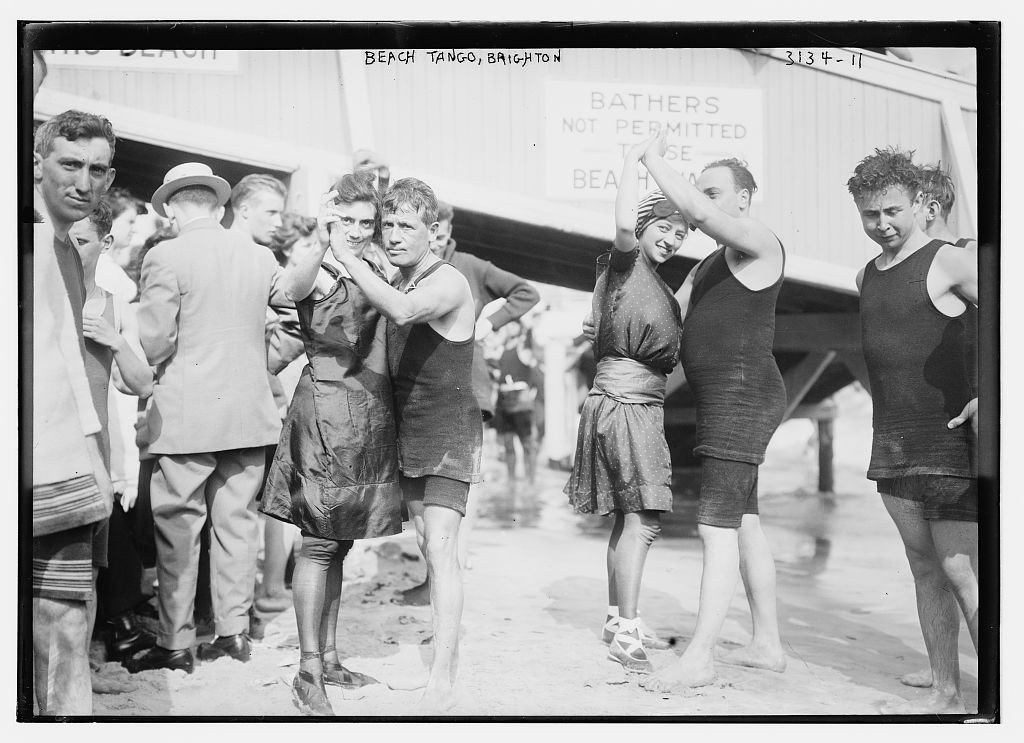
Beach Tango -- Brighton
Unknown artist
- Collection:
- Prints & Photographs
- Source:
- Library of Congress
- Rights:
- Rights vary by item — check the source record before reusing this image. Source record ↗
- Recorded as:
- Library of Congress — no known restrictions (verify per item)
This photograph provides rare visual evidence of tango's early social practice in Britain and its integration into public leisure spaces outside the ballroom. It shows the dance being performed not by professionals or in formal attire but by ordinary bathers, and documents the specific frame, hold, and posture of tango as it was actually danced in 1910—more upright and contained than the dramatic style later associated with theatrical tango. For dance historians, it is valuable evidence of how quickly a Latin American dance became normalized in European popular culture.
What you are looking at
A seaside photograph taken at Brighton beach, showing a mixed group of bathers and spectators gathered near a changing structure or beach hut marked with a sign reading "BATHERS NOT PERMITTED" and "USE BEACH." The scene is composed around several figures in 1910s swimming costumes: men and women wearing one-piece wool bathing suits typical of the era, sleeveless vests, and fitted trunks. In the center, two couples appear to be dancing or performing a partnered movement on the sand, while others stand nearby watching or waiting. The photograph has the grainy, high-contrast quality of early 20th-century documentary photography, with natural seaside light creating sharp shadows. The composition captures a moment of seaside leisure and social interaction, with the beach infrastructure and warning signage suggesting this was a regulated public bathing area.
The dancing
The central dancers are in ballroom closed position or closed frame—chest to chest, with the leader's right hand on the follower's back and left hand held at shoulder height. Both dancers wear period-correct bathing costumes that allow full leg visibility; the woman wears a darker, heavier suit with a gathered skirt, the man a lighter sleeveless vest and trunks. The weight appears to be held upright through the torso. A second couple is visible to the right, also in contact and upright frame. The remaining figures—several men in suits and hats, other bathers in swimming attire—are arranged as spectators and participants, creating a social gathering rather than a formal performance.
The dance depicted
This is Argentine tango or ballroom tango being danced on the beach at Brighton, likely as a public demonstration or social entertainment around 1910. The closed frame, the upright carriage, and the partnered counter-balance visible in the nearest couple's posture are consistent with early 20th-century tango practice. The photograph documents the rapid spread of tango from Buenos Aires to European seaside resorts; by 1910–1912, tango was the dominant fashionable dance in ballrooms and public spaces across Britain and Europe. The image is notable for showing tango performed not in a dance hall but in everyday clothes and a public beach setting, suggesting both the dance's social penetration and the phenomenon of impromptu or exhibition dancing at entertainment venues.
How it was made
This is a black-and-white photograph on gelatin silver print or similar period photographic stock, showing the documentary aesthetic and slight motion blur characteristic of hand-held photography of the 1910s. The caption "BEACH TANGO, BRIGHTON" and the accession number suggest this was part of a news or documentary photographic archive—likely collected by a major newspaper or press agency to record topical social scenes. The photograph's grainy texture, tonal range, and the visible depth of field indicate it was taken in natural seaside daylight, probably at or near midday. Its preservation in an institutional collection and its composition suggest it was intended for publication or archival documentation of leisure and entertainment practices.
About this work
A candid photograph from circa 1910 showing couples dancing tango on Brighton beach in period swimming costumes, surrounded by spectators and bathers. The image documents the astonishing rapid adoption of Argentine tango into British popular culture in the early 20th century, capturing it not as formal ballroom dance but as impromptu public entertainment at a seaside resort. The photograph is a documentary artifact of both the dance's history and the era's visual culture of leisure and spectacle—a moment when the tango craze was so dominant that it appeared everywhere, even at the beach.
How to look at it
Attend first to the frame and hold of the central couple: the closed ballroom position, the upright carriage, and the way the dancers' bodies are aligned parallel and facing the same direction. This posture distinguishes ballroom or salon tango from the more compact, dramatic postures of later theatrical tango. Notice the bathing costumes and the beach setting—ordinary clothing for ordinary people, not professionals in evening dress—which tells you this was social dancing, not formal performance, yet significant enough to photograph and record. The presence of spectators and other couples suggests this was a public exhibition or social event, possibly organized as entertainment at the beach, and the documentary photographic style (grainy, natural light, no studio setup) indicates this was captured as news or social documentation, not as formal art.
The artist
The photographer is not recorded. The image forms part of a news or documentary archive held by the Library of Congress, suggesting it was taken by a press photographer or documentary photographer working for a newspaper or news syndicate. The cataloguing and preservation practices suggest systematic documentation of social and entertainment scenes for publication or archival record-keeping.
The period
The tango craze swept across Europe and America from approximately 1910 onward, following the dance's emergence in Buenos Aires in the 1880s and 1890s. By 1910–1912, tango dominated fashionable ballroom dancing in London, Paris, Berlin, and other major cities; it was danced at tea dances, variety shows, and seaside entertainment venues. The dance was initially controversial—condemned by some as sexually suggestive—but rapidly became normalized and commercialized. Seaside resorts like Brighton were major entertainment and leisure destinations, and their dance halls and public spaces became sites where the latest fashionable dances were performed and observed. The photograph captures tango at the moment of its maximum social penetration in Britain, when it was no longer exotic but a standard feature of public entertainment.
Where it lives
Held by the Library of Congress Prints & Photographs Online Catalog (loc.gov), catalogued as part of a documentary photography collection. The accession number 3134-11 and the geographical and subject indexing suggest the image was part of a news archive or systematic documentary record of British social scenes. The work is preserved as a primary source document of early 20th-century leisure and entertainment culture.
Dance in this work
Questions about this work
How do we know this is tango and not another dance?
The photograph is captioned 'BEACH TANGO, BRIGHTON' on the archive record. Visually, the closed frame (chest-to-chest partner contact), the upright torso carriage, and the parallel alignment of the dancers' bodies are consistent with ballroom tango as danced in the 1910s. The pose and frame are distinct from contemporary waltz or foxtrot.
Why would people dance tango on a beach in bathing costumes?
Brighton beach was a major British seaside resort and entertainment destination. Beach huts, pavilions, and public spaces hosted dancing as part of seaside attractions and tea dances. The tango craze was so dominant around 1910–1912 that it appeared everywhere—ballrooms, music halls, variety shows, and seaside entertainment venues. This image may capture an organized beach entertainment event or an impromptu social gathering.
What does this tell us about how tango was danced in 1910?
The photograph shows tango as a closed-frame, upright ballroom dance—not the low, compact, or dramatically backward-tilting pose associated with later theatrical or Argentine tango. The dancers are formal in carriage and in frame, suggesting tango as it was danced in European ballrooms had incorporated ballroom dance posture and technique. The presence of multiple couples suggests it was a social dance learned and performed by non-professionals.
More dance artwork





