49 works in this view — arrow keys or swipe to move between them.
Dance in Art
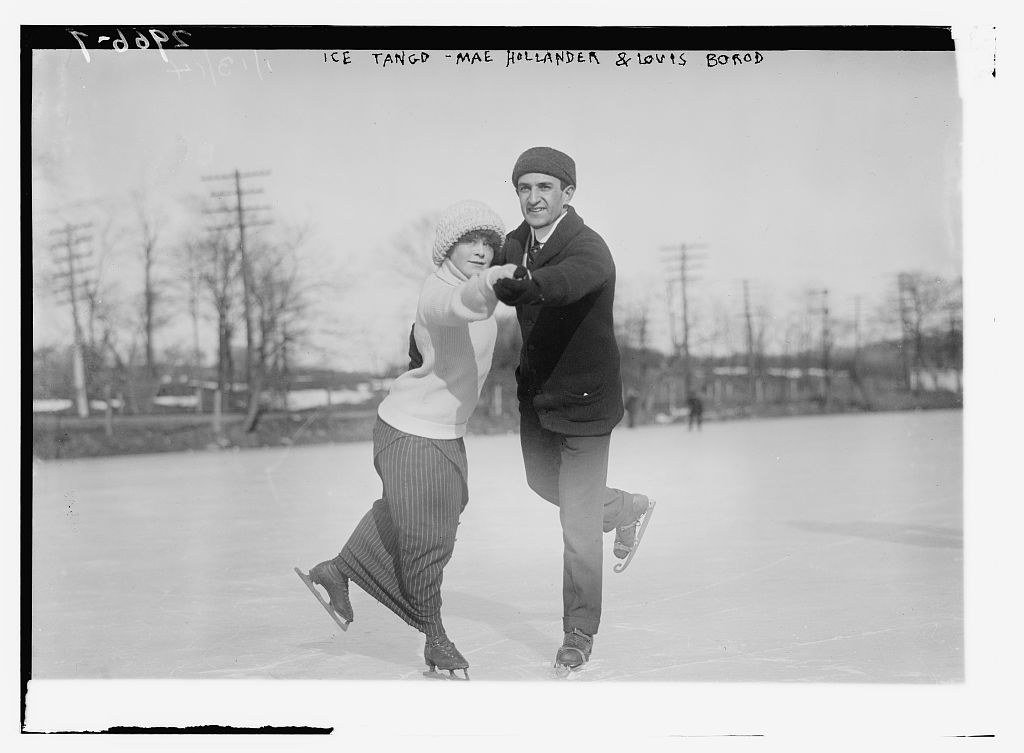
Ice Tango - Mae Hollander and Louis Borod
Unknown artist
- Collection:
- Prints & Photographs
- Source:
- Library of Congress
- Rights:
- Rights vary by item — check the source record before reusing this image. Source record ↗
- Recorded as:
- Library of Congress — no known restrictions (verify per item)
This image documents a moment when ice performance and theatrical dance were beginning to merge as commercial entertainment forms. It shows how the tango—a controversial and newly fashionable dance—was adapted into novelty spectacle for public consumption, revealing the relationship between ballroom fashion and theatrical innovation in the early twentieth century.
What you are looking at
Two figures perform on a frozen pond or outdoor ice rink, photographed from a low angle that emphasizes their elevation and extension. The man, in dark winter clothing and a flat cap, supports the woman in a lift or skating pose. The woman wears a white knit sweater and striped pants, her head tilted back in an arabesque-like extension. The ice surface stretches behind them, flat and gleaming. Bare trees and utility poles line the background, their vertical lines creating a geometric frame. The image is rendered in black and white with clear definition, suggesting an early twentieth-century gelatin print or similar photographic medium. The lighting is cool and diffuse, characteristic of daylight on a winter afternoon.
The dancing
The man maintains an upright stance with one arm supporting the woman's torso in a controlled grip; his weight appears planted firmly on the ice. The woman's body is extended in an inverted or nearly horizontal line, one leg extended, her upper back arched, creating an asymmetrical silhouette. This is not a skating position but an acrobatic or balletic pose held while on skates. The pose suggests partner work in which the man is the support and the woman the extended figure—a relationship more familiar to theatrical acrobatics or novelty ice entertainment than to ballroom tango.
The dance depicted
The title identifies this as ice tango, but the image shows something closer to ice ballet or ice acrobatics. No characteristic tango posture is visible: there is no closed ballroom frame, no forward-moving stride, no cucaracha or ochos. Instead, the photograph documents a theatrical lifting and extension—a figure display rather than a dance in motion. This likely represents early twentieth-century ice show entertainment, in which professional skaters performed novelty numbers that borrowed names and aesthetic gestures from popular ballroom and theatrical dances without adhering to their structural rules. Mae Hollander and Louis Borod may have been professional exhibition skaters whose act combined skating skill with theatrical spectacle.
How it was made
This is a photograph, almost certainly a gelatin silver print, with the crisp detail and tonal range typical of professional studio or sports photography from the 1910s. The sharp focus, controlled composition, and dramatic low angle suggest this was a formal publicity or promotional shot rather than candid documentation. The print's clarity and the ease with which the figures are read at distance indicate this image circulated widely—in newspapers, magazines, or theatrical programs promoting the performers or the novelty of ice dancing entertainment.
About this work
This is a publicity photograph of an ice novelty dance performed by professional skaters Mae Hollander and Louis Borod, titled Ice Tango. The image does not document ballroom tango on ice, but rather a theatrical acrobatic display in which the male partner lifts and supports the female performer in an extended aerial pose. It represents an early twentieth-century entertainment form in which skating skill was combined with theatrical gesture and borrowed dance vocabulary to create spectacle for mass audiences.
The photograph belongs to the history of ice entertainment as a distinct practice—neither pure sport nor pure theatrical dance, but a hybrid form. It is valuable as evidence of how popular dances were adapted and reimagined for new technical contexts and performance venues, and of how the tango craze of the 1910s influenced entertainment culture far beyond the ballroom.
How to look at it
Look first at the positioning of the bodies: the woman is not standing upright on skates as a ballroom partner would be, but is inverted or nearly horizontal, supported entirely by the man's upper-body strength. This is a freeze-frame of a lifting action, not a moment in a progressive dance. Notice how the composition emphasizes verticality—the man's upright frame, the extension of the woman's leg, the poles and trees in the background—which draws the eye upward and creates a sense of elevation and effort. The photographer has chosen a low angle from which to shoot, making the figures tower against the flat ice and trees, heightening the dramatic effect. This is the language of theatrical publicity photography rather than sports documentation.
The artist
The photographer is unrecorded. Mae Hollander and Louis Borod were professional exhibition skaters active in the early twentieth century, likely performing in ice shows or theatrical productions that catered to the entertainment boom of the Gilded Age. Their names and act do not appear prominently in surviving theatrical records, suggesting they were skilled regional or touring performers rather than internationally famous stars.
The period
The photograph dates to approximately 1910, at the height of the tango craze that swept North America and Europe in the early 1910s. Ballroom tango, newly imported from Argentina, was exotic, sensual, and controversial; it fascinated entertainment entrepreneurs. At the same time, ice skating was transitioning from a recreational winter activity to an organized sport and a venue for professional performance. The combination of these two trends—fashionable dance and emerging ice entertainment—created novel hybrid forms like the one shown here. The photograph's formal quality and the evident professionalism of the performers suggest this was a marketable act, part of the broader culture of mass entertainment and novelty attractions that characterized the period.
Where it lives
This is a gelatin silver print held in the Prints & Photographs Online Catalog at the Library of Congress. It is catalogued as a theatrical or promotional photograph, part of the broader holdings of early twentieth-century entertainment and performing arts documentation. The image's condition and format are consistent with professional promotional prints created for circulation to newspapers, magazines, and theatrical venues.
Dance in this work
Questions about this work
Is this actually tango?
Not in the ballroom sense. The pose and frame bear no resemblance to tango movement or posture. The title reflects how novelty ice shows of the 1910s borrowed names from fashionable dances while creating entirely new forms suited to skating. This is better understood as ice ballet or ice acrobatics performed by skaters who borrowed the cultural cachet of the tango craze.
Who were Mae Hollander and Louis Borod?
They were professional exhibition skaters active in the early twentieth century. Beyond this photograph, little is known of their careers. They likely performed in ice shows or traveling theatrical productions during the height of the ice entertainment boom.
What does the low camera angle tell us?
It is a deliberate choice by the photographer to create drama and emphasize the impressive extension and lift. Shooting from below makes the figures appear to soar, magnifying the sense of athletic accomplishment and theatrical spectacle. This is the visual language of early twentieth-century publicity and promotional photography.
Why would someone call skating tango 'tango'?
The tango was wildly fashionable and controversial in 1910. Entertainment entrepreneurs capitalized on that fame by attaching the name to any act with sensual or dramatic partnering, even if the actual movement had no connection to ballroom tango. This was a marketing strategy as much as a dance description.
More dance artwork





