49 works in this view — arrow keys or swipe to move between them.
Dance in Art
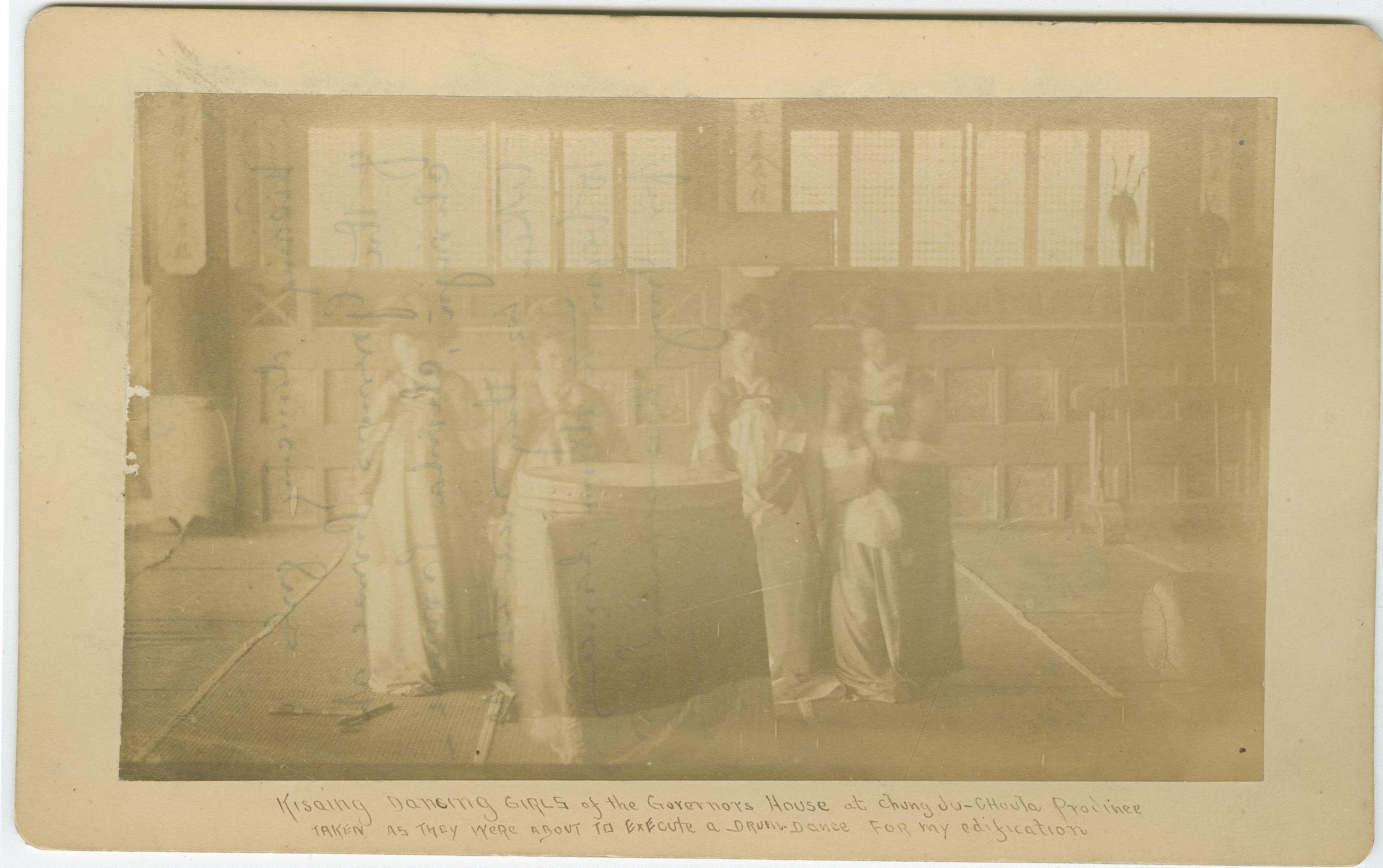
South Korea, Dancers Performing Tongyong Drum Dance (Victory Dance).
Unknown artist
- Collection:
- Prints & Photographs
- Source:
- Library of Congress
- Rights:
- Rights vary by item — check the source record before reusing this image. Source record ↗
- Recorded as:
- Library of Congress — no known restrictions (verify per item)
This is one of the earliest photographic documents of Korean ceremonial dance, made before most such forms were disrupted by colonization and modernization. It provides rare visual evidence of how a court or victory dance was organized in space, dressed, and performed in an official interior setting—knowledge that cannot be recovered from written description alone. The photograph also documents the moment of contact between Western observation and Korean cultural practice, showing what a foreign visitor chose to record as noteworthy.
What you are looking at
This photograph captures an interior scene of a substantial hall or reception space with large windows along the upper walls, flooded with natural light. Six figures in long white or pale garments stand scattered across a polished wooden floor. The composition suggests a formal or ceremonial moment frozen mid-action. The architectural setting—with its clean lines, regular fenestration, and substantial height—appears institutional or official, consistent with the caption's reference to the Governor's House. The photograph is sepia-toned and shows the fading characteristic of early photographic processes, suggesting age and exposure to light over time.
The dancing
The six figures are distributed across the floor space in a loose formation rather than a tight ensemble. All wear long, flowing robes or court dress in white or cream tones. Several figures appear to be in motion or mid-gesture, with arms raised or extended, though the image quality and sepia tone make precise limb positions difficult to discern. The postures suggest a processional or ceremonial movement through the space rather than a partnered or formation dance. The clothing and stature suggest this may include both male and female participants, though the photograph's condition and distance complicate certainty.
The dance depicted
The caption identifies this as a 'Victory Dance' performed by girls at the Governor's House in Chang-Jo-Chodle, Peiliung, and states that the dancers were 'about to execute a disturbance for my education.' This appears to document a Korean ceremonial or celebratory dance, likely from the late 19th century when the photograph was taken. The term 'Tongyong Drum Dance' in the catalogue title suggests connection to a drum-accompanied form, though no drums are visible in this hall scene. The formality of the setting, the white dress, and the dispersed formation suggest this may be a court dance or official ceremony rather than a popular or social form. Without identifying marks in the photograph itself—no drums, distinctive postures, or recognizable hand positions—the specific identification rests entirely on the caption and catalogue attribution.
How it was made
This is an albumen print or gelatin silver print, standard photographic media of the 1880s. The sepia tone results from oxidation and age rather than deliberate choice. The photograph shows the characteristic soft focus and tonal compression of early panchromatic or orthochromatic film stock, which renders fine detail in fabrics and movement difficult to resolve. The image has clearly been mounted on card stock and may have been part of a bound album or collection. The photographic medium allowed documentary capture of gesture and dress impossible in drawing or painting, though the technical limitations of the era—long exposures, fixed viewpoint, and monochrome rendering—impose their own constraints on what can be seen.
About this work
This photograph documents a ceremonial dance performance in a late-19th-century Korean official context, likely during the early period of Western engagement with Korea. It is one of very few surviving visual records of Korean court or victory dances from this period, made at a moment when such forms were still actively performed but rarely photographed by Western observers. The image is valuable precisely because it shows the setting, dress, and general disposition of dancers in a formal Korean dance rather than a stylized or theatrical reconstruction. It belongs in a dance history collection as evidence of Korean choreographic practice at the threshold of modernization, and as an example of how early photography could capture unfamiliar dance forms for audiences who would never witness them live.
How to look at it
Attend to the spacing and formation of the dancers: they are not in the tight ensemble patterns typical of European court dances, but rather distributed through the space in a looser configuration. Notice the white dress and its flow—the long robes suggest restricted footwork and an emphasis on upper-body carriage and gesture rather than intricate stepping. The setting itself—a formal hall with the dancers aligned to its architecture—tells you this is a ceremony of state rather than entertainment. The photographer chose to capture the dancers in a relatively static moment, not a peak of dramatic action, which suggests either the limitations of the medium or a deliberate choice to document the complete arrangement rather than a single gesture.
The period
Korea in 1884 stood at a critical juncture. The Joseon dynasty was in its final decades, and Western colonial interest in East Asia was intensifying. Photography had only recently been introduced to Korea, and most surviving images from this era were made by foreign residents or visitors. Traditional court dances, deeply rooted in Joseon performance culture, were still practiced but increasingly marginalized by Westernization pressures. This photograph was likely made by or for a foreign resident or diplomat—the phrase 'for my education' suggests the photographer's perspective as an outsider documenting unfamiliar practices. By the early 20th century, many of these same ceremonial forms would be suppressed or transformed under Japanese colonial rule.
Where it lives
This photograph is held in the Library of Congress Prints & Photographs collection. It appears to be part of a larger body of material on Korea from the 1880s–1890s, likely assembled by a foreign resident or visitor. The mounting and caption style are consistent with personal albums or collections made by Western diplomats or observers during the period of increasing foreign engagement with Joseon Korea.
Dance in this work
Questions about this work
Is this actually a 'Victory Dance' or is that a mistranslation?
The caption authority and original context are not established in the available record. The term may reflect the photographer's understanding, translation convention of the era, or the informant's explanation at the time. Without access to Korean-language documentation or the photographer's notes, we cannot confirm the original Korean name or category for this performance.
Why are the dancers in white?
White robes were standard formal dress in Joseon court contexts and for ceremonial performance. The color had associations with purity and formality in Korean tradition. The pale tone also made the figures more visible in early photography, which was insensitive to the red end of the spectrum.
Can you identify the specific dance form from the image alone?
No. The photograph shows six figures in white robes in a dispersed formation, but without visible drums, recognizable hand positions, footwork, or other diagnostic elements, the specific form cannot be identified from the visual evidence alone. The identification depends on the caption and catalogue attribution.
Who was the photographer?
The photographer is not identified in the available record. The phrase 'for my education' in the caption suggests a foreign resident or visitor, possibly a diplomat, missionary, or trader, but this remains a guess.
More dance artwork





