49 works in this view — arrow keys or swipe to move between them.
Dance in Art
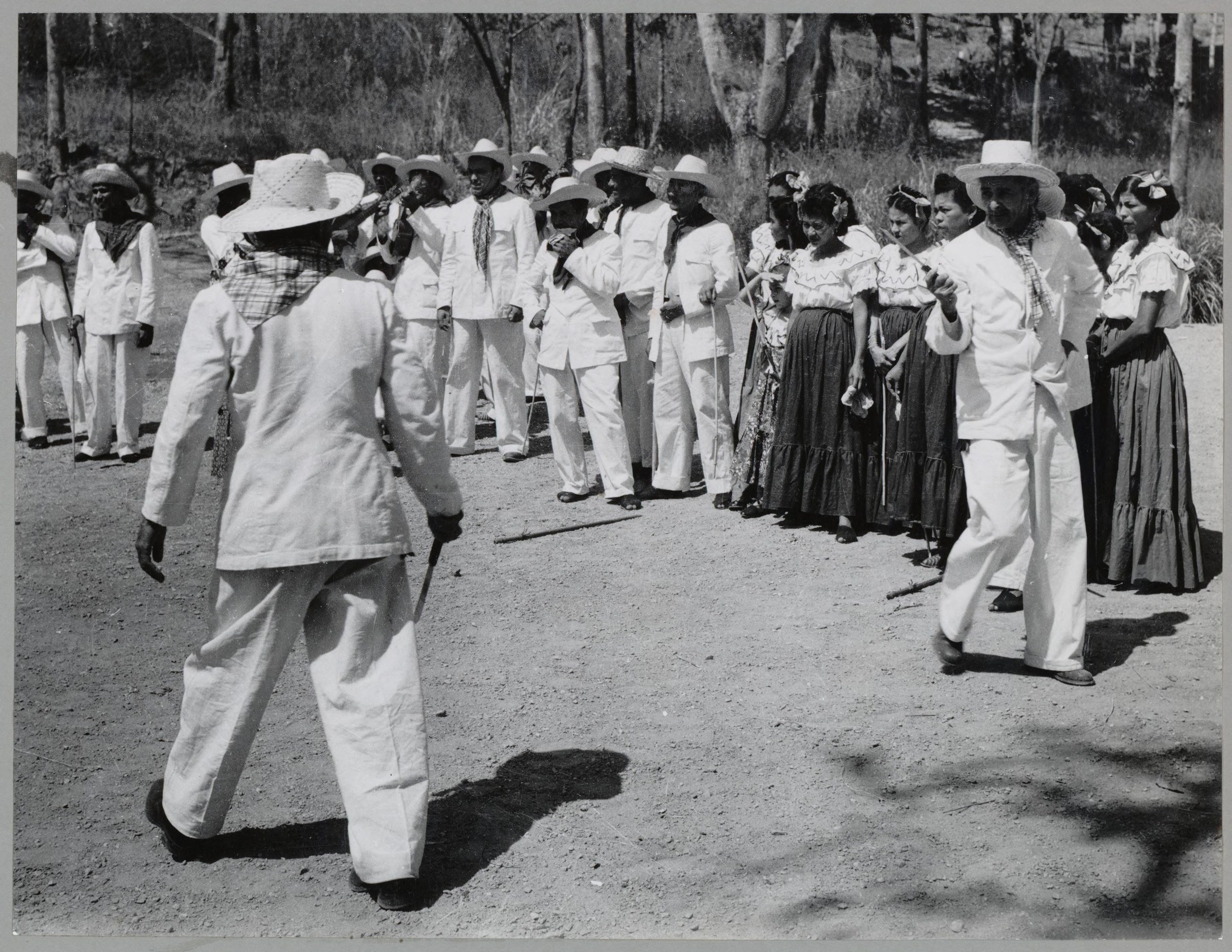
The Tamunangue Folk Dance.
Unknown artist
- Collection:
- Prints & Photographs
- Source:
- Library of Congress
- Rights:
- Rights vary by item — check the source record before reusing this image. Source record ↗
- Recorded as:
- Library of Congress — no known restrictions (verify per item)
Tamunangue represents an important strand of Venezuelan cultural practice, and photographs of it in active performance are relatively scarce in major collections. This image documents the dance as a living community practice rather than as a codified or staged form, showing the actual social context and scale in which it occurs. For scholars and practitioners interested in folk dance traditions of the Americas and their relationship to indigenous, African, and European influences, such documentary evidence is invaluable.
What you are looking at
A large outdoor gathering in bright sunlight, with perhaps thirty people arranged in a loose circle or gathering space on a dirt road. The setting appears rural, with trees visible in the background. Most of the figures wear white clothing—long white shirts and trousers for the men, many wearing wide-brimmed white hats. Some women wear white blouses with darker, full skirts. A few figures in the foreground and middle ground appear to be in active motion or engaged more intensely than others, while many in the background stand relatively still, observing. The composition suggests an informal, community-scale event rather than a staged performance.
The dancing
Two figures in the immediate foreground are notably in motion, their bodies leaning forward with dynamic posture, their legs appearing to stride or step with energy. The majority of other participants stand relatively upright and still, many with arms at their sides or gesturing conversationally. The contrast between the active movers and the standing observers suggests this is a participatory dance rather than a performance with a clear audience-performer divide. The white clothing across all figures creates a unified visual field against the darker ground and foliage.
The dance depicted
This is documented as the Tamunangue folk dance, a Venezuelan tradition of considerable antiquity. Tamunangue is a festive, community-based dance typically performed at celebrations and social gatherings, characterized by its informal, participatory nature and its blend of European and indigenous influences. The image captures the essential character of the form: a gathering of community members, mixed gender, in outdoor daylight, with some individuals actively dancing while others stand ready to join or continue. The white clothing and outdoor setting are typical of how Tamunangue is performed in rural Venezuelan contexts.
How it was made
This is a black and white photograph, likely from documentary or ethnographic work. The print quality and tonal range suggest professional photography, possibly captured on medium-format film stock. The composition is wide and relatively shallow in depth of field, keeping most of the gathered figures in legible focus. Documentary photography of this era was often used to record cultural practices for archival and educational purposes, making such images significant records of lived tradition.
About this work
This photograph documents the Tamunangue, a participatory folk dance tradition of Venezuela captured in an outdoor community setting in 1968. The image records not a staged or formal performance but an active social gathering, with participants in white clothing actively dancing or standing in readiness within a circle. The work belongs in a dance gallery as a straightforward visual record of how this tradition was actually practiced at community scale, away from theatrical framings. It preserves evidence of costume, gathering practice, and the democratic, inclusive structure of the form.
How to look at it
Attend to the asymmetry of activity in the frame: notice which figures are in motion and how their posture differs from those standing. The two actively moving figures in the foreground show dynamic weight transfer and forward momentum; observe how their bodies differ in angle and tension from the observers. The wide-brimmed hats and white clothing create a visual rhythm across the frame that unites the group despite their varying levels of engagement. The outdoor setting and daylight are not incidental—they are part of how Tamunangue is traditionally performed, as a daytime social occasion rather than an evening theatrical event.
The period
In 1968, documentary photography of folk traditions was an active field, with ethnographic and folkloric projects across Latin America aiming to record cultural practices before modernization. Venezuela's folk traditions were increasingly being documented by both national and international efforts. The photograph dates to a period when such dances remained primarily community-based rather than professionalized for tourism or national performance, though this was changing during the 1960s. The image captures a moment before many such traditions underwent significant transformation through formalization and theatrical presentation.
Where it lives
The photograph is held by the Library of Congress Prints & Photographs collection. It appears to be part of documentary or archival work on Latin American folk traditions, though the specific source project and photographer are not recorded in the current catalog entry.
Dance in this work
Questions about this work
What is Tamunangue and where does it come from?
Tamunangue is a traditional folk dance of Venezuela with roots in a blend of Spanish, indigenous, and African cultural practices. It is typically performed as a community celebration, often outdoors, and is characterized by its festive, participatory nature. The dance remains an important part of Venezuelan cultural identity, particularly in rural regions.
Why are the dancers wearing white?
White clothing is traditional for Tamunangue performance and is associated with celebration and festivity. The uniform white dress seen here—white shirts and trousers for men, white blouses and dark skirts for women—follows the established convention for the dance as it was performed in 1968.
Is this a performance or a social gathering?
This appears to be an active social gathering rather than a formal staged performance. Tamunangue is fundamentally a participatory community dance, not a theatrical form designed for an external audience. The photograph captures the dance in its natural social context, with participants and observers sharing the same space without a formal stage.
What year was this photograph taken and why does that matter?
The photograph dates to 1968, a moment when folk traditions across Latin America were still actively practiced as community events before wider professionalization and tourism adaptation. This dating makes it a valuable historical record of how Tamunangue was actually performed in mid-twentieth-century Venezuela.
More dance artwork





