49 works in this view — arrow keys or swipe to move between them.
Dance in Art
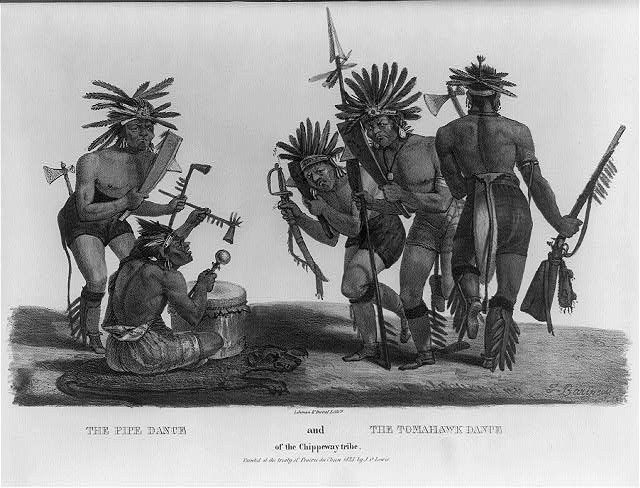
The pipe dance and the tomahawk dance
Unknown artist
- Collection:
- Prints & Photographs
- Source:
- Library of Congress
- Rights:
- Rights vary by item — check the source record before reusing this image. Source record ↗
- Recorded as:
- Library of Congress — no known restrictions (verify per item)
This engraving is one of the earliest published visual records of Great Lakes Indigenous dance practices, and it shows the machinery by which Indigenous performance was extracted from cultural context and repackaged for Euro-American consumption as exotic ethnographic display. Understanding how these dances were visually translated—what the engraver chose to record, what was lost in translation, and how the imagery circulated—is essential to understanding both the history of Indigenous dance and the history of how dance scholarship itself has been shaped by colonial documentation practices.
What you are looking at
This engraving depicts two groups of Indigenous dancers positioned on a bare ground against a plain background, arranged as if for direct comparison or documentation. On the left, a single figure performs what is labeled the "Pipe Dance": a male dancer in profile, bare-chested and legged, wears an elaborate feathered headdress and holds implements—a long pipe and what appear to be ritual objects—in his outstretched arms. His posture is upright and frontal, weight planted. To the right, a group of three male dancers perform the "Tomahawk Dance": they wear similar feathered headdresses and minimal dress, and hold weapons (tomahawks or similar implements) aloft. Their bodies are more dynamically posed, with bent knees and forward-tilting torsos that suggest active movement. All figures are rendered in strong black line with careful anatomical attention to musculature. The composition is ethnographic in intent—a side-by-side presentation that invites visual comparison.
The dancing
The Pipe Dance figure stands in a formal, nearly static pose with arms extended and weight evenly distributed, holding the long pipe and ritual objects as though displaying them rather than moving with them. The three Tomahawk dancers show more kinetic energy: their knees are flexed, torsos inclined, and their weapon-bearing arms are raised and activated in what appears to be a strike or thrust pattern. The musculature of all figures is carefully rendered to convey strength and physical presence. There is no closed-hold or partner connection; each dancer occupies independent space.
The dance depicted
These are identified in the engraving's caption as dances of the Chippeways (Anishinaabe or Ojibwe), documented from an 1835 perspective. The Pipe Dance is presented as a solo performance involving ritual objects and a formal, presentational posture—consistent with ceremonial and diplomatic practices among Great Lakes and northern woodland Nations, where the pipe held profound sacred and political significance. The Tomahawk Dance depicts a group weapon dance, likely tied to warrior culture and martial preparation. Both are presented as ethnographic specimens rather than as living cultural practices with their own internal logic. The engraving makes no attempt to capture movement quality or rhythm, instead fixing moments of posture that the artist believed representative.
How it was made
This is a steel or copper engraving, a reproductive print technology well suited to fine anatomical detail and wide circulation. The technique allowed the artist to incise lines of varying depth to create tone and shadow, particularly visible in the musculature and the feathered headdresses. Engravings of this era were commonly used for ethnographic documentation and natural history illustration, making them a standard format for publishing Indigenous cultural imagery to European and American audiences. The clean lines and formal composition indicate a professional engraver, likely working from a drawing or field sketch rather than from life observation.
About this work
This 1835 engraving documents two dances recorded among the Chippeways, presenting them as ethnographic specimens arranged for comparative study. The Pipe Dance is shown as a formal, ritual solo, while the Tomahawk Dance appears as a more kinetically active group performance. The engraving exemplifies the 19th-century practice of rendering Indigenous dance as static posture rather than as movement—a flattening that preserves silhouette and costume while losing rhythm, music, social context, and the kinesthetic understanding that would inform how these dances were actually performed and understood by their practitioners.
The work is valuable precisely because it reveals the limitations of early ethnographic visualization: the artist has recorded what was visually memorable (elaborate feathered dress, weapons, musculature) while having no framework to represent ceremonial significance or movement quality. It is an artifact of the encounter between Western visual documentation practices and Indigenous cultural knowledge, and it demonstrates how much is lost when dance is treated as a still image rather than as temporal experience.
How to look at it
Attend to the posture and spacing: the Pipe Dance figure is frontal, formal, and isolated—presented as a display or demonstration. The Tomahawk dancers are more dynamic in their flexed knees and tilted torsos, but they too are frozen mid-gesture rather than caught in flowing movement. The engraver has chosen to emphasize musculature, feathered ornament, and the held objects—visual markers of identity and function—rather than to suggest the rhythm, weight shift, or spatial relationship that would characterize how these dances actually moved. The plain background and side-by-side arrangement signal scientific or comparative intent, as if these were specimens being classified. The fine lines and careful shading create an illusion of anatomical precision that may give unwarranted authority to what is actually a partial and culturally mediated interpretation.
The artist
The artist is not recorded. The engraving is credited in the Library of Congress holding to a printed source titled "History of the Indian Tribes of North America" (the title appears to reference Henry Schoolcraft's influential multi-volume work of the 1850s, though the 1835 date suggests an earlier publication). The engraver was likely a professional illustrator working within the conventions of natural history and ethnographic publishing, trained to render human anatomy with anatomical precision but without specialized knowledge of Indigenous performance or dance.
The period
In the 1830s, the Indian Removal Act (1830) and the forced relocations that followed created intense Euro-American appetite for visual documentation of Indigenous peoples imagined as vanishing. Ethnographic engraving flourished as a medium for publishing travel narratives, natural histories, and anthropological collections. Dance was rarely documented for its own sake; it appeared in these publications as an element of costume, ritual, or warfare—signs of cultural difference rather than as an art form. The visual conventions of the period treated Indigenous bodies as objects of anatomical study, with no interest in the dancers' own understanding of their practice. At the same time, theatrical representations of Indigenous dance (in Wild West shows and popular entertainment) were becoming a separate and entirely fictive genre.
Where it lives
Held in the Library of Congress Prints & Photographs Online Collection. This is a mass-produced engraving, likely one of many impressions from a plate, and would have circulated as part of a published ethnographic or natural history work in the early 19th century. Such prints were affordable and accessible to educated readers and collectors with an interest in Indigenous peoples and natural history.
Dance in this work
Questions about this work
Did the Anishinaabe actually dance these dances in 1835?
Yes, both pipe ceremonialism and weapon dances were central to Great Lakes Indigenous practice. But this engraving does not show how they were danced—only what an outside observer thought was worth recording about their outward appearance and posture. The sacred and political meanings of the pipe dance, and the social and martial contexts of the tomahawk dance, are completely absent from the image.
Why is there only one figure in the Pipe Dance and three in the Tomahawk Dance?
The engraver may have been working from field sketches or descriptions that suggested the pipe dance as a solo or leadership role and the tomahawk dance as a group or warrior activity. It is also possible that the composition was designed to create visual variety—one figure balances three—without any claim that the dances were always performed in those numbers.
How do I know this is an engraving and not a drawing or painting?
The technique is visible in the fine parallel lines (hatching) used to create shadow and tone, the precise black line work, and the overall crispness of the image. This is characteristic of copper or steel engraving, a reproductive print technology that allowed multiple identical copies to be made from a single plate.
What is the artist trying to show with the feathered headdresses?
The elaborate feathered headdresses were a visually distinctive marker of identity and status. To a Euro-American viewer, they signaled exoticism and difference. But the engraver rendered them with fine detail because they were visually striking—not because they understood their symbolic or ceremonial function within Anishinaabe culture.
More dance artwork





