49 works in this view — arrow keys or swipe to move between them.
Dance in Art
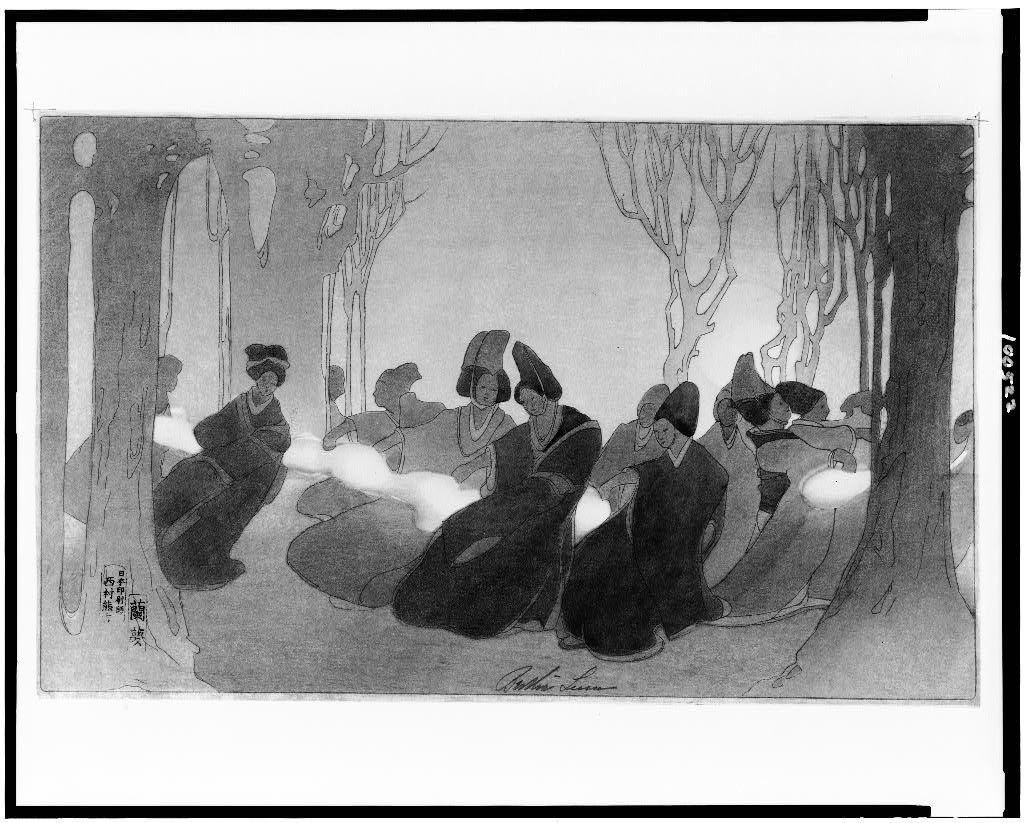
[Goblin dance]
Unknown artist
- Collection:
- Prints & Photographs
- Source:
- Library of Congress
- Rights:
- Rights vary by item — check the source record before reusing this image. Source record ↗
- Recorded as:
- Library of Congress — no known restrictions (verify per item)
This image documents the visual vocabulary of early 20th-century theatrical dance, particularly the use of costume and low-postured ensemble work to signify the supernatural or folkloric. For historians of stage design and dance theater, it shows how character and narrative were communicated through silhouette, grouping, and distinctive dress before the rise of modernist abstraction.
What you are looking at
A group of figures in dark clothing sits in a semi-circle within a bare, vertical landscape of towering tree trunks or similar structures. The setting appears to be outdoors or in a wooded space rendered in grayscale tones. The figures are clustered together, many wearing distinctive headdresses or hats with prominent peaks or wings—consistent with theatrical or ceremonial costume. Some figures appear to be in crouching or squatting positions; others lean forward or toward one another. The composition suggests an intimate gathering or performance, with the tall vertical elements framing the scene and drawing the eye toward the grouped figures at center. The overall mood is theatrical and somewhat mysterious, with strong tonal contrasts between the dark figures and the lighter background.
The dancing
The dancers are predominantly in low positions—crouching or squatting—rather than standing or in elevated poses. Several lean inward toward the group center, creating a closed, inward-facing composition. The distinctive headdresses visible on multiple figures suggest coordinated costume or character work. Arm gestures are not clearly legible, though bodies are angled and compressed in postures more consistent with pantomime or character movement than classical dance technique. The grouping suggests ensemble work and ritual or ceremonial framing rather than paired or partnered movement.
The dance depicted
The title identifies this as a 'goblin dance,' suggesting theatrical or fantastical subject matter. The costume elements—particularly the pointed or winged headdresses—and the inward-facing, low-postured ensemble positioning align with early 20th-century theatrical or folk-influenced character dance, possibly from a stage production or illustrated narrative. The work appears to depict a scene of supernatural or mythological figures rather than ballroom or concert dance. Without signatures or clearer contextual markers, the specific dance tradition cannot be definitively established, but the compositional logic suggests European theatrical tradition of the 1910s.
How it was made
This is a grayscale photomechanical print or lithograph, likely early 20th-century reproduction. The tonal modeling, the soft gradations in the background, and the linear rendering of the landscape elements suggest either a lithographic original or a photogravure process. The technique allowed for subtle tonal effects and the delicate rendering of fabric and headdress detail. The print's presence in a Library of Congress holding suggests it was a published illustration or poster image, likely distributed to a broad audience.
About this work
This work depicts a theatrical scene titled '[Goblin Dance],' probably from a stage production or illustrated tale of the 1910s. The ensemble of costumed figures in low, inward-facing postures and distinctive headdresses creates a scene of supernatural or folk-inspired character work. The composition and costume vocabulary suggest European theatrical tradition, though the specific production, choreographer, and dancers remain unidentified. The work belongs in a dance gallery as evidence of how early 20th-century theater visualized mythological and folkloric movement, and how print culture distributed such theatrical imagery.
How to look at it
Attend to the postures and the distinctive headdresses: the artist has chosen to freeze a moment of stillness or low-energy ensemble work rather than a leap or lifted pose. The vertical landscape framing and the inward-facing grouping create a sense of ritual or ceremony. The tonal softness and the treatment of fabric suggest the artist understood costume as a primary vehicle for character and narrative, and worked to render textile and silhouette with subtlety.
The period
The 1910s were a period of intense experimentation in European theatrical dance, particularly in response to the success of the Ballets Russes (founded 1909) and the growing influence of folk and non-Western dance forms on stage practice. Designers and choreographers increasingly drew on fairy tale, mythology, and folklore as sources for character work and ensemble composition. Print reproduction and theatrical illustration reached a mass audience during this period, making images like this a primary way dance and theater circulated beyond the live performance.
Where it lives
The work is held in the Prints & Photographs Online Catalog of the Library of Congress. It appears as a published print or theatrical illustration, reproduced photomechanically and distributed for public circulation.
Dance in this work
Questions about this work
What is a 'goblin dance'?
The title suggests a theatrical depiction of supernatural or folkloric figures, likely from a staged performance or illustrated narrative. In early 20th-century European theater, such subjects were popular in fairy tale adaptations and modernist experiments with non-realistic character work. The specific production is not identified in the catalogue record.
Why are the figures in such low positions?
The crouching and squatting postures suggest either a moment of rest, ritual, or movement idiom specific to the character or narrative. In early theatrical dance, low positions were often used to signal the supernatural, the animal, or the non-human, creating visual and kinetic contrast to classical upright stance.
How was this image reproduced?
Based on the tonal qualities and the softness of the line work, this is likely a lithograph or photomechanical print (such as a photogravure) from the early 20th century. Such processes allowed subtle modeling of tone and fabric texture, and enabled mass production and distribution.
More dance artwork





