49 works in this view — arrow keys or swipe to move between them.
Dance in Art
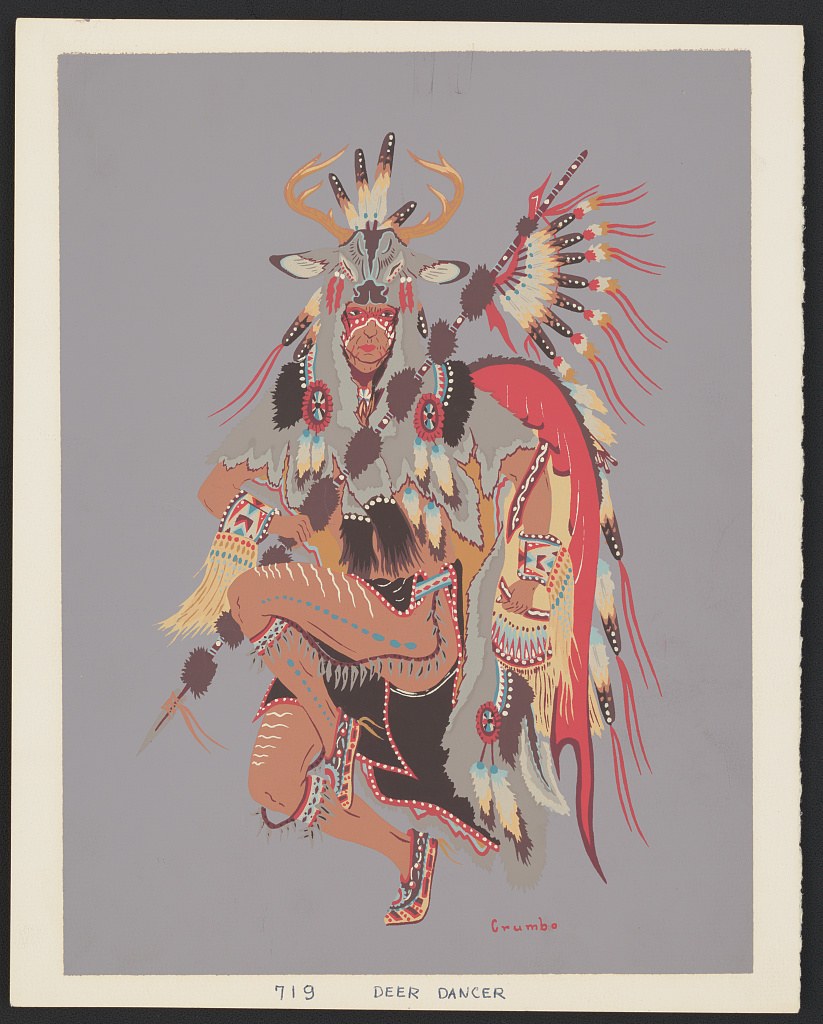
Deer dancer
Unknown artist
- Collection:
- Prints & Photographs
- Source:
- Library of Congress
- Rights:
- Rights vary by item — check the source record before reusing this image. Source record ↗
- Recorded as:
- Library of Congress — no known restrictions (verify per item)
The Deer Dance is a living ceremonial practice with deep spiritual and cultural significance in Yaqui communities, and documentary images of the costume are important records of indigenous material culture and artistic practice. However, this image's static presentation and its archive within a Western institution raises questions about how indigenous dances have been collected, represented, and circulated outside their performative and spiritual contexts.
What you are looking at
A figure in elaborate Native American regalia stands centered against a lavender-gray ground, posed in an upright, frontal stance with weight evenly distributed. The dancer wears a magnificent deer mask with branching antlers rendered in orange and cream, and the entire costume is constructed from layered animal furs, feathers, and beaded ornaments in warm earth tones—ochre, rust, cream, and black. A long panel of red cloth hangs from the right side of the body, and the arms hang naturally at the sides with hands visible. The lower body is partially obscured by the voluminous costume, but the legs appear to be in a grounded stance rather than mid-leap. Every surface of the garment is covered with ceremonial detail: pendant strips of fur, shell or bone ornaments, beaded bands, and feathered elements that create a vertical emphasis. The composition is symmetrical and hieratic, presenting the costume as a complete ensemble object rather than capturing a moment of dynamic movement.
The dancing
A single standing figure, frontally posed with a neutral, grounded weight distribution and arms at rest. The body does not suggest active motion but rather a presentation or processional stance. The mask and costume components are highly structured and worn, not held, indicating these are worn regalia. The overall carriage is upright and dignified rather than kinetically expressive; there is no suggestion of the flexed knees, tilted pelvis, or traveling locomotion typical of social dance.
The dance depicted
This is almost certainly a depiction of the Deer Dance (Danza del Venado), a ceremonial dance from the Yaqui people of Mexico and the American Southwest. However, the image shows the costume in a static, presentational mode rather than capturing the dance in performance. The Deer Dance typically involves a solo or paired dancer wearing a deer mask and moving with bounded, deliberate steps that evoke the animal's motion and spiritual significance. The footwork is usually precise and percussive, often accompanied by music, and the body moves with intentional restraint rather than the expansive, athletic quality seen in many other indigenous dances. The image documents the costume's construction but provides limited evidence of the actual choreographic movement that defines the dance.
How it was made
This appears to be a color lithograph or similar print process, given the flat color fields, crisp outlines, and the characteristic color registration visible in the composition. The technique allowed for the detailed rendering of costume elements—each feather, bead, and pendant is distinctly articulated—while maintaining a decorative, almost heraldic presentation. The medium was well-suited to ethnographic and anthropological documentation of costume and material culture, which was a common purpose for such prints in the early twentieth century. The palette, handling, and composition suggest this was part of a larger series of cultural documentation.
About this work
This is a representational study of Yaqui Deer Dance regalia, presented as a complete costume object in a frontal, static pose. Rather than depicting the dance as performed movement, the image functions as a visual inventory of the mask, furs, feathers, beads, and cloth that compose the costume ensemble. The work belongs to a tradition of ethnographic documentation through portraiture of indigenous dress and material culture, common in American art of the early twentieth century. It sits at the intersection of dance, material culture, and indigenous representation—valuable as evidence of costume construction and ceremonial dress, but limited as a record of the actual choreography and performed movement of the Deer Dance itself.
How to look at it
Examine the costume from top to bottom: the mask's construction, the branching antler form, the layering and draping of furs, the precise placement of beads and pendants, and the long hanging cloth element. The artist has chosen to present this as a complete object, fully frontal and symmetrical, which emphasizes the costume's structural unity and decorative detail rather than the dynamic, embodied quality of movement. Note how every element is attached to and moves with the body—this is not a costume studied in isolation but a visual record of how the complete regalia is worn. The static pose is itself significant: it presents the Deer Dance costume not as a captured moment of performance but as a material artifact and cultural treasure.
The artist
The signature 'Crumbo' visible in the lower right is likely that of Woodrow Wilson Crumbo (Arikara/Pawnee, 1912–1989), an influential Native American artist who worked extensively in painting, printmaking, and illustration. Crumbo was known for detailed, decorative studies of indigenous regalia, ceremonial dress, and cultural practice, often working in gouache, watercolor, and print media. His work was widely published in the mid-twentieth century and exhibited in museums and galleries across the United States, though he is less widely known today than some of his contemporaries in the Native American art movement.
The period
This work dates to the 1950s, a period when Native American art and culture were experiencing increased documentation and exhibition in American museums, though often through a lens of preservation and ethnographic study rather than as living practice. In the 1940s and 1950s, artists like Crumbo were instrumental in bringing Native American art into mainstream American galleries and publications, though their work sometimes reproduced the static, museum-ethnography framing that characterized earlier anthropological documentation. The Deer Dance itself continues to be performed by Yaqui communities in Mexico and Arizona, but its representation in art and archives often reflects the moment of collection more than the dance as practiced.
Where it lives
Held by the Prints & Photographs collection at the Library of Congress. The catalogue identifies it as 'Deer dancer' but provides no artist attribution or medium specification in the record, though the signature and visual evidence suggest it is a Crumbo work and likely a color print.
Dance in this work
Questions about this work
Is this showing the Deer Dance as it is actually performed?
No. The image presents the costume in a static, presentational pose. The Deer Dance in performance involves rhythmic, bounded movement and footwork that evoke the animal. This image documents the material culture—the mask, furs, and ornaments—rather than the choreography.
Who dances the Deer Dance and where?
The Deer Dance is a ceremonial dance of the Yaqui people, indigenous to the Mexico-Arizona border region. It continues to be performed in Yaqui communities in Mexico and in the southwestern United States, particularly in Arizona. It is a sacred practice with deep spiritual significance.
What is the deer mask made of?
The mask and entire costume is constructed from natural materials: animal hide and fur, feathers, bone or shell ornaments, beads, and woven or dyed cloth. The specific materials vary, but the costume represents an investment of labor and resources reflecting its ceremonial importance.
Why is this in a dance collection rather than a natural history museum?
The Deer Dance is both a performed art form and a cultural practice, making it relevant to dance history and ethnography. However, the boundary between art museum, natural history museum, and cultural archive is historically fluid—many institutions hold indigenous material culture, and how it is catalogued reflects institutional priorities as much as the nature of the object itself.
More dance artwork





