49 works in this view — arrow keys or swipe to move between them.
Dance in Art
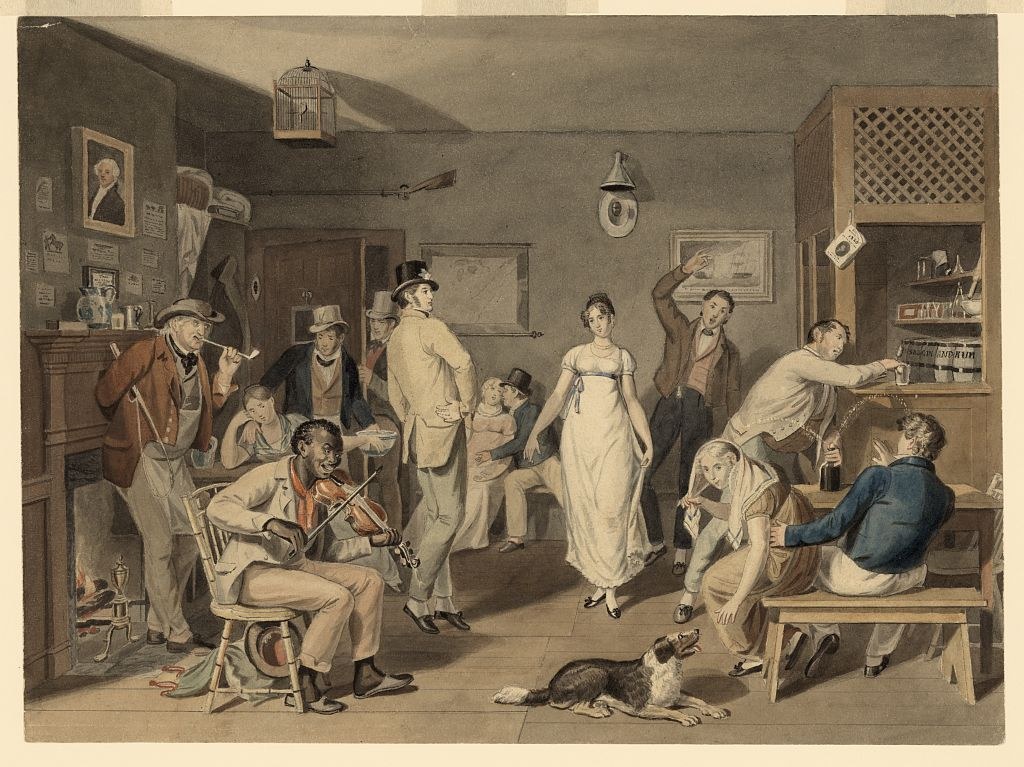
[Barroom dancing]
Unknown artist
- Collection:
- Prints & Photographs
- Source:
- Library of Congress
- Rights:
- Rights vary by item — check the source record before reusing this image. Source record ↗
- Recorded as:
- Library of Congress — no known restrictions (verify per item)
This work documents vernacular, working-class social dancing in an era when most surviving dance imagery focuses on aristocratic or genteel practice. It shows the crucial role of the fiddler in enabling dance and suggests that country dances, reels, and cotillions were vibrant, joyful social practices among ordinary people—not merely formal ballroom exercises. The satirical tone and commercial circulation also reveal how early 19th-century print culture made fun of and consumed images of lower-class leisure.
What you are looking at
A crowded interior domestic scene, rendered in hand-colored engraving or aquatint, shows a mixed company of men and women in Regency dress (circa 1820) gathered in a modest parlor. The space is cluttered with period furnishings—a fireplace with a mantelpiece crowded with pictures and objects on the left, a window with latticed shutters on the right, hanging birdcage, clock on the wall. A violinist sits prominently in the foreground left, bow drawn across the strings. In the center, a woman in a high-waisted white muslin gown (fashionable of the era) stands upright while a man in tan breeches and coat gestures toward her in an animated manner. Around them, other figures stand, sit, and gesture—some watching, some conversing, some in postures of enthusiasm or mockery. A small dog occupies the floor. The lighting is even and brownish, typical of the period's printmaking. The composition is deliberately busy and satirical in tone: this is not a formal ball but a lively, somewhat chaotic domestic gathering.
The dancing
The central male dancer stands with one arm extended toward the woman, the other raised or gesturing; his posture is forward-leaning, animated. The woman opposite maintains an upright, formal stance in closed position relative to him, her arms at her sides or held low. The violinist in the left foreground is seated, his body angled to allow the bow to draw across the strings. Several onlookers stand with exaggerated expressions of pleasure or surprise—arms raised, mouths open. The poses suggest improvised, exuberant movement rather than the precision of formal ballroom technique; the energy is social and convivial rather than disciplined.
The dance depicted
This depicts social dancing in a working or lower-middle-class domestic setting, most likely a country or provincial inn, tavern, or parlor dance of the Regency era. The fiddler provides live music. The style appears to be a country dance, cotillion, or reel—common social dances of the 1810s–1820s in Britain—rather than the more formal quadrilles or contradances of the ballroom. The woman's plain white muslin gown and the man's casual dress, together with the cramped, cluttered room and the boisterous atmosphere, mark this as vernacular social dance rather than genteel ballroom practice. The title 'Barroom dancing' suggests an alehouses or public-house setting, though the interior shown is more consistent with a private room or modest inn parlor.
How it was made
The print is hand-colored engraving or aquatint, a technique widely used for satirical and genre scenes in early 19th-century Britain. The soft tonal washes and the fine linear detail suggest etching or aquatint rather than pure engraving. Hand coloring (visible in the reds, tans, and whites of the clothing and furnishings) was applied after printing, which implies this was a commercial print intended for a broad audience—not a fine-art original but a mass-market satire or entertainment print. The technique allowed for rapid production and sale in print shops, making such scenes accessible to the reading and viewing public.
About this work
This is a hand-colored satirical or genre print from circa 1820 depicting a lively social dance in a cramped domestic or public-house interior. A fiddler provides live music while a couple and their onlookers engage in country or vernacular social dancing typical of working-class British life in the Regency era. The composition is deliberately crowded and exuberant, capturing the informality and social joy of dancing outside the ballroom. The print belongs to a rich tradition of Regency-era satirical and genre imagery that recorded the manners and amusements of different social classes. It is valuable as evidence of how ordinary people danced and socialized in the early 19th century, and of the role of live music and improvisation in vernacular social practice.
How to look at it
Notice the violinist's active pose and the position of his bow—he is the engine of the scene, not merely accompaniment. Observe the woman's formal upright carriage and the man's energetic, reaching gesture: this shows the contrast between prescribed posture and exuberant social engagement. Look at the onlookers' expressions and arm positions—their enthusiasm is physical and unrestrained. The crowded, cluttered room and the small scale of the figures tell you this is not a grand ballroom but an intimate, informal space. The hand coloring, now faded, originally emphasized the bright whites of the woman's gown and the warm browns and reds of the men's coats, making the scene vivid and readable from a distance.
The period
The early 19th century saw a flourishing of satirical genre prints in Britain, particularly in London. Artists such as James Gillray, Thomas Rowlandson, and others produced hand-colored engravings and etchings that mocked or affectionately documented contemporary manners, dress, and social behavior across class lines. The Regency era (1811–1820) was a period of intense social change, and prints served as a form of popular entertainment and social commentary. Dancing was a central leisure activity for all classes, but the nature and setting of dance varied enormously: the ballroom quadrille and waltz for the gentry, the country dance and reel for rural and working people, the cotillion and country dances for the professional and merchant classes. This print captures that vernacular world.
Where it lives
The work is held in the Prints & Photographs Online Collection at the Library of Congress. It is a commercially produced hand-colored print typical of early 19th-century British satirical and genre printmaking, intended for circulation among a broad urban and provincial audience through print shops and booksellers.
Dance in this work
Questions about this work
What kind of dance is this?
Most likely a country dance, cotillion, or reel—social dances common in working-class and rural Britain in the 1810s–1820s. These were learned informally and danced to live fiddle music in inns, parlors, and public houses. Unlike the formal quadrilles of the ballroom, they allowed for more improvisation and exuberance.
Why is the woman's dress so plain?
Her high-waisted white muslin gown is fashionable for the era but simple and unadorned—the dress of a working woman or a woman of modest means, not a wealthy lady. This signals the social setting and the class of the participants.
What does the title 'Barroom dancing' tell us?
It suggests the setting is a public house, alehouse, or tavern rather than a private home or ballroom. However, the interior shown—with its fireplace, pictures, and domestic furnishings—may represent a private room within an inn or public house, a compromise between public and domestic space.
Is this a real scene or a caricature?
The print is satirical in tone but likely based on observed social practice. The exaggerated expressions and crowded composition are typical of Regency-era satirical prints, but the basic scene—people dancing to a fiddler in a modest interior—reflects authentic social behavior. It mocks and celebrates at the same time.
More dance artwork





