49 works in this view — arrow keys or swipe to move between them.
Dance in Art
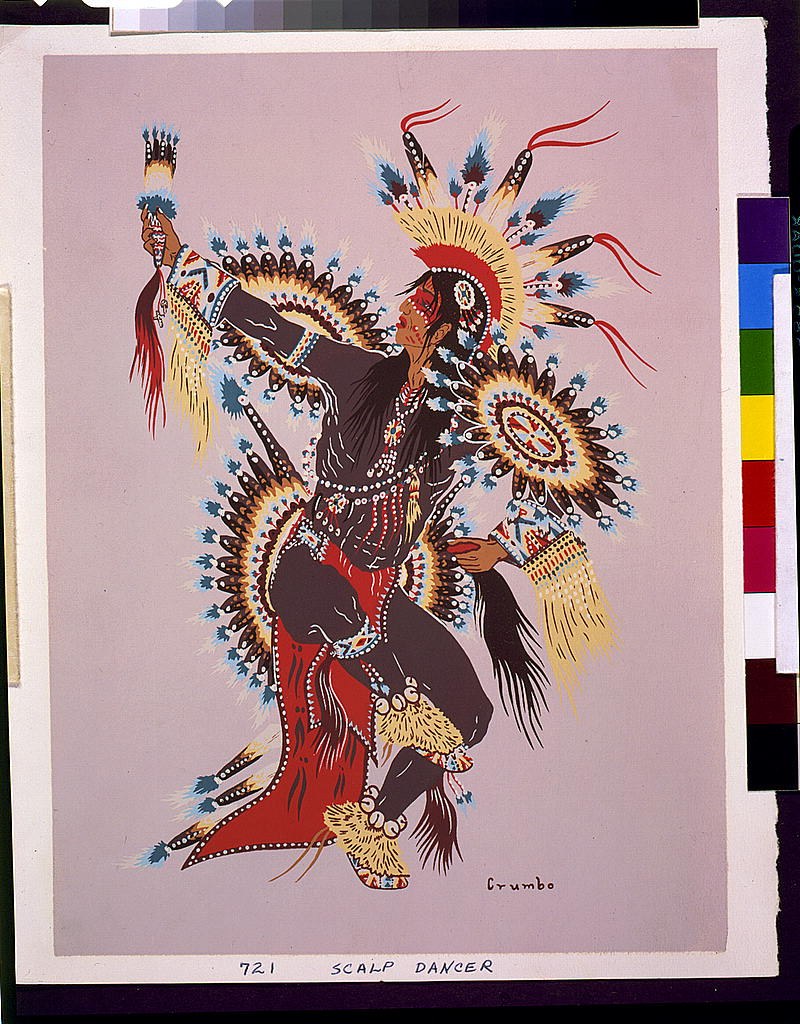
[Scalp dancer]
Unknown artist
- Collection:
- Prints & Photographs
- Source:
- Library of Congress
- Rights:
- Rights vary by item — check the source record before reusing this image. Source record ↗
- Recorded as:
- Library of Congress — no known restrictions (verify per item)
This print is one of relatively few mid-20th-century visual documents of the Scalp Dance by a Native American artist. Crumbo's treatment offers an insider perspective on how indigenous peoples represented their own ceremonial forms during a period when most artistic interpretation came from outsiders. The work matters to dance history because it visualizes a performance tradition that was orally transmitted and live, capturing the verticality, power, and spiritual intensity that written descriptions alone cannot convey.
What you are looking at
A single figure dominates this print against a soft mauve background, portrayed in an explosive, radiating composition. The dancer wears dark clothing (black or deep brown) with red accents—notably red leggings or lower garments—and is adorned with elaborate indigenous regalia: multiple feathered headdresses in yellow and blue arranged in a circular, sunburst pattern around the body, white beadwork or shell ornamentation creating patterns across the torso and limbs, and red ribbon or sash elements flowing upward. The figure's posture is dynamic and lifted, with limbs extended in multiple directions, creating a sense of upward momentum and spiritual power. Small blue feathered elements—possibly representing movement or spiritual forces—radiate outward from the body. A ceremonial object (possibly a rattle or shield) is held aloft in the upper left. The composition suggests a moment of ecstatic movement or transformation rather than a grounded social dance.
The dancing
A single figure dominates, their body arranged in an asymmetrical, uplifted pose with arms and legs extended dynamically outward. The weight appears lifted and buoyant, with the torso arched and twisted to create maximum visual extension. The figure's stance is neither a static pose nor a conventional balletic alignment, but rather suggests a moment of spiritual intensity or shamanistic transformation. The extended limbs and radiating posture create lines that pull the viewer's eye outward from the center, making the dancer's energy seem to emanate in all directions.
The dance depicted
This work documents or represents Native American ceremonial dance, most likely a Scalp Dance—a war ritual historically performed by Plains and other indigenous nations following military victories. The Scalp Dance involved rhythmic, celebratory movement with complex regalia as a way of honoring warriors and processing triumph and loss. The explosive, radiating composition conveys the spiritual and martial intensity of the form. The artist has captured the dancer's exultant verticality and the ceremonial significance of the regalia rather than anatomical realism. Whether this represents an actual performance witnessed or a romanticized or ethnographic interpretation is unclear from the image alone.
How it was made
This is a color print, likely lithographic or hand-colored, from 1952. The soft, pastel mauve background, the linear quality of the feather rendering, and the controlled color palette suggest a commercial or artistic print made for distribution. The signature reads 'Crumbo,' identifying the artist. The technique allowed for bold compositional choices and flattened perspective that emphasize the spiritual and symbolic dimensions of the costume over photographic accuracy.
About this work
This 1952 print documents the Scalp Dance, a ceremonial performance form central to the warrior traditions of Plains and other Native American nations. The artist, Crumbo, captures the dance's ecstatic, upward-lifting energy through a radial composition that treats the dancer's body as a center from which spiritual power emanates. The regalia—feathered headdresses, beadwork, ribbons—are rendered with specificity and respect, suggesting ethnographic interest rather than theatrical exoticization, though the romanticized context of American art in 1952 complicates any interpretation. The work appears in the Library of Congress Prints and Photographs collection as a cultural document and artistic interpretation of indigenous ceremonial practice.
How to look at it
Attend to the upward, radiating composition: the artist chose a moment of maximum lift and extension rather than a grounded or contained movement. Notice how the feathered headdresses and the body create concentric circles and outward-pointing lines, which conveys spiritual power and joy rather than martial aggression. The symmetry is broken and dynamic—not a static display, but a glimpse of motion in progress. The beadwork and ribbon details are rendered with specificity and love, indicating the artist's familiarity with the regalia's construction and significance. The soft background allows the figure to float, giving the composition an almost dreamlike or transcendent quality.
The artist
The signature identifies the artist as Crumbo, a Native American printmaker and painter active in the mid-20th century. Crumbo was associated with the Native American art movement of the 1940s–1950s, which centered indigenous artists' visual interpretation of tribal traditions and ceremonial forms. The work reflects Crumbo's commitment to documenting and celebrating indigenous cultural practice through fine art media, positioning Native American artists as authorities on their own traditions rather than subjects of ethnographic study.
The period
In 1952, indigenous ceremonial practices were undergoing significant suppression and transformation. The Indian Reorganization Act of 1934 had officially ended some of the most repressive policies, but many ceremonial forms remained discouraged or marginalized on reservations. The same period saw the rise of Native American art movements in the Southwest, where artists like Crumbo reclaimed visual representation of indigenous culture as a form of cultural preservation and assertion. Simultaneously, mainstream American visual culture was consuming romantic and often distorted images of Native Americans through Wild West imagery and ethnographic display. Crumbo's print sits at the intersection: an artistic treatment that assumes indigenous ceremonial practice as worthy of serious visual representation, yet made in the context of a dominant culture still learning to regard Native Americans as contemporary peoples rather than historical subjects.
Where it lives
The work is held by the Library of Congress Prints and Photographs Collection, catalogued as item 721. The catalogue record is sparse—no medium or date recorded in the existing description—but the verso label identifies it as 'Scalp Dancer' and notes the year 1952.
Dance in this work
Questions about this work
What is a Scalp Dance?
The Scalp Dance was a ceremonial war dance performed by many Plains and other Native American nations, historically following military victories. It combined celebratory movement, rhythmic footwork, and elaborate regalia as a way of honoring warriors, processing collective emotion, and affirming cultural identity. The form was communal and often involved multiple dancers, though this print depicts a single figure in a moment of exultant individual expression. The practice was suppressed during periods of U.S. federal assimilation policy but has been revived and is performed today as a living tradition.
Who was Crumbo?
Crumbo was a Native American artist active in the mid-20th century, part of a generation of indigenous painters and printmakers who asserted creative authority over the representation of tribal culture. Working primarily in the Southwest, Crumbo created works documenting ceremonial forms, portraits, and cultural narratives. The artist's work reflects the broader Native American art movement of the 1940s–1950s, which positioned indigenous artists as interpreters and guardians of their own traditions rather than subjects of external ethnographic study.
Is this a document of an actual dance or an artistic interpretation?
It is likely both. The specificity of the regalia and the understanding of the dance's upward, ecstatic energy suggest knowledge of actual performance. However, the radial, flattened composition and the intense color palette are artistic choices that emphasize the ceremonial and spiritual aspects of the form rather than attempting photorealism. The work sits between documentation and interpretation—a visual translation of ceremonial practice into fine art media.
Why is this work in a dance collection?
While the Scalp Dance is a living ceremonial tradition, it is not a secular social dance and is rarely captured in visual records. This print is significant because it documents a performance form that has been largely invisible in mainstream American art history and because it represents an indigenous artist's own interpretation of tribal tradition. For dance historians and dancers, it offers a rare visual witness to the form's power, verticality, and spiritual intensity.
More dance artwork





