49 works in this view — arrow keys or swipe to move between them.
Dance in Art
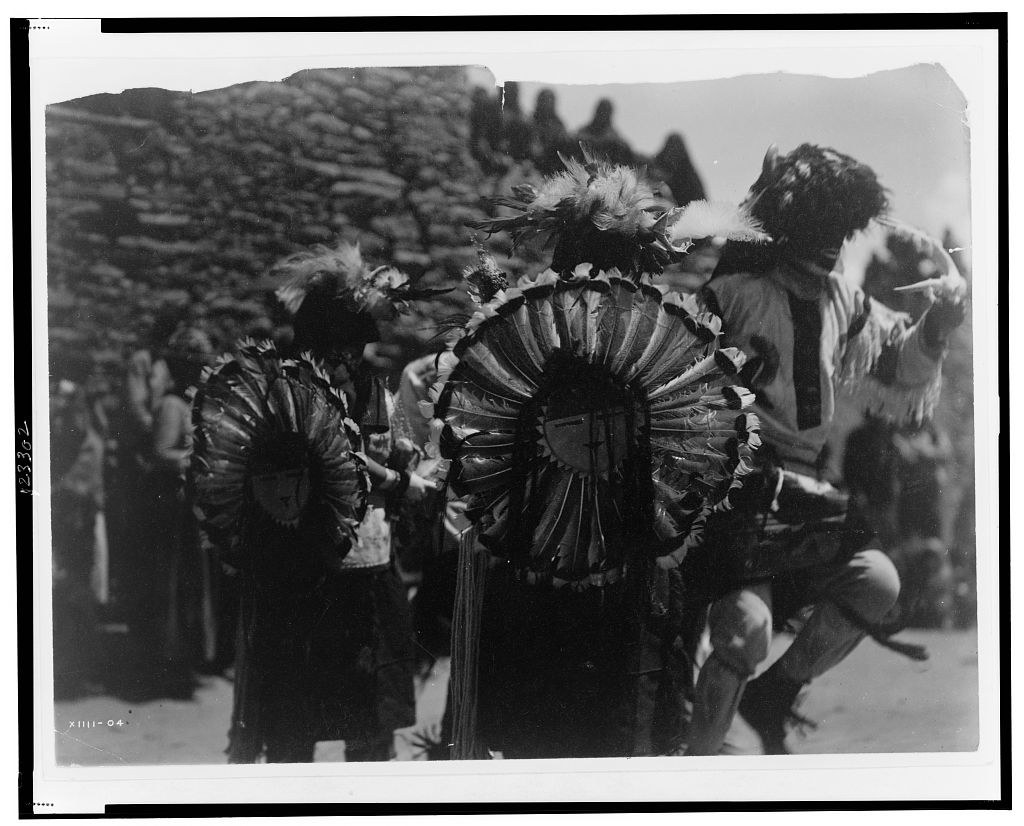
Buffalo dancers
Unknown artist
- Collection:
- Prints & Photographs
- Source:
- Library of Congress
- Rights:
- Rights vary by item — check the source record before reusing this image. Source record ↗
- Recorded as:
- Library of Congress — no known restrictions (verify per item)
This photograph is one of the few surviving visual records of early twentieth-century powwow regalia and men's traditional dance costume in detail. It documents a moment in Native American cultural continuity and the aesthetic choices powwow dancers made in constructing and displaying their regalia during this period. For students of Native American dance, powwow history, and indigenous performance traditions, such photographs are rare primary sources.
What you are looking at
A black and white photograph captures a group of Native American dancers in full regalia, photographed outdoors with forested mountains visible in the distant background. The central figures wear elaborate feathered headdresses and fringed or quilled garments that extend broadly from the shoulders—the characteristic bustles and regalia of powwow dancers. At least three dancers are clearly visible in the foreground, with additional figures visible in the background. The photograph is taken at close to middle distance, allowing detail of the costumes while showing the spatial relationship of the dancers. The lighting is clear and even, typical of daytime outdoor photography, and the image has the slight softness and tonal quality of early twentieth-century photographic stock.
The dancing
The dancers stand upright with their bodies posed to display the full breadth of their regalia, particularly the large feathered bustles that project horizontally from the back and sides. The posture is formal and frontal, characteristic of documentation or display rather than the dynamic mid-movement capture. Arms are positioned to frame the regalia, and the overall stance suggests the dancers are either pausing between movements or have positioned themselves specifically for the camera. The dancers appear to range from adult to young adult, though the photograph's focus is on costume rather than technique.
The dance depicted
This is a photograph of Native American powwow dancers, likely from a tribal gathering or ceremonial occasion. The title 'Buffalo dancers' may refer to a specific dance tradition or may be a period term for men's traditional regalia dancing. The elaborate feathered bustles, quilled or fringed garments, and decorative regalia visible here are consistent with men's traditional powwow dance styles, though the photograph documents appearance and costume rather than movement itself. The outdoor setting and group assembly suggest a public or semi-public gathering rather than a private ceremony.
How it was made
This is a gelatin silver print or similar photographic process typical of 1905. The image shows the characteristics of early twentieth-century documentary photography: soft focus in the background, good tonal range in the midtones, and the slightly yellowed or cool cast of aged photographic emulsion. The photographic medium allowed for straightforward documentary recording and was well suited to capturing textile detail and regalia ornamentation. As an early field photograph, it likely served archival or ethnographic purposes rather than artistic display.
About this work
This photograph documents Native American powwow dancers in their regalia, likely recorded during a tribal gathering in the early twentieth century. The image is valuable as both a record of specific dance costume and regalia styles and as evidence of powwow culture in the early 1900s. The photograph preserves details of feathered bustles, quill work, and fringed garments that would otherwise survive only in fragmentary form. For dance historians, it provides crucial visual documentation of the material culture surrounding these dances and their display in the early powwow era. The work sits at the intersection of ethnographic documentation, costume history, and dance recording.
How to look at it
Attend to the costume details: the scale and construction of the feathered bustles, the distribution of quill work and fringe, the headdress design, and the overall silhouette these elements create. The photograph is documentary in intent, so it prioritizes static visibility of the regalia over motion. The posed frontal stance allows examination of how these dancers chose to present themselves and their cultural regalia. The background landscape and the presence of multiple dancers suggest this was a public or semi-public gathering rather than a private or ceremonial context, which affects how we understand the photograph's purpose and audience.
The period
The early 1900s saw increasing documentation of Native American cultural practices through photography, often by government agencies, ethnographic expeditions, and museums collecting material culture. Powwows as organized public gatherings were consolidating their modern form during this era, following decades of cultural restriction. The photograph reflects the period's documentary impulse—whether driven by ethnographic interest, archival ambition, or the simple fact that photography had become the standard medium for recording cultural practices. The formal, posed quality of the photograph is typical of early twentieth-century ethnographic work, which often prioritized clear visibility of costume and regalia over the capture of dynamic movement.
Where it lives
The photograph is held by the Library of Congress Prints & Photographs collection. It bears the reference number XIII-04, indicating it comes from a larger photographic series or archive.
Dance in this work
Questions about this work
What is a buffalo dancer?
The title likely refers to a men's traditional powwow dance style, though the specific meaning may be tied to a particular tribal tradition or to the historical naming conventions of early twentieth-century ethnographic documentation. The regalia visible here—particularly the feathered bustles and fringed garments—are consistent with men's traditional dance costume in powwow culture. Without additional documentation, the precise meaning of the title cannot be confirmed.
When and where was this photograph taken?
The catalogue records the date as 1905. The location is not specified in the available record. The outdoor setting with forested mountains suggests a region with such geography, but the precise location would require additional documentation.
Who were these dancers?
The photograph does not identify the individual dancers or the tribal affiliation of the group. It functions as a documentary record of regalia and costume rather than as a portrait of specific individuals.
How does this compare to modern powwow dancing?
Modern powwow dance and regalia have evolved significantly since 1905, though some foundational styles and costume elements remain recognizable. This photograph documents an earlier moment in powwow development, when the gathering tradition was still consolidating its contemporary form.
More dance artwork





