49 works in this view — arrow keys or swipe to move between them.
Dance in Art
Buffalo dancer
Unknown artist
- Collection:
- Prints & Photographs
- Source:
- Library of Congress
- Rights:
- Rights vary by item — check the source record before reusing this image. Source record ↗
- Recorded as:
- Library of Congress — no known restrictions (verify per item)
Buffalo Dances were central to Plains Indian ceremonial life and represent a living tradition of sacred performance with deep cultural meaning. This image is important because it preserves the visual language of a specific dance tradition from the mid-20th century, at a moment when such ceremonies were under pressure from cultural suppression, and shows how the transformation of the dancer's body through costume and stance accomplishes the dance's spiritual work.
What you are looking at
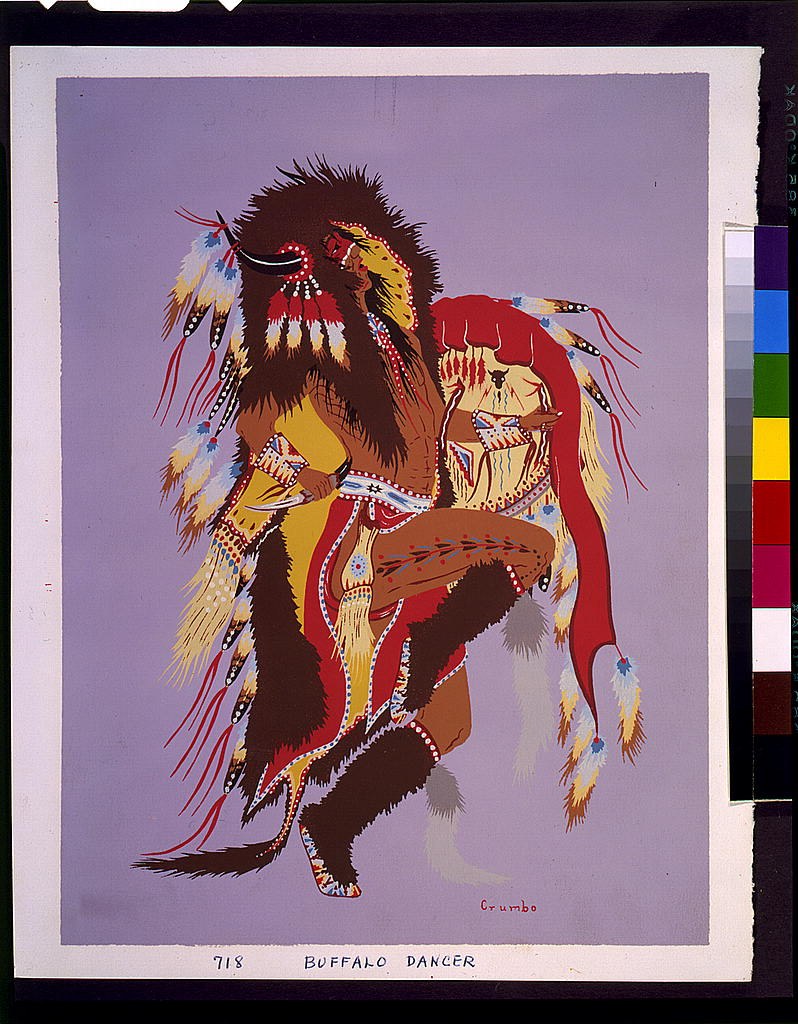
A single figure dominates the composition against a soft purple background, depicted in a dynamic, athletic pose that suggests vigorous movement. The dancer wears an elaborate costume of dark brown fur or hide covering most of the body, with a prominent dark brown head topped with stiff, spike-like hair or quills standing upright. The face is painted or masked in deep red with white markings, particularly around the mouth and eyes. The costume features extensive ornamentation: long strands of fringe and feathering in red and natural fibers cascade from the shoulders and arms, and multiple strands of small white beads or shells hang as attachments throughout. The lower body shows geometric patterned hide in brown and red tones, and the dancer appears to be in a wide, grounded stance with one leg bent and forward. The overall effect conveys power, animal transformation, and ceremonial presence rather than human form.
The dancing
The single figure occupies the full height of the composition, viewed frontally in a powerful, wide-legged stance. The torso is upright but the legs are splayed in a posture of strength and grounding. The arms are positioned with the hands near the body, one slightly raised, suggesting containment of energy rather than extended movement. The weight appears evenly distributed or slightly forward, creating a sense of readiness or mid-action pause. The overall frame conveys ceremonial dignity and controlled intensity rather than the flowing extension typical of theatrical dance.
The dance depicted
This depicts a Buffalo Dancer, a ceremonial figure from Native American tradition, most likely from Plains culture given the costume elements and the title. The buffalo dance held spiritual and hunting significance, and was performed as part of ceremonial cycles to honor the buffalo and ensure successful hunts. The costume's transformation of the dancer into the animal—achieved through fur, the prominent horn-like quills, and the powerful stance—is central to the dance's purpose. The image captures not a moment of kinetic movement but the iconic presence and potency of the dancer as transformed being, which is fundamental to ceremonial dance's function.
How it was made
This is a color lithograph or hand-colored print, as indicated by the flat color fields, the sharp outlines, and the watercolor-like wash of the purple background. The artist has used a limited but carefully composed palette of dark brown, red, cream, and blue-grey tones. The technique allowed for precise rendering of the intricate costume details—the individual fringe strands, bead attachments, and geometric patterns—while maintaining the decorative, graphic quality essential to the work's impact. The style and execution suggest a mid-20th-century artistic representation created for education or documentation rather than ethnographic recording.
About this work
This is an artistic rendering of a Native American Buffalo Dancer in full ceremonial regalia, created as a color lithograph in 1952. The work presents the dancer not in kinetic mid-motion but as a powerful, iconic figure—a transformation into the sacred animal whose spirit the dancer embodies. The meticulous rendering of the costume's details and the commanding composition reflect mid-century artistic interest in Native American culture and ceremonial practice. The image belongs in a dance gallery because it documents a sacred dance tradition and captures the visual and bodily grammar through which spiritual power and animal presence are conveyed.
How to look at it
The artist has frozen the dancer in a stance of power and presence rather than mid-leap or mid-step. Notice how the upright torso and wide-planted legs create a base of stability and strength—this is the grammar of ceremonial presence rather than theatrical spectacle. The elaborate costume is rendered with the same visual weight as the body itself, emphasizing that the regalia is not decoration but the visible form of the dancer's transformation. The frontality and symmetry of the composition reinforce the ceremonial and iconic function: this is not a moment caught in passing but a presentation of the dancer as embodiment of sacred power.
The artist
The artist is credited as 'Crumbo' in the lower right, likely Woodrow Wilson Crumbo (Willeto), a Pawnee artist (1912–1989) known for painting Native American subjects and ceremonies with ethnographic attention and artistic sophistication. Crumbo was part of the mid-century Native American artistic renaissance and worked to document and celebrate indigenous cultural practices.
The period
In 1952, Native American ceremonial practices were being suppressed under federal policy, and indigenous artists were beginning to reclaim and document their own traditions through fine art. The mid-20th century saw growing interest in Native American culture among non-Native audiences and increased efforts by Native artists themselves to preserve and represent their heritage in permanent artistic form. This period also marked the emergence of Native American modernism, in which artists combined traditional subject matter with contemporary art techniques.
Where it lives
This color lithograph is held in the Library of Congress Prints & Photographs Online Collection, where it is catalogued as item 718. It is part of the broader documentary record of Native American cultural practice and artistic representation in the 20th century.
Dance in this work
Questions about this work
What is a Buffalo Dancer?
The Buffalo Dancer is a ceremonial figure from Plains Indian traditions, particularly associated with the Pawnee, Blackfoot, and other Plains nations. The dancer, dressed in buffalo hide and regalia, embodies the buffalo spirit and performed in ceremonies seeking to honor the animal and ensure successful hunts. The dance held spiritual significance and was part of the ceremonial cycles that maintained the relationship between human and animal worlds.
Why is the dancer standing still rather than dancing?
The artist has captured the iconic, grounded presence of the dancer as a transformed being rather than a moment of kinetic movement. This is appropriate to the ceremonial function: the power of the dance lies partly in the visual presence and spiritual force of the transformed dancer. Many ceremonial dances are not primarily about continuous motion but about embodying and radiating spiritual power through stance, costume, and presence.
Who was Crumbo?
Woodrow Wilson Crumbo (Willeto) was a Pawnee artist (1912–1989) who was instrumental in documenting and celebrating Native American ceremonies and cultural life through painting and printmaking. He was part of the Native American artistic renaissance of the mid-20th century and worked to preserve indigenous traditions in permanent artistic form while developing a modernist approach to representation.
More dance artwork





