49 works in this view — arrow keys or swipe to move between them.
Dance in Art
[The spear dance]
Unknown artist
- Collection:
- Prints & Photographs
- Source:
- Library of Congress
- Rights:
- Rights vary by item — check the source record before reusing this image. Source record ↗
- Recorded as:
- Library of Congress — no known restrictions (verify per item)
This print provides direct visual evidence of early Edo-period theatrical performance practice, capturing not merely what the costume looked like but how the dancer moved and deployed a weapon as part of choreographed action. For historians of Japanese theater and dance, it is a primary source for understanding the vocabulary of movement, the integration of props, and the aesthetic priorities of a major performance tradition. The work demonstrates how printmaking served as a technology for broadcasting ephemeral performance across space and time, making a single moment of live theater available to thousands.
What you are looking at
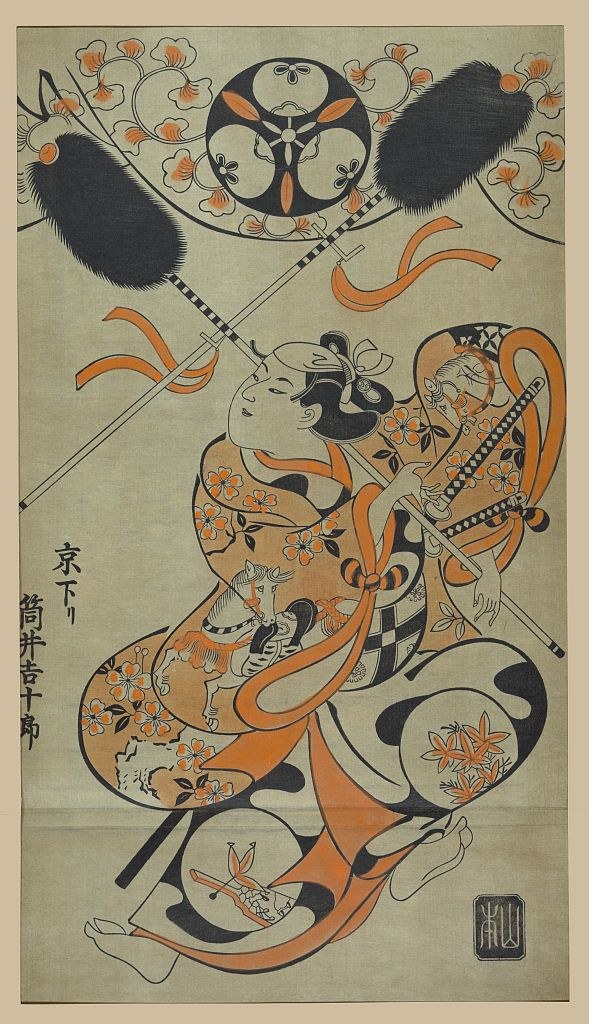
A dynamic composition in the Japanese woodblock print style depicts a figure in elaborate costume performing with a spear, rendered in the characteristic technique of early 18th-century prints. The dancer wears richly patterned garments in orange and black, with decorative floral motifs covering much of the body, and moves with theatrical energy against a cream-colored ground. Two large dark forms—likely fans or stage properties—frame the upper portion of the image, while delicate flowering branches bearing orange blossoms extend across the composition. The dancer's posture is dramatically angled, with the body twisted and limbs extended in a pose suggesting vigorous movement. A decorative spear with geometric patterning runs diagonally through the composition, and serpentine orange ribbon or fabric elements billow around the figure. The overall effect is one of controlled theatrical display, with the ornamental treatment of the costume and the careful compositional framing suggesting a performance of high cultural significance.
The dancing
The single figure dominates the composition, captured mid-movement in a twisted, asymmetrical stance that suggests rotation or turning. The torso is sharply angled, the limbs extended with apparent force, and the overall frame conveys explosive energy within a carefully balanced composition. The elaborate costume—heavily patterned and ornamented—appears designed for visibility and visual impact rather than ease of movement, suggesting a formal theatrical context. The positioning of the spear in relation to the body indicates it is an active prop, integral to the movement vocabulary rather than merely carried.
The dance depicted
This print most likely documents a moment from a spear dance (槍舞) or combat-related theatrical performance from the early Edo period. The style and costume ornament suggest a connection to kabuki or similar theatrical traditions where dance incorporated weaponry and martial stylization. The spear's diagonal placement and the dancer's dynamic stance indicate this was a performance combining choreography with the manipulation of a theatrical weapon. The term 'spear dance' in the title aligns with Japanese theatrical vocabulary, though the specific performance context—whether kabuki, ritual performance, or popular entertainment—cannot be definitively established from the image alone. The floral decoration may reference seasonal or celebratory themes common to theatrical performances of this era.
How it was made
This is a woodblock print (likely a woodcut) in the Japanese tradition, executed with the characteristic techniques of early 18th-century prints: bold outlines, flat color planes in orange and black, and careful negative space composition. The medium allowed for rapid reproduction and relatively affordable circulation among urban audiences. The print's technical refinement—the crisp registration of colors, the confident line work defining costume ornament, and the sophisticated compositional balance—indicates this was produced by a skilled workshop rather than a single hand. Woodblock printing's requirement for bold, readable forms meant the artist simplified costume detail into readable pattern rather than attempting naturalistic rendering.
About this work
This Japanese woodblock print documents a moment of theatrical performance from the early 18th century, capturing a dancer wielding a spear in elaborate costume against a composed, carefully balanced ground. The work is a record of a specific performance tradition—likely kabuki or a related theatrical form—and reveals how Japanese artists documented dance through the medium of prints. The ornamental treatment of the figure and the decorative framing elements indicate this was a culturally valued performance, one worthy of being preserved and circulated through printmaking. As a historical document, it shows what a contemporary audience would have seen: the silhouette and energy of the movement, the richness of the costume, and the central role of the spear as a theatrical and kinetic element. The print circulated among urban dwellers in Japan, making dance visible to audiences beyond the theater itself.
How to look at it
Attend first to the dynamic diagonal thrust of the spear and the dancer's twisted posture—the artist has chosen a moment of apparent rotational movement, not a static pose. Notice how the costume ornament, though decorative, emphasizes the outline of the figure and makes the limbs and torso articulation legible against the plain ground. Observe the compositional framing: the two large dark forms at the top (possibly representing stage curtains or properties), the flowering branches that create a natural 'frame' around the figure, and the way the serpentine orange elements echo and extend the movement of the body. The print documents a specific theatrical moment but also demonstrates how Japanese artists constructed visual legibility through silhouette, pattern, and compositional balance rather than through modeling or spatial illusion.
The artist
The artist is not recorded, though the quality of execution and the sophisticated compositional balance suggest an experienced hand working within the conventions of the Edo-period theatrical print tradition. The seal visible in the lower right is not identified in available records. Early 18th-century print makers often worked in workshops where attribution became diffused, and many prints circulated without a named artist. The style and execution are consistent with mainstream practice of the period, suggesting the artist was responding to established audience expectations for theatrical prints rather than developing an idiosyncratic vision.
The period
The early 18th century (the print is dated 1704) was a period of flourishing theatrical culture in Japan, with kabuki established as a major urban entertainment. Woodblock printing was becoming increasingly sophisticated as a medium, and the market for theatrical prints—documenting and promoting performances—was expanding among urban audiences who sought visual memory of live performances. Spear dances and combat choreography were consistent elements of kabuki, often appearing in historical or martial plays. The decorative floral ornament may reference the seasonal programming of theaters, where performances often incorporated references to the season in both costume and thematic content. The date places this well into the mature Edo period, when both theater and printmaking had developed complex aesthetic conventions.
Where it lives
The print is held in the Prints & Photographs collection of the Library of Congress. It is a single sheet from the broader tradition of Japanese woodblock theater prints, which were produced and circulated in large numbers during the Edo period. The collection information indicates this came from a Western print collection and was catalogued according to Western archival practices, though the object itself is a Japanese cultural artifact.
Dance in this work
Questions about this work
What is a spear dance?
A spear dance was a theatrical performance that combined choreography with the manipulation of a spear or similar weapon, common in Japanese kabuki and related traditions. It typically appeared in historical or martial-themed plays and demonstrated both the dancer's skill and the dramatic potential of the weapon as a prop. The spear was both a visual element and an active participant in the movement vocabulary, creating dynamic compositional lines and emphasizing the force of the dancer's motion.
Why is this figure so ornately decorated?
The elaborate patterned costume served multiple functions in theatrical performance: it made the dancer visible to audiences in the theater, it conveyed information about the character and social status, and it created visual richness that appealed to audiences. The ornament was designed to be legible from a distance and to enhance the visual impact of movement. The print's flattened style makes this ornament even more prominent, as the medium emphasized bold pattern and readable silhouette.
What do the flowers mean?
The flowering branches may reference the seasonal timing of the performance or the season being represented in the theatrical narrative. In Japanese aesthetic tradition, seasonal references were common in theater, poetry, and visual arts. The flowers could also simply serve a compositional function, framing the central figure and creating a naturalistic context for the performance.
How do we know this is from 1704?
The catalogue record dates this to 1704, though without additional documentation (seals, inscriptions, or other identifying marks) visible in the image itself, the basis for this dating cannot be confirmed from the print alone. The style and technique are consistent with early 18th-century Japanese woodblock prints, but precise dating of unsigned prints often depends on archival records or stylistic analysis by specialists in the medium.
More dance artwork





