49 works in this view — arrow keys or swipe to move between them.
Dance in Art
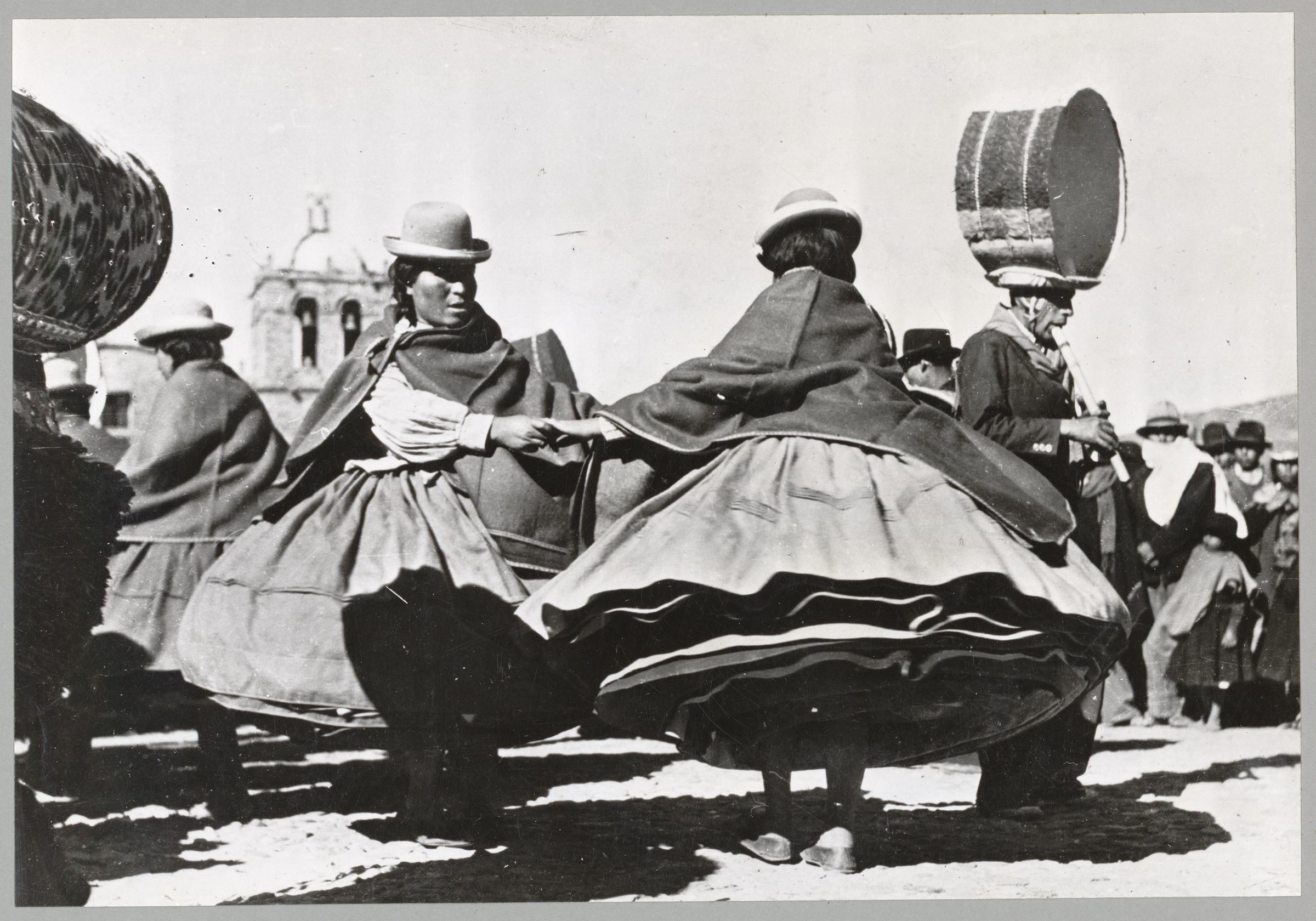
Fiesta "Huayno," a Folk Dance.
Unknown artist
- Collection:
- Prints & Photographs
- Source:
- Library of Congress
- Rights:
- Rights vary by item — check the source record before reusing this image. Source record ↗
- Recorded as:
- Library of Congress — no known restrictions (verify per item)
Huayno is one of the foundational dance forms of the Andes and carries both spiritual and political significance as a marker of indigenous identity and continuity. This photograph is one of few mid-century visual records of the dance as it was actually performed in community context, showing the integration of domestic and ceremonial practice that characterizes Andean worldview. For choreographers and anthropologists, it provides rare evidence of movement vocabulary, costume, and social organization that might otherwise be lost.
What you are looking at
A photograph captures a fiesta celebration, likely in the Andes, with dancers in traditional dress mid-performance. In the foreground, two figures in dark skirts and shawls dominate the composition; the nearer dancer wears a bowler hat and grips a large cooking pot or ceremonial vessel as part of the choreography, while a second dancer behind holds an equally large pot aloft. Both wear layered skirts that flare and billow with movement. The background shows a crowd of onlookers in similar traditional dress—bowler hats, shawls, layered skirts—gathered around a colonial church or chapel, its bell tower visible in soft focus. The photograph is shot in bright daylight, casting sharp shadows and creating strong contrast. The setting appears to be a town plaza or sacred space, and the gathering suggests a major religious or seasonal festival rather than a staged performance.
The dancing
The two primary dancers occupy low, grounded stances with bent knees, their bodies leaning slightly forward into the weight of the vessels they carry. The pots are held not as props but as structural elements of the movement—one dancer clutches hers at waist level with both hands while the second hoists hers high, requiring torso extension and shoulder engagement. The skirts, made of multiple layers, swing and catch the light with each weight shift, indicating rapid footwork beneath. No ballroom frame or upright posture: the dancers are earthbound, using their entire bodies to manage the heft and balance of the objects. The relationship between the two is parallel and coordinated rather than partnered in the European sense.
The dance depicted
This is a documented performance of *huayno* (also spelled *waino* or *huaino*), a circle or processional dance from the high Andes of Peru, Bolivia, and Ecuador. Huayno is both a social and ceremonial dance, performed at fiestas, harvest celebrations, and religious festivals, and is characterized by a steady, grounded rhythm and the integration of everyday objects—here, cooking vessels—into the choreography. The use of large pots suggests either a fertility or harvest ritual context, or a display of domestic abundance. The costume and setting confirm an early-to-mid twentieth-century Andean practice, and the photograph's documentary quality suggests ethnographic or journalistic documentation of living tradition rather than reconstruction.
How it was made
This is a black-and-white photograph, likely gelatin silver print or similar process, taken in bright natural daylight with a camera positioned at mid-distance to capture both the detail of the dancers' dress and the wider context of the gathering. The depth of field keeps the dancers sharp while the background recedes slightly, focusing attention on the movement. The date 1960 and archival housing suggest this was taken by a news photographer, ethnographer, or cultural documentarian with access to the community. The photograph's clarity and composition indicate professional or semi-professional work intended for publication or institutional record.
About this work
This photograph documents a performance of huayno, an indigenous Andean circle dance, captured during a fiesta celebration in 1960. The image records both the choreography—the use of large vessels as integral to the movement—and the social world of the performance: the plaza gathering, the colonial church, the community dress and hierarchy visible in the crowd. For dancers and choreographers, it preserves evidence of how an ancient tradition was practiced and celebrated in the mid-twentieth century; for historians, it documents the persistence of indigenous performance in the colonial landscape of the Andes. The photograph is neither staged performance nor abstract documentation, but rather the everyday sacred life of the community.
How to look at it
Notice the low center of gravity and the way the dancers' bodies accommodate the weight and balance of the pots—this is not ballet's verticality but an entirely different relationship to the ground and to the object. Watch how the skirts move: the layering and volume create visual rhythm independent of the footwork, making the garment itself a choreographic element. Observe the crowd in the background: fiesta dances are communal and participatory, not performances for external audiences, and the gathering shows how the event coheres the plaza and the community. The church in the background is not incidental—Andean fiestas blend indigenous and Catholic calendars, and the spatial relationship between the dancers and the colonial building speaks to centuries of cultural negotiation.
The artist
The photographer is not recorded. The image appears to be part of a documentary or journalistic project, given its clarity, framing, and the Library of Congress housing. The style and approach are consistent with mid-twentieth-century ethnographic photography, which often aimed to document indigenous practices with a mix of anthropological and journalistic intent.
The period
In 1960, Andean indigenous practices were both celebrated and suppressed by various governments and institutions. In Peru, Ecuador, and Bolivia, the postwar decades saw increasing interest in indigenous culture as a national heritage, even as indigenous communities faced economic marginalization and pressure to assimilate. Huayno experienced a revival during the 1960s as part of broader movements of cultural reclamation and pan-indigenous solidarity. Photographic documentation of such practices served both commercial (tourism, journalism) and scholarly (anthropology, folklore) purposes, though the power dynamics of who documented whom and for whom remain complex.
Where it lives
This photograph is held by the Library of Congress Prints & Photographs Online Catalog, likely as part of a larger collection related to Latin American culture or documentary photography. The sparse cataloging and lack of attributed photographer suggest it may have entered the collection through a news archive or ethnographic survey rather than as a standalone artwork.
Dance in this work
Questions about this work
Is huayno the same as the dance called 'Andean dance' or 'Peruvian dance'?
No. Huayno is one specific genre within Andean music and dance traditions, characterized by a particular rhythm, movement vocabulary, and cultural context. Andean dance and Peruvian dance are broad umbrella terms that encompass many forms, including huayno, marinera, festejo, and others. Huayno is distinguished by its connection to indigenous Quechua and Aymara cultures, its agricultural and ceremonial contexts, and its use of communal circle or processional structures.
What are the large pots for? Are they just props?
The pots are not decorative props but integral to the dance itself. In Andean fiesta contexts, the inclusion of everyday domestic objects—cooking vessels, agricultural tools, textiles—into choreography expresses the integration of labor, abundance, and community care into ceremonial space. The dancer's ability to move skillfully while managing the weight and balance of the pot demonstrates strength, control, and the fusion of work and ritual.
Why is there a colonial church in the background?
Many Andean fiestas take place in town plazas centered on colonial Catholic churches, reflecting centuries of cultural layering in which indigenous practices have been performed in and around spaces of colonial administration and conversion. The fiesta calendar often aligns Catholic saints' days with indigenous agricultural or spiritual cycles, and the physical geography of the plaza expresses this complex negotiation.
When did huayno originate?
Huayno has deep pre-Columbian roots in the music and movement traditions of the Andes. The form as documented in the twentieth century reflects centuries of evolution and adaptation, including influences from Spanish colonial music and Catholic ritual. The specific version captured in this 1960 photograph represents a living, changing tradition rather than a static historical form.
More dance artwork





