49 works in this view — arrow keys or swipe to move between them.
Dance in Art
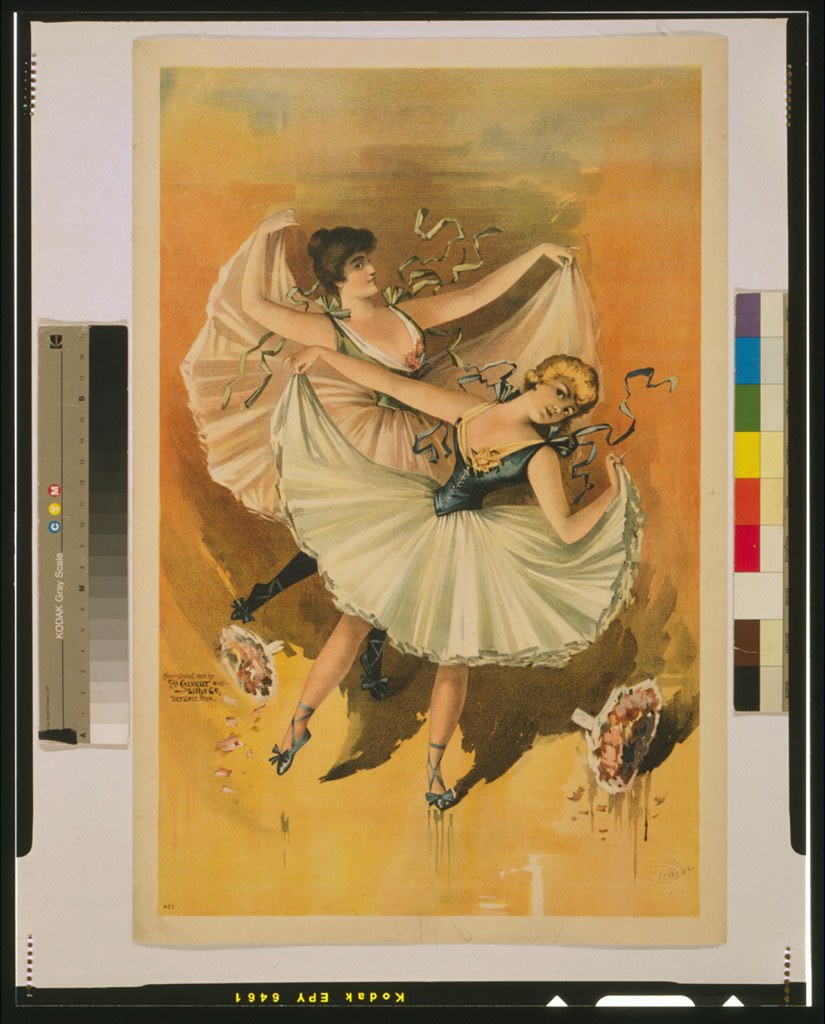
[Two ballerinas, blond woman in front with brunette woman behind]
Unknown artist
- Collection:
- Prints & Photographs
- Source:
- Library of Congress
- Rights:
- Rights vary by item — check the source record before reusing this image. Source record ↗
- Recorded as:
- Library of Congress — no known restrictions (verify per item)
This image documents how dance was conceptualized and marketed in the 1890s, at a moment when the ballet establishment was facing serious challenge from emerging modernist forms. The allegory of weightless, classically dressed female bodies defying gravity reveals contemporary anxieties and aspirations about what dance could mean beyond the rigid codes of ballet technique. For historians of dance aesthetics, this print is evidence of how chromolithography, as a mass medium, shaped public imagination about dance as an art form.
What you are looking at
Two women in diaphanous classical dress float against a warm golden-orange sky in this 1890s chromolithograph. The figures occupy most of the composition, positioned at a diagonal that suggests upward motion. The woman in front, dark-haired, wears a pale pleated chiton with a dark belt; her companion, blonde and positioned higher and behind, wears a similar costume. Both have their arms extended and fabric billowing around them in an impossible defiance of gravity. Below them, fragments of classical statuary and architectural elements drift downward—a marble head, broken columns, decorative vessels—as if the dance itself has scattered the classical world. The palette shifts from cool pale tones where the figures cluster toward intense orange and yellow at the composition's edges, creating an ethereal, dreamlike atmosphere. The work is executed with the precise registration and soft color gradations characteristic of chromolithographic printing.
The dancing
The bodies are elongated and weightless, positioned in an exuberant upward diagonal. The front figure's torso twists as her arms spread wide, one arm extended fully while the other gestures upward; her weight appears suspended. The rear figure's pose echoes and amplifies the movement, her arms similarly flung open. Neither figure demonstrates the structured line, turnout, or epaulement of ballet technique; instead, the bodies are naturalistic and unformed, more akin to classical statuary or allegorical painting. The floating arrangement suggests neither partnered dance nor a grounded technique, but rather two figures caught in an ecstatic or weightless moment.
The dance depicted
This is not a representation of a specific codified dance, but rather an allegorical image of dance itself as a classical subject. The costumes—Greco-Roman chiton, classical draping—position this in the nineteenth-century tradition of interpreting ancient dance through contemporary imagination. The floating, gravity-defiant poses and the scattering of classical fragments suggest an Idealized vision of dance as transcendent and disembodied, characteristic of Romantic-era aesthetic values. The image participates in the late-nineteenth-century fascination with reconstructed or imagined classical dance, contemporary with the development of interpretive dance and distaste for the artifice of ballet technique.
How it was made
This is a chromolithograph, a color printing process that dominated commercial art production in the 1890s. Multiple stone plates, each inked with a single color, were layered to create the subtle gradations of the golden background and the soft modeling of the drapery. Chromolithography allowed for mass production of art images at moderate cost, making decorative prints widely available to middle-class homes and collections. The technique's characteristic soft edges and luminous color made it ideal for this ethereal, painterly effect; the registration is precise and the tonal transitions smooth.
About this work
This is a chromolithographic print from circa 1890 depicting two classical female figures floating weightlessly in an allegorical representation of dance. The work belongs to the late nineteenth-century tradition of treating dance as a subject for fine art, drawing on classical sources and Romantic aesthetics to position dance as an elevated and transcendent activity. The composition, costume, and technique all reflect the values and commercial practices of the 1890s art market.
The print represents dance not as a technique to be mastered or a courtship ritual to be observed, but as an idea—beauty, freedom, the transcendence of the physical body. The artist's choice to depict not a recognizable social or theatrical dance, but a floating, classicized fantasy, places the work squarely within the aesthetic tradition that would nurture interpretive dance and Art Nouveau.
How to look at it
Attend first to the composition's radical upward thrust and the impossible positions of the bodies—neither figure could hold these poses in gravity. The artist has frozen not a moment of dance as it would be performed, but a fantasy of what dance represents. Notice the treatment of the drapery: every fold is rendered precisely, the fabric more substantial and detailed than the bodies themselves, suggesting that the costume and its classical associations matter more than the anatomical accuracy of the dance. The scattering of classical fragments below anchors this image in a tradition of representing dance as destruction and transcendence of the old order—the classical statuary is being danced away, replaced by weightless, dematerialized female forms.
The period
The 1890s saw the final crisis of classical ballet's monopoly on theatrical dance. While the Russian Imperial Ballet was solidifying its academic tradition and Paris was entranced by *Danse Macabre* and exotic spectacle at the Moulin Rouge, reformist figures like François Delsarte and Isadora Duncan were beginning to articulate alternatives to ballet technique. This print, with its refusal of ballet's structural geometry and its embrace of classical drapery and weightlessness, sits on that fault line. The chromolithograph as a medium was at its height of commercial viability and artistic prestige; fine art prints like this one reached drawing rooms and parlors across Europe and America, making allegorical images of dance part of domestic consumption. The image also reflects the nineteenth-century Hellenism that made classical dress a marker of purity, spirituality, and refined taste.
Where it lives
This chromolithograph is held in the Library of Congress Prints & Photographs collection, where it was catalogued without attribution. Chromolithographs of this quality and subject were produced in significant numbers by European and American publishers in the 1880s–1900s, often without attribution to the artist; the work may be European or American in origin.
Dance in this work
Questions about this work
Is this a ballet?
Not in any technical sense. The figure's poses do not follow ballet training—there is no turnout, no epaulement, no structured use of the body. Rather, this is an allegorical representation of dance as an ideal or transcendent state. It belongs to a broader nineteenth-century tradition of imagining what ancient Greek dance might have been like, and reflects the period's critique of ballet as artificial and overly technical.
Why are they floating?
The floating is deliberate and symbolic. It positions dance as weightless, spiritual, and removed from the everyday physical world. This reflects Romantic and early-modern ideas about dance as a means of transcendence—a common theme in both the symbolist visual arts and in Isadora Duncan's emerging modern dance philosophy of the same period.
What are the broken statues for?
The scattered fragments of classical statuary—columns, heads, vessels—suggest that this dance is at once rooted in classical antiquity and actively destroying or transforming it. The image may reflect anxieties about the ending of the nineteenth century and the displacement of academic art traditions by new forms. Alternatively, it may simply emphasize that this is a classical subject elevated and set apart from the material world.
Who made this print?
The catalogue record does not attribute the work. It is a chromolithograph from around 1890, likely produced by a commercial art printing house. The precise execution and allegorical subject suggest it was made for a middle-class art market, but the artist remains unidentified in Library of Congress records.
More dance artwork





