49 works in this view — arrow keys or swipe to move between them.
Dance in Art
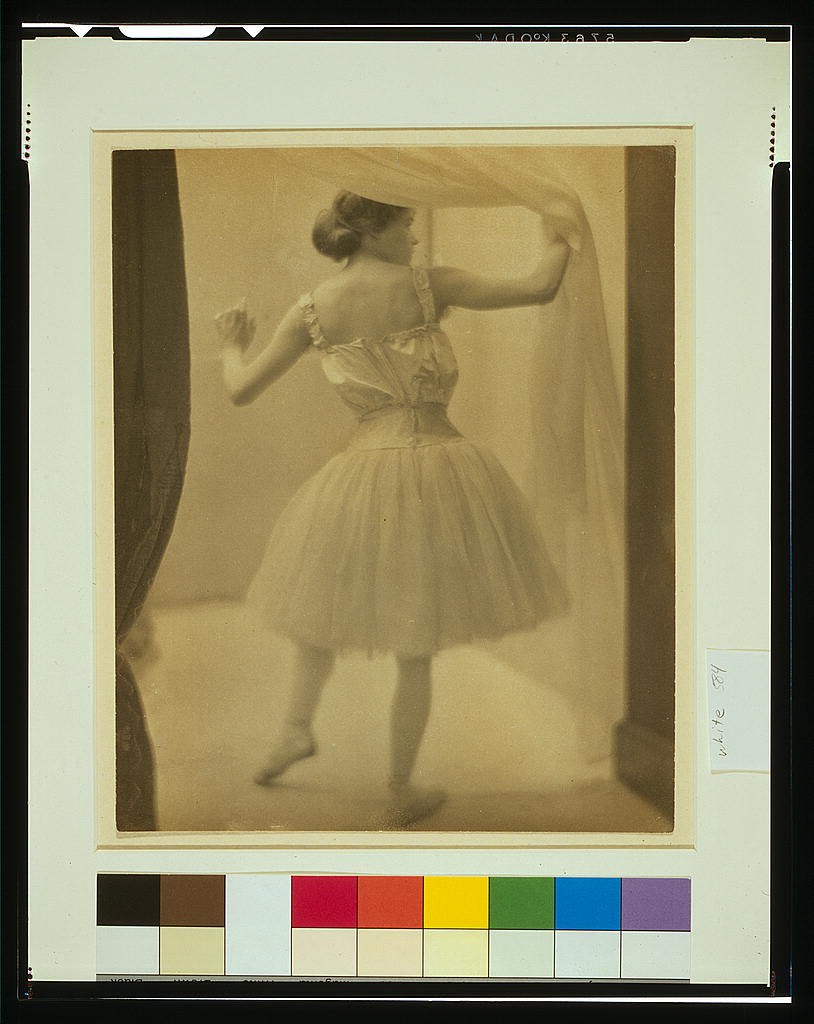
Study of a dancer
Unknown artist
- Collection:
- Prints & Photographs
- Source:
- Library of Congress
- Rights:
- Rights vary by item — check the source record before reusing this image. Source record ↗
- Recorded as:
- Library of Congress — no known restrictions (verify per item)
This photograph captures the aesthetic and technical standards of classical ballet at a moment when photography was becoming the primary means of documenting dance outside the theatre. It shows what dancers and teachers valued in the female ballet body of the era: verticality, extension, control, and a particular kind of 'line' that could only be achieved through years of disciplined training. For historians of dance and photography, it offers evidence of how the medium was enlisted to serve the pedagogical and promotional needs of theatrical dance in the early 20th century.
What you are looking at
A young woman in a sleeveless, short tulle skirt with a fitted bodice stands in profile within a shallow interior space defined by dark vertical elements on either side—likely curtains or doorframe. She faces left, her right arm raised and bent at the elbow, her left arm extended downward in a graceful line. Her posture is one of arrested motion: the body holds a careful balance, the torso slightly angled, the head turned to follow the direction of her gaze. The photograph is taken from a low vantage point that emphasizes her height and the lift of her frame. The soft, diffused lighting—characteristic of early 20th-century studio photography—creates a warm, almost ethereal tonality across the image. The composition suggests a moment of studied repose rather than vigorous action: this is a dancer caught between movements, or posed to demonstrate the line and carriage expected of the art form.
The dancing
A single dancer, young and slender, stands with her weight apparently held upward through the torso and legs. Her raised right arm suggests preparation for or completion of a movement requiring upper-body extension; the lowered left arm creates a counterbalance. The pose suggests training in classical technique—the body is aligned vertically, the limbs shaped carefully rather than relaxed. Her bare feet and the high hem of her skirt allow full visibility of the leg line from hip to toe. The overall carriage suggests a dancer of some training, posed to show off line and control rather than caught in dynamic action.
The dance depicted
This appears to be a study from the early 20th-century theatrical ballet tradition, likely made as a rehearsal photograph or a record of a dancer's training and technique. The short tulle skirt (a tutu), the fitted bodice, the bare feet, and the formal pose all align with classical ballet practice of the 1910s. The photograph serves the same function as a life drawing: to document the dancer's body in a position that demonstrates training, extension, and the aesthetic ideal of the period. The pose does not depict a narrative moment from a ballet but rather a technical study—a 'position' held for documentation.
How it was made
This is a gelatin silver print or albumen print, evidently a studio photograph made under controlled lighting. The soft focus and warm tonality are consistent with diffused studio lighting of the early 1910s. The photograph was taken with a horizontal format and preserved with a mount typical of archival photography of the era. The technique allowed for the creation of multiple prints from a single negative, suggesting this was circulated or kept as a record—likely used for teaching, documentation of a dancer's training, or as a memento of a performer's career. The presence of a color reference chart at the base suggests this may have been a reproduction or digitization reference.
About this work
This is a studio photograph of a ballet dancer from approximately 1910, presented as a technical study rather than a narrative or performance image. The dancer is posed to demonstrate line, extension, and the aesthetic standards of classical ballet training in the early 20th century. The work belongs in a gallery of dance art because it documents not a performance but the underlying discipline and visual ideal that governed theatrical ballet: the body trained to hold a particular shape, to embody a set of technical principles made visible. It is a record of how dancers of this period understood their own bodies and presented them for inspection and admiration.
How to look at it
Attend to the quality of the pose: this is not a snapshot of movement but a held, studied position. Notice the alignment of the body from foot through hip to the crown of the head—the vertical axis is the foundation of classical ballet training. The arm positions are not random but follow conventions: the raised arm suggests the preparatory or closing position used in many classical exercises and movements. The photograph was taken from a low angle, which elongates the figure and emphasizes the lift and extension the dancer is demonstrating. The bare feet and visible leg line are essential details, as they show the dancer's use of turnout (rotation from the hip) and the shape of the foot—markers of classical training.
The period
In the 1910s, photography was increasingly used to document and study dance technique. The studio portrait of a dancer in a training position or a signature pose was a common genre, circulated among dancers, teachers, and ballet companies. This photograph predates the widespread use of film and belongs to a moment when still photography was the primary visual record of how dancers looked and moved. The short tutu was standard in classical ballet training and performance of this period, and the bare feet were essential to the classical aesthetic. The pose itself reflects the influence of classical ballet on modern dance—by 1910, American and European modern dancers were beginning to assert alternatives to classical ballet training, but the classical ideal remained dominant in professional theatrical dance.
Where it lives
The photograph is held in the Library of Congress Prints & Photographs collection. The archival mark and color reference chart visible at the base suggest it is part of a larger documentation project or collection, possibly assembled for a public or institutional archive.
Dance in this work
Questions about this work
Is this a photograph of an actual performance?
No. This is a studio photograph made in a controlled setting, with the dancer posed to demonstrate technique and line rather than captured during a performance. It serves as a technical study—a record of training and aesthetic standards rather than a moment from a choreographed work.
What kind of ballet is this?
This is classical ballet, the dominant form of theatrical dance in the early 20th century. The tutu, bare feet, upright carriage, and formal pose all follow the conventions of classical ballet training. The photograph does not document a specific ballet but rather the underlying technique and visual standard that governed all classical ballet work.
Why was this photograph taken?
Studio photographs of dancers were made for several reasons: to document a dancer's training and development, to create promotional images, to provide visual records for teaching and choreography, and as mementos of a performer's career. This photograph likely served one or more of these purposes.
What does the dancer's pose tell us about classical ballet?
The vertical alignment, the extension of the limbs, the careful shaping of the arms, and the emphasis on the bare foot all reflect the classical ballet ideal of a trained, elongated, controlled body. The pose demonstrates the dancer's years of training and her ability to hold her body in a state of alert readiness and aesthetic refinement.
More dance artwork





