49 works in this view — arrow keys or swipe to move between them.
Dance in Art
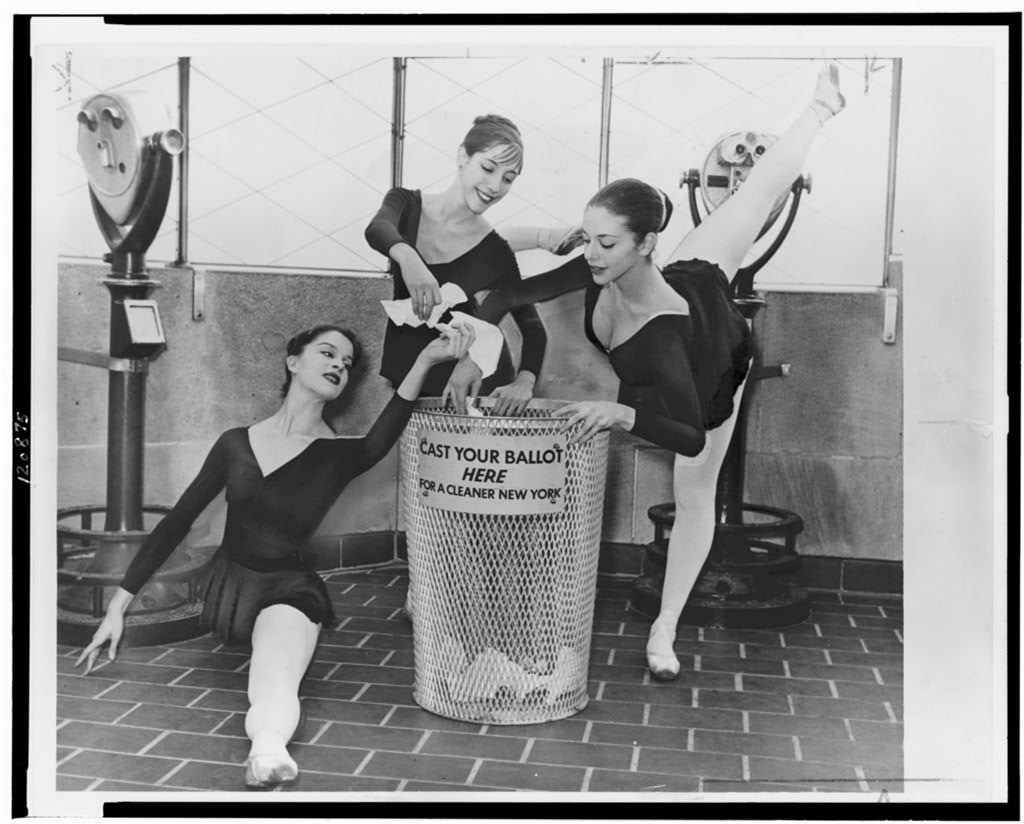
[Three ballerinas perform pas de trois as they cast ballots into trash can, atop the Empire State Building]
Unknown artist
- Collection:
- Prints & Photographs
- Source:
- Library of Congress
- Rights:
- Rights vary by item — check the source record before reusing this image. Source record ↗
- Recorded as:
- Library of Congress — no known restrictions (verify per item)
This image reveals how ballet was commodified and deployed in American civic culture at mid-century, treated not as a complete art form but as a visual vocabulary for refinement and authority. It also suggests an early, playful entry into what would become conceptual dance—using the formal language of ballet to frame and question ordinary social acts, a strategy that would intensify in experimental dance over the following decades.
What you are looking at
Four young women in black leotards and pointe shoes perform a staged ballet tableau in what appears to be an observation room or studio with a grid-marked ceiling and institutional walls. A large perforated metal waste bin labeled 'CAST YOUR BALLOT HERE FOR A CLEANER NEW YORK' stands center stage. Three of the dancers are actively placing ballots into the bin—one crouching, two bending forward in coordinated positions—while a fourth, seated in an elevated pose to the left, watches with an expression of satisfaction. The women's bodies are arranged in a formal compositional group; the floor is tiled in a brick pattern. Multiple coin-operated viewing machines (like those found on observation decks) are visible in the background, suggesting this was photographed at a public venue, possibly the Empire State Building observation level. The scene is a surrealist or satirical staging: ballet dancers engaged in civic participation.
The dancing
The four dancers are posed in a controlled, linear arrangement rather than a flowing ensemble. The woman at left sits with her weight lifted and her posture upright, suggesting a ballet sitting position. Two dancers bend forward at the waist with their upper bodies folded toward the ballot bin, legs extended behind, approximating a penché or arabesque-adjacent line. A fourth crouches beside the bin, gathered tightly. All four maintain the formality and elongation of trained ballet bodies; their arms are softly placed rather than emphatic. The composition emphasizes vertical lift and port de bras restraint, despite the absurdist action of voting.
The dance depicted
This is theatrical ballet, staged explicitly as a political or civic campaign tableau rather than as narrative dance. The dancers perform in classical ballet positions and carriage—pointe shoes, turnout, elongation—but the action is balletic *framing* applied to an anti-narrative act (voting into a trash bin). This appears to be a publicity photo or campaign document from a 1960 New York civic initiative ('For a Cleaner New York'), using ballet dancers as emblems of civility and order. The work is not a ballet in the traditional sense but a conceptual staging that weaponizes ballet's aesthetic of refinement and control for social messaging.
How it was made
This is a black-and-white photograph, likely a professional studio or press documentation image printed on glossy stock. The clarity and lighting suggest it was taken with a large-format or medium-format camera and developed to archival standard. The composition is carefully framed and level, indicating deliberate studio control rather than candid capture. As a photograph rather than a drawn or painted image, it documents an actual staged event; it circulated as a campaign or promotional artifact, making it a document of performance, publicity, and visual culture simultaneously.
About this work
This is a 1960 publicity photograph of a staged ballet tableau created to promote a New York City cleanliness campaign. Four trained ballet dancers in classical attire perform balletic positions around a civic voting bin, transforming an ordinary sanitation initiative into a surreal and refined visual spectacle. The image exemplifies mid-century American use of high-art forms—ballet specifically—as instruments of public relations and municipal messaging. It sits at the intersection of concert dance, conceptual theater, and political advertising: a moment when ballet's cultural prestige could be borrowed to make voting and cleanliness feel aspirational and graceful. The photograph itself is the artwork: a document of performance staged for the camera.
How to look at it
Observe how the photographer has applied the formal vocabulary of ballet portraiture—the lift, the alignment, the precise positioning—to an absurd premise: dancers treating a trash bin as the focal point of their composition. Notice the careful framing of each body; nothing is casual or incidental. The satire (if that is the intent) or the earnestness (if the campaign was sincere) depends on whether the viewer reads the juxtaposition as critique or celebration. The institutional setting—the grid ceiling, the viewing machines—grounds the image in a specific public place, making the ballet intrusion feel surreal. The women's expressions range from engaged to serene, adding to the uncanny formality of the scene.
The artist
The photographer is not recorded in the catalogue. The dancers and choreographer, if credited at all, are not identified. This anonymity is typical of campaign and publicity photography from the period; the image was made to serve the civic message rather than to advance an artist's name or vision. The work belongs to the genre of New Deal–era and post-war public relations photography that deployed professional performers and refined aesthetic forms in service of government and municipal initiatives.
The period
In 1960, ballet in America was experiencing a post-war cultural boom. The art form was increasingly framed as a marker of urban sophistication and civic pride; municipal governments invested in dance as a symbol of cultural advancement. Simultaneously, this was the beginning of a period in which experimental artists (particularly dancers influenced by John Cage and Merce Cunningham) were beginning to question the boundaries of dance by staging ordinary actions in concert contexts. The photograph captures a moment of tension between ballet's establishment status—its use by institutions to signal refinement—and the emerging avant-garde practice of defamiliarizing the everyday. The 'cleaner New York' campaign itself reflects mid-century anxieties about urban decay and the desire to market cities as orderly, cultivated spaces.
Where it lives
The photograph is held by the Library of Congress Prints & Photographs Online Catalog. It appears to be a press or campaign document from a 1960 New York City civic initiative, likely distributed to media outlets and municipal archives. Its inclusion in the LOC suggests it was deemed of documentary or historical significance.
Dance in this work
Questions about this work
Is this an actual ballet, or a staged photograph for a campaign?
It is a staged photograph created for a civic campaign promoting street cleanliness in New York. The dancers are positioned in ballet poses and use ballet's formal language, but the piece is not a narrative ballet or concert work. It is conceptual: ballet technique and aesthetic deployed to frame and elevate a municipal message. This makes it closer to performance art or publicity than to classical ballet theater.
Why use ballet dancers for a cleanliness campaign?
Ballet in 1960 America was a marker of refinement, civilization, and high culture. By positioning ballet dancers as the faces of civic order, the campaign implied that supporting cleanliness was an aspirational, cultured act. The juxtaposition of formal classical dance with a mundane civic duty lends dignity to the cause and appeals to urban audiences who valued the arts.
What does this tell us about dance in the 1960s?
It shows that ballet was established enough to be used as a symbol of civility and was considered appropriate for public campaigns. It also hints at experimental impulses emerging in dance at the same moment—the idea of staging ordinary actions in ballet form foreshadows conceptual and post-modern dance, which would soon challenge classical dance's separation from everyday life.
More dance artwork





