49 works in this view — arrow keys or swipe to move between them.
Dance in Art
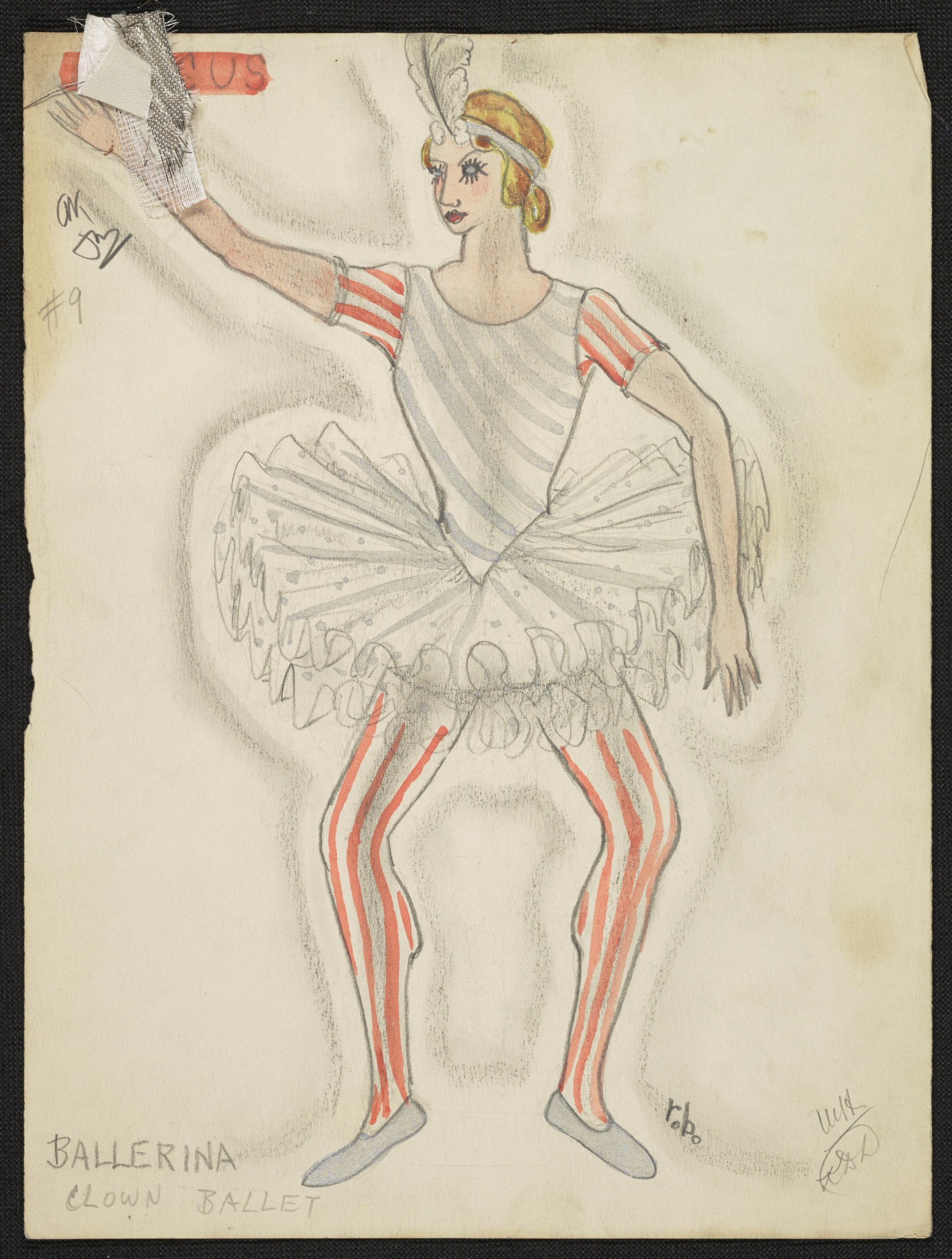
[Circus: Clown Ballerina: orange & white striped stockings with white and silver bodice and tutu]
Unknown artist
- Collection:
- Prints & Photographs
- Source:
- Library of Congress
- Rights:
- Rights vary by item — check the source record before reusing this image. Source record ↗
- Recorded as:
- Library of Congress — no known restrictions (verify per item)
The clown ballerina was a staple of early twentieth-century circus and music-hall performance, a character type that mocked ballet's pretensions through costume and movement. This sketch documents that tradition visually and preserves a specific interpretation of the character. For historians of circus, clown culture, or the relationship between high art (ballet) and popular entertainment, the work is direct evidence of how professional performers understood and used parody.
What you are looking at
A single figure in a theatrical pose dominates the composition: a performer in a striped costume, drawn in colored pencil or crayon with graphite outlines. The dancer stands in a wide, playful stance with one arm raised and bent, the other extended, as if mid-gesture. The costume consists of a plain pale bodice (silver or white) with short sleeves striped in coral-red and white, and matching coral-and-white striped stockings that cover the legs to gray ballet slippers. A tulle skirt billows outward from the waist, rendered in delicate pencil with minimal shading to suggest volume and lightness. The figure's face is turned in profile, painted with exaggerated theatrical makeup: a prominent red mouth, heavily lined eyes with long lashes, and blonde or honey-colored hair gathered under a headband or cap. The pose and the makeup emphasize performance and spectacle rather than classical form. The paper itself is aged cream-colored, with handwritten notations in the margins and catalogue stamps visible at the edges.
The dancing
One figure shown in full length, viewed from the front with the head turned three-quarter profile. The body is light and linear, the stance splayed and informal, far from the turned-out alignment of ballet training. The raised arm is bent casually rather than extended in a classical line; the lowered arm extends at an angle suggesting playfulness. The wide leg position and the bent knees (barely visible through the voluminous skirt) suggest a moment of balance or comedy rather than technical precision. The tulle skirt spreads in all directions, emphasizing breadth and burlesque theatricality over the vertical lift of classical ballet.
The dance depicted
This is a circus or music-hall performer, most likely a clown ballerina—a figure who parodies ballet training rather than embodying its ideals. The striped stockings and cartoonish makeup are classic clown signifiers, while the tulle skirt and ballet slippers reference classical ballet itself. This figure type was popular in early twentieth-century circus, vaudeville, and avant-garde theater. The exaggerated facial expression and the playful, off-balance pose confirm that the work documents performance comedy rather than straight dance technique. The inscription 'BALLERINA CLOWN BALLET' at the bottom confirms this reading and dates the costume concept to a specific tradition of theatrical parody.
How it was made
Executed in colored pencil or crayon over graphite sketch on wove paper, with some areas of heavier color saturation (the striped sleeves and stockings) contrasting with lighter washes and outlines. This is a costume design sketch or theatrical study rather than a finished artwork, in the tradition of early twentieth-century stage design documentation. The technique allows for rapid iteration and legibility: the stripes are crisp and the colors distinct even at small scale, suggesting the work was made as a practical guide for costume construction or as a record of a performed character. The age and wear of the paper, combined with the institutional markings, indicate this was archived by a theatrical or costume collection.
About this work
A costume design for a clown ballerina character, dating to 1934, rendered in colored pencil on paper. The work documents a theatrical type—the parodic 'ballerina'—that flourished in circus and music-hall performance in the early twentieth century. The figure wears the apparatus of classical ballet (tutu, ballet slippers, tulle) in combination with clown signifiers (exaggerated makeup, striped stockings, cartoonish proportions) to satirize ballet's formality. This is not a study of a real dancer but a costume concept that transforms ballet into comedy through deliberate contradiction.
The work belongs to a body of theatrical design documentation that treated the costume and the character as inseparable. The inscription and the systematic rendering of striped detail suggest the artist was recording a specific performed version of this character, likely for a circus or theatrical production. The figure's pose—splayed, informal, face turned in profile with an exaggerated expression—emphasizes the performer's intent to amuse rather than impress through technique.
How to look at it
Attend to the deliberate contradiction between the costume elements: the classical tutu and slippers are rendered with theatrical care, but placed on a body in an absurd, unstable pose. The face is the key to the character's intent—the exaggerated makeup and the three-quarter profile turn demand the viewer's recognition of the performer's awareness of the joke. The striping of the stockings and sleeves is rendered with graphic precision, making those elements read clearly even from a distance, which suggests they were the visual signature of the character in performance. Notice how the artist has avoided any rendering of technical skill in the body; the legs are not turned out, the posture is not lifted, and the overall effect is one of deliberate incompetence performed with confidence.
The period
In the 1930s, when this was drawn, circus was still a major form of entertainment in America, with large traveling shows employing specialist performers including clown-dancers. The tutu and ballet vocabulary had become iconic symbols of high art by this period, making them ripe for comic inversion. At the same time, avant-garde artists and designers (including those in Surrealism and the experimental theater movement) were interested in circus and clown performance as sources of spontaneity and anti-bourgeois critique. The figure of the clown ballerina sits at the intersection of popular entertainment and artistic parody.
Ballet itself was undergoing rapid evolution in this period: classical technique was being challenged by modern dance and by experimental choreographers. The clown ballerina character comments obliquely on these debates by refusing classical form entirely while retaining its visual symbols. The work is a record of a moment when ballet was still exotic and formal enough to be funny.
Where it lives
Part of the Prints & Photographs collection of the Library of Congress, accessioned from unspecified theatrical or costume archives. The object is catalogued as a single work and is likely one of many similar costume studies made in the same period. The inscription and catalogue marks indicate it was preserved as part of institutional documentation of performance.
Dance in this work
Questions about this work
Is this a real ballet dancer or a parody?
This is a parody—specifically, a clown ballerina character. The inscription confirms it: 'BALLERINA CLOWN BALLET.' The exaggerated makeup, the playful unstable pose, and the striped stockings are all signals that the performer is mocking ballet, not practicing it. The tutu and slippers are borrowed from classical ballet vocabulary but are worn by a character in comedy.
What does the striped costume mean?
The striped stockings and sleeves are classic clown signifiers—visual markers that identify the performer as a comic character rather than a serious artist. In circus and music-hall tradition, stripes, bright colors, and exaggerated patterns on clothing advertised the performer's commitment to comedy and spectacle. The contrast between the pure white bodice and the gaudy stripes emphasizes the deliberate clash of styles.
Where would you have seen this character perform?
In circus (particularly traveling circuses like those touring in America in the 1930s), in music halls or vaudeville theaters, and occasionally in avant-garde theatrical productions that borrowed from circus aesthetics. The clown ballerina was a specialist act: a performer who had trained in both clowning and dance and could execute the specific genre of ballet parody. This costume design would have been used by a single performer or company as their signature character.
Why did early twentieth-century audiences find this funny?
By 1934, classical ballet had become a symbol of refinement, formality, and European high culture. The clown ballerina's exaggerated face, unstable pose, and crude costume directly mocked that pretension through bodily contradiction: 'I have the apparatus of a ballerina but refuse to behave like one.' The humor relies on the audience's recognition of what real ballet looks like—the straighter and more formal their expectations, the funnier the parody becomes.
More dance artwork





