49 works in this view — arrow keys or swipe to move between them.
Dance in Art
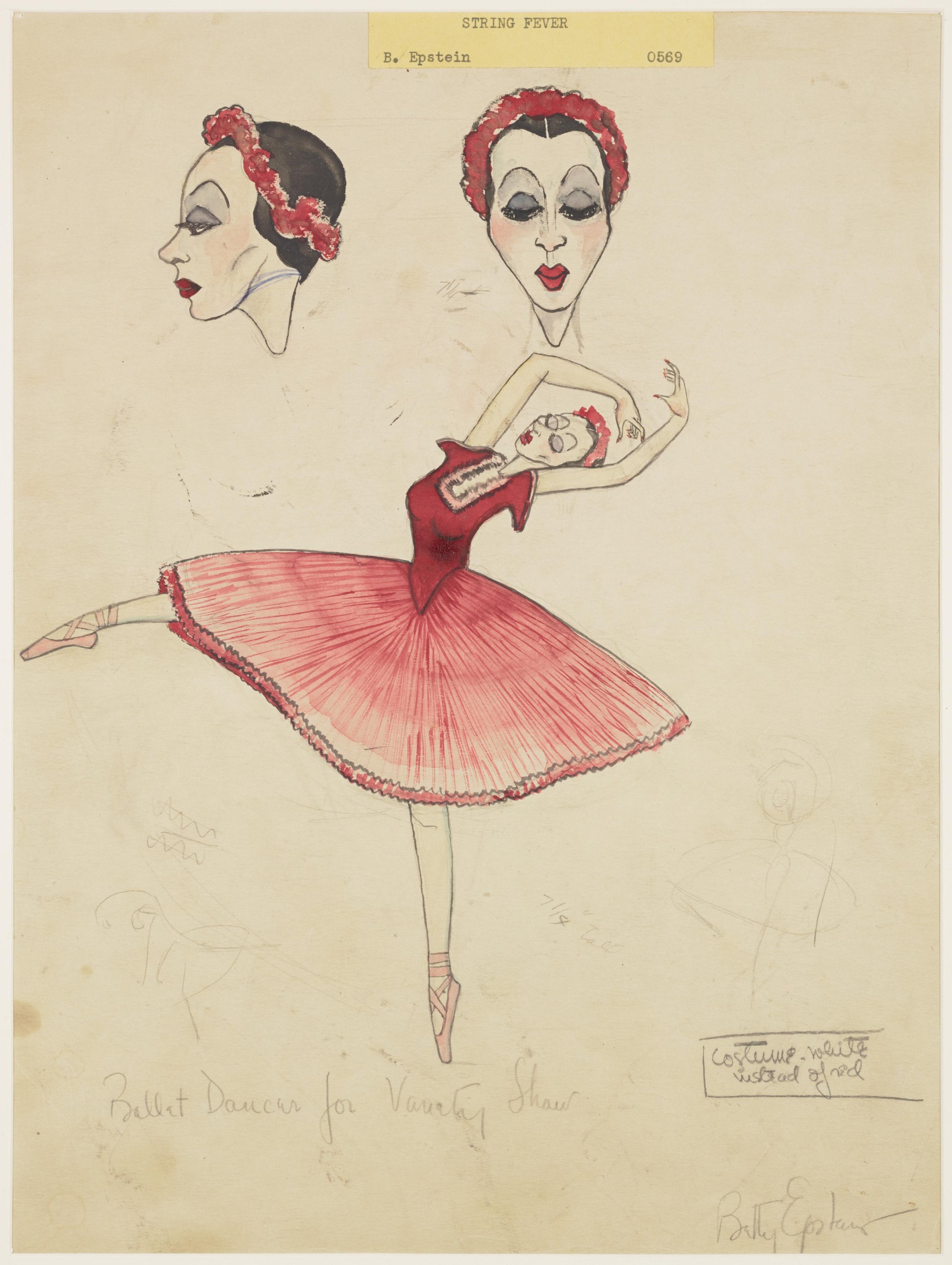
[String Fever(marionette): Ballet Dancer. Red ballerina costume with pink slippers and red flower crown.]
Unknown artist
- Collection:
- Prints & Photographs
- Source:
- Library of Congress
- Rights:
- Rights vary by item — check the source record before reusing this image. Source record ↗
- Recorded as:
- Library of Congress — no known restrictions (verify per item)
Marionette ballet reveals how thoroughly ballet had penetrated popular culture and design practice by the 1930s, to the point where even entertainment forms distant from human dance adopted its visual language. For historians and dancers, this work documents the aesthetic conventions of ballet as they were understood and deployed in non-human performance contexts, showing what aspects of ballet were felt to be essential enough to replicate in a puppet.
What you are looking at
A costume design sketch for a marionette ballet dancer, shown in three views: a profile of the head, a frontal face, and a full-length figure in dancing pose. The dancer wears a vivid red tutu with scalloped trim, a matching red bodice, pink pointe shoes, and an elaborate headdress of red flowers or feathers. The figure is captured mid-movement, balanced on the toes of one foot with the other leg extended, arms raised in a graceful port de bras. The sketch is executed in ink with hand-applied watercolor wash, on a cream paper ground showing age-related patina. The artist has used fine line for anatomical definition and bold color blocking for the costume elements, creating a design sheet that communicates both the character's look and the quality of movement intended.
The dancing
The full-length figure demonstrates classical ballet posture: elongated neck, squared shoulders, and a lifted sternum typical of academic ballet training. One leg is straightened and pointed, supporting the body's weight on the ball of the foot in a relevé or half-pointe position; the other extends behind or to the side in a gesture of balance and extension. The arms are positioned in a soft fifth position or in port de bras, showing understated upper-body articulation. The proportions—small head, long legs, arched feet—follow the conventional idealization of the ballet body as it was drawn in the early 20th century.
The dance depicted
This is a costume design for a marionette ballet dancer, created as part of theatrical puppet design rather than human ballet documentation. The notation 'Ballet Dancer for Variety Show' inscribed below the figure suggests the work was created for a vaudeville or variety performance, where puppet ballet interludes were popular entertainment in the early 20th century. The design draws directly from classical ballet vocabulary—the tutu, pointe shoes, flower crown, and turned-out positions—but is intended to be executed by a puppet, making this a record of theatrical design rather than human dance technique. Marionette ballets were a distinct genre of performance in early modern theater, blending puppetry, music, and the visual language of dance.
How it was made
This is an original drawing in black ink with hand-applied watercolor wash, characteristic of theater design practice in the early 20th century. The technique allows the designer to communicate both precise anatomical and costume details (through the line work) and the visual color and texture (through the wash). The sketch uses multiple views—a standard practice in costume design to allow the maker to understand the silhouette, proportion, and detail from different angles. The medium implies this was a working document made for a theater workshop or costume department, not a finished artwork for exhibition, suggesting its practical circulation within the entertainment industry rather than fine art institutions.
About this work
This is a costume design sketch for a marionette ballet dancer, likely created in the 1930s for a theatrical variety show or puppet performance. The work documents a moment when ballet language had become so pervasive in popular entertainment that puppet ballet was a viable theatrical form. The sketch shows careful attention to the conventions of classical ballet—the turned-out position, the pointe shoes, the formal headdress—but miniaturized and adapted for puppet construction. It belongs in a dance art collection because it demonstrates how ballet aesthetics shaped entertainment design across media, and because puppet ballet was a legitimate performance practice with its own audiences and technical traditions. The inscription attributes it to designer B. Epstein and records it in a catalog system, suggesting it was preserved as part of a theatrical archive or costume collection.
How to look at it
Attend to the clarity with which the artist has conveyed ballet position and proportion in miniature. The three views—profile, frontal, and full-length—are arranged to give a costume maker all necessary information. Notice the deliberateness of the pose: the dancer is not captured in a frozen moment of drama, but in a posed, teachable position that displays the tutu, the turn-out, and the line of the leg. The red-on-cream color scheme is striking and would have read clearly across a theater stage or in the pages of a design folio. The headdress is given particular attention, suggesting it was a key element of the character's identity or theatrical effect.
The artist
The artist is identified in the record only as 'B. Epstein,' with no further biographical information given. The catalogue record notes this as a design work (C869) within a collection of costume and theatrical materials, suggesting Epstein worked as a theater designer or costume specialist in the early 20th century. No additional details about training, nationality, or other works are provided.
The period
Marionette ballet flourished in European and American theaters during the 1920s and 1930s, as a form of experimental theater and variety entertainment. This period coincided with the international success of the Ballets Russes, which had made ballet a central mode of modernist theatrical culture. The ballet's influence extended well beyond concert dance into fashion, illustration, and mass entertainment; puppet ballets were one expression of this penetration. The early 1930s setting of this work places it in the final years before World War II disrupted European theatrical life, when variety shows and vaudeville were still major forms of popular entertainment.
Where it lives
This work is held in the Library of Congress Prints and Photographs collection (catalog number C869), where it was recorded as part of theatrical design or costume holdings. The inscriptions and catalog information suggest it was preserved as a working document within theater archives, rather than acquired for fine art purposes.
Dance in this work
Questions about this work
Was marionette ballet a real performance form?
Yes. Puppet ballet was an established theatrical genre in Europe and America, particularly from the 1920s through the 1940s. Performances ranged from intimate salon events to large-scale stage productions, often appearing in variety shows or as interludes in theatrical programs. The form combined puppetry skill, classical music, and ballet aesthetics to create a distinct performance experience.
How would this design have been used?
This sketch served as a costume design template: a reference document for the puppet maker or costume specialist to construct the bodice, tutu, and accessories, and to understand the character's appearance from multiple angles. The three views would allow different makers to work on different parts without constant consultation.
Why does a puppet dancer wear pointe shoes?
The pointe shoe was a visual marker of classical ballet identity by the 1930s. Even though a marionette cannot physically perform the biomechanical work that pointe technique requires in human dancers, the shoe signals to the audience that this figure is a 'ballet dancer' in the classical tradition. It is a costume element communicating character and genre rather than a functional tool.
Is this a famous design or performance?
The work is not readily identified with a major or well-documented marionette ballet production. It remains a minor example of theatrical design practice from the period, preserved in the Library of Congress collection but not extensively documented in secondary literature about puppet theater or ballet history.
More dance artwork





