49 works in this view — arrow keys or swipe to move between them.
Dance in Art
The Minuet
Unknown artist
- Collection:
- Prints & Photographs
- Source:
- Library of Congress
- Rights:
- Rights vary by item — check the source record before reusing this image. Source record ↗
- Recorded as:
- Library of Congress — no known restrictions (verify per item)
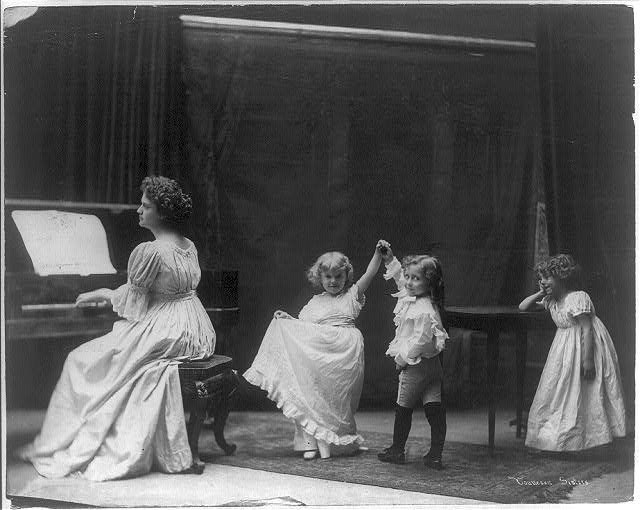
The image shows the minuet not as a historical curiosity preserved in museums or theaters, but as a living—if strictly formal—practice within the home and the social order. For dance historians, it is evidence of how historical dance forms were taught and valued in their own moment, and what dance instruction looked like before the professionalization of dance pedagogy. For social historians, it captures a vanished world of domestic refinement and the role of movement and music in the marking of class.
What you are looking at
A woman in a pale Edwardian tea gown sits at a piano, her attention turned toward three children and a young girl in white dresses who are dancing or learning to dance in the parlor behind her. The scene is lit from a high window, casting soft light across the polished floor. The composition suggests an informal music lesson or domestic dance instruction: the pianist provides accompaniment while the children move through the steps, their bodies arranged in a loose formation that suggests both play and tutelage. The setting is genteel and domestic—a well-appointed room of the Gilded Age with dark walls and simple furnishings—and the mood is one of leisured instruction, the kind of accomplishment expected of well-bred children.
The dancing
The pianist sits upright at the keyboard, her posture formal and attentive. The dancing children are arranged informally; one stands with arms raised or extended, two others appear to be in motion or waiting, and a fourth child stands to the right observing or preparing to participate. None of the children adopts a balletic turnout or theatrical frame. Their arms and bodies are relaxed and natural rather than trained. The spacing and the informal grouping suggest social dance instruction rather than staged performance or professional training.
The dance depicted
The title identifies this as a minuet, the formal courtly dance of the eighteenth century that remained a staple of children's dance instruction well into the twentieth. By 1901, when this photograph was taken, the minuet was taught to children of the upper classes as a matter of etiquette and refinement, not as a living social form. The image captures a domestic lesson in this historical dance form, likely one in a series of social accomplishments—along with music and deportment—that constituted a gentleman or gentlewoman's education. The relaxed posture and informal arrangement of the children suggest this is instruction in basic steps and courtesy rather than performance preparation.
How it was made
This is a gelatin silver print, a photographic medium that by 1901 was the standard for commercial and documentary photography. The photograph captures a fleeting domestic moment with the natural light and tonal subtlety possible only in the photographic medium. The grain and slight soft focus are characteristic of early twentieth-century portrait and genre photography. The ability to reproduce the image mechanically meant it could circulate widely, whether as a press photograph, an illustration, or a personal keepsake—making it an accessible record of how the educated classes taught their children to move.
About this work
This photograph documents a private dance lesson in the minuet, a centuries-old courtly form that by the early twentieth century had become a matter of social instruction rather than active practice. The image captures not virtuosity but pedagogy—an Edwardian drawing room in which music and movement are part of the curriculum of gentility. The work sits at the intersection of two histories: the long life of the minuet as a marker of refinement, and the role of photography in making such intimate domestic scenes visible and reproducible. It is a record of how the upper-middle class transmitted taste and manners through the body.
How to look at it
Notice the contrast between the formality of the title and the informality of the scene. There is no stage, no audience, no elevated position for the dancers; the children stand on the same domestic floor where they would play or sit. Watch the position of the pianist—she is part of the lesson but not watching the dancers, suggesting that the music itself is as important as the steps. The title 'The Minuet' makes the photograph historical: it tells us that what we are witnessing is not a game or free play, but the transmission of a specific, named dance form, now reduced to a matter of instruction and propriety.
The period
The minuet originated in the French court in the seventeenth century and remained the most prestigious social dance through the eighteenth century. By the Gilded Age, it had long ceased to be danced socially; instead, it was taught to children—particularly girls—as a marker of breeding and education, alongside piano, French, and needlework. The photograph dates to 1901, an era in which such domestic accomplishments were still expected of the daughters of the prosperous, though the twentieth century would rapidly erode the social weight of such instruction. The image documents a moment of transition, in which the minuet was already becoming historical even as it was still being taught.
Where it lives
The work is held in the Library of Congress Prints & Photographs Online Catalog (loc.gov), a major repository for American documentary and commercial photography of the late nineteenth and early twentieth centuries. It is catalogued by title but with no named photographer, suggesting it may have been a press photograph, a commercial print sold for domestic use, or a documentation of social customs.
Dance in this work
Questions about this work
What is the minuet and why would children be learning it in 1901?
The minuet was the most prestigious courtly dance of the seventeenth and eighteenth centuries, but by 1901 it was no longer danced socially. Instead, it was taught to upper-class children—especially girls—as part of their education in refinement, etiquette, and 'accomplishments,' alongside music and languages. It signified breeding and social position, even though no adult would dance it except in historical revivals or theatrical contexts.
How do we know this is actually a minuet and not some other social dance?
The title is our primary evidence. The photograph itself does not show clear enough footwork or formal enough positioning to identify the dance style from movement alone. However, the domestic setting, the informal instruction, and the presence of children all fit the historical practice of teaching the minuet to young people as a social accomplishment.
Why is the woman at the piano not watching the dancers?
In dance instruction, the music is the primary guide; a competent pianist does not need to watch the dancers to provide proper accompaniment. The separation also reflects the practical reality: a child learning by watching the teacher's feet cannot do so if the teacher is seated at a piano. The lesson is structured around the music, not the visual demonstration.
More dance artwork





