49 works in this view — arrow keys or swipe to move between them.
Dance in Art
Minuet
Unknown artist
- Collection:
- Prints & Photographs
- Source:
- Library of Congress
- Rights:
- Rights vary by item — check the source record before reusing this image. Source record ↗
- Recorded as:
- Library of Congress — no known restrictions (verify per item)
This print documents the minuet not as an abstract choreography but as a lived social practice in aristocratic households—a dance learned, taught, performed, and witnessed in intimate domestic settings. It shows the minuet as a space of courtship and the display of female grace and male attentiveness, central to how young people of rank were introduced into society. For historians of dance pedagogy and social ritual, the image records the posture, carriage, and audience structure that underpinned one of Europe's most influential court dances.
What you are looking at
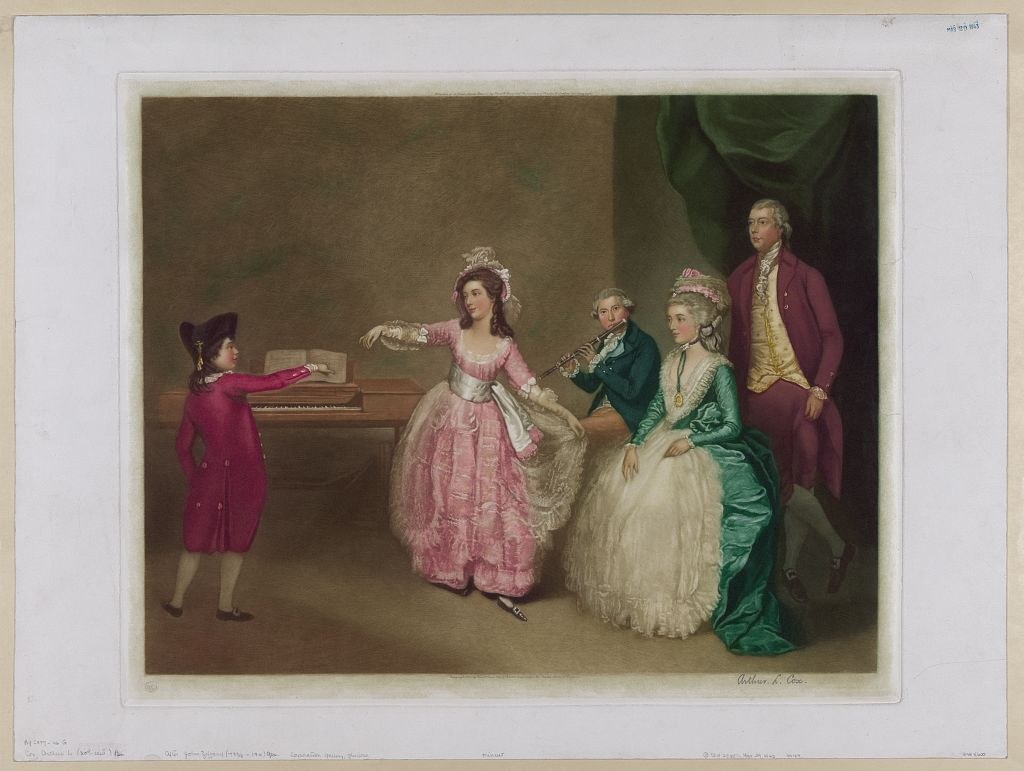
A formal drawing room scene depicting a music lesson or social gathering centered on a keyboard instrument. A young boy in a vivid magenta coat stands at the left, turned toward the keyboard; a elegantly dressed young woman in pink silk with an ornate headdress stands center-left, one arm extended gracefully. To her right, seated, are two women in formal dress—one in white with an elaborate headdress, the other in emerald silk—both attending to the scene. Behind them stand two men in burgundy velvet coats with yellow waistcoats, observing. The setting is austere: neutral-toned walls, dark drapery at the upper right, warm floor. The light is soft and diffused, focusing attention on the figures in their costly dress. The composition suggests a moment of performance or instruction rather than active dancing—a pause in which the figures are posed for maximum visibility and elegance.
The dancing
The central woman holds an upright posture with one arm raised and extended, a gesture of deportment or grace rather than active movement. Her body faces slightly toward the keyboard but her head turns toward her companions, creating a social triangle. The boy's stance is attentive and formal. The seated women are still, focused observers. The standing men are static witnesses. There is no dynamic weight transfer, no footwork, no closed or open hold between partners—the bodies are arranged for display and social interaction rather than the rapid, repetitive motion characteristic of partner dance. The overall frame is one of stillness and composed attention.
The dance depicted
This image most likely depicts a minuet—the title supports this—but as a social accomplishment or lesson rather than an active dance in progress. The minuet was the most formal and widely taught court dance of the eighteenth century, essential to the education of young people of rank. The scene appears to show instruction or demonstration: the young woman's lifted arm and composed posture exemplify the controlled elegance the minuet required, while the boy and assembled witnesses suggest a teaching moment. No couple is in the characteristic minuet hold or demonstrating the characteristic stepped pattern (Z-shaped floor track with measured processional steps). Instead, the image emphasizes the minuet as a marker of refinement and status, performed before an appreciative audience in a private interior.
How it was made
This is a hand-colored engraving or print, likely from the late eighteenth or early nineteenth century, as evidenced by the fine stippled and linear work creating volume and texture in the drapery, the soft modeling of flesh, and the careful attention to costume detail. The colorist applied translucent pigment to define the silk textures and jewel tones (magenta, emerald, pink, cream) that signal wealth and fashion. The technique allowed wide circulation—this print could be distributed to readers across Europe as an image of polite accomplishment, making it both a record of dance practice and a prescriptive visual lesson in gentility. The print medium suggests this was a published illustration, likely from a book on manners, dance instruction, or fashionable life.
About this work
This is a formal interior scene depicting a minuet as an act of social cultivation and display rather than as vigorous partner dancing. The composition—with a young woman as the focal point, her posture exemplifying grace and control, surrounded by observers—shows the minuet as a rite of aristocratic or upper-bourgeois education. The careful rendering of dress, setting, and the stillness of the moment all underscore the minuet's role not as a physical feat but as a performance of refinement. It belongs in a dance gallery because it documents how the minuet functioned in practice: as a disciplined, highly visible social accomplishment, taught to young people and witnessed by assembled company in a domestic setting.
The work is valuable as evidence of the minuet's pedagogical and social role in the period. Rather than capturing the fluidity of the dance itself, it freezes the moment of instruction or demonstration, making visible the posture, arm carriage, and composed bearing that the minuet demanded. The image thus tells us not just that the minuet was danced, but how it was understood: as an essential skill, a marker of status, and a ritual of courtship and social bonding.
How to look at it
Attend to the young woman's posture and raised arm: this is the image's central teaching gesture, showing the minuet's essential requirement—an upright, composed carriage with controlled arm movement and a small, pointed foot. Notice how her body is still but legible, designed for visibility from all angles. Watch how the other figures arrange themselves as an audience, their gazes directing the viewer's attention to the woman and boy: this composition teaches that the minuet was a spectacle of courtship and refinement, not a private pleasure. The formal symmetry and stillness of the scene—its lack of energy or blur—tell you that this is a moment of instruction or demonstration, not a dance in full motion.
The period
The minuet dominated European ballrooms and drawing rooms from the seventeenth through the late eighteenth century. By the period suggested by this image's style and fashion (likely 1770s–1800s), the minuet had become less a dance of courtship and novelty and more a formal ritual—the opening dance of a ball, a test of breeding, and a subject of instruction. Dance masters published treatises and prints teaching its steps and deportment; young people, especially women, studied it as part of their education. This print belongs to a wider genre of didactic imagery about manners and accomplishments aimed at the middle and upper classes. The formal interior and careful arrangement of figures reflect Enlightenment ideals of reason, order, and the cultivation of taste through art and dance.
By the early nineteenth century, when this image was likely circulated, the minuet was already becoming historical—a tradition rather than a living practice—yet it remained a marker of education and refinement. Images like this one preserved its memory and its prescriptive power, teaching viewers (through visual example) how grace, attention, and formal movement embodied social order.
Where it lives
Held in the Library of Congress Prints & Photographs collection, this is a reproduction print, likely from a published series on manners, dance, or fashionable life. The hand-coloring and engraving technique suggest late eighteenth-century or early nineteenth-century circulation, probably as an educational or aspirational image for the middling and upper classes.
Dance in this work
Questions about this work
Why aren't they actually dancing?
This image shows the minuet as a demonstration or lesson rather than an active dance. The young woman is posed to display the correct carriage and arm position, while the surrounding figures watch and learn. The minuet was so formalized and so central to education that images of it often froze a moment of instruction or presentation rather than capturing the motion of the steps. The stillness makes the refinement visible.
Who would have danced the minuet?
The minuet was the preeminent dance of the European aristocracy and upper bourgeoisie from the seventeenth to the late eighteenth century. Young people—especially young women—learned it as an essential social skill. This image depicts exactly that: a young person (likely a debutante or young noblewoman) being instructed or presented before witnesses in a wealthy household.
What is the keyboard instrument?
It appears to be a harpsichord or early piano. The minuet was almost always danced to keyboard accompaniment, and the presence of the instrument indicates that music and dance are inseparable here. The boy at the keyboard may be preparing to play, or the instrument may simply establish the context of a music lesson.
What do the clothes tell us?
The elaborate headdresses, silk fabrics, and costly tailoring mark these as people of wealth and rank. The young woman's pink silk gown with ornate trim, the men's burgundy velvet coats, and the intricate white headdress of the seated woman all signal aristocratic or upper-bourgeois status. Costume was central to the minuet's social meaning—it was a dance for the dressed, the visible, the observed.
More dance artwork





