49 works in this view — arrow keys or swipe to move between them.
Dance in Art
The minuet
Unknown artist
- Collection:
- Prints & Photographs
- Source:
- Library of Congress
- Rights:
- Rights vary by item — check the source record before reusing this image. Source record ↗
- Recorded as:
- Library of Congress — no known restrictions (verify per item)
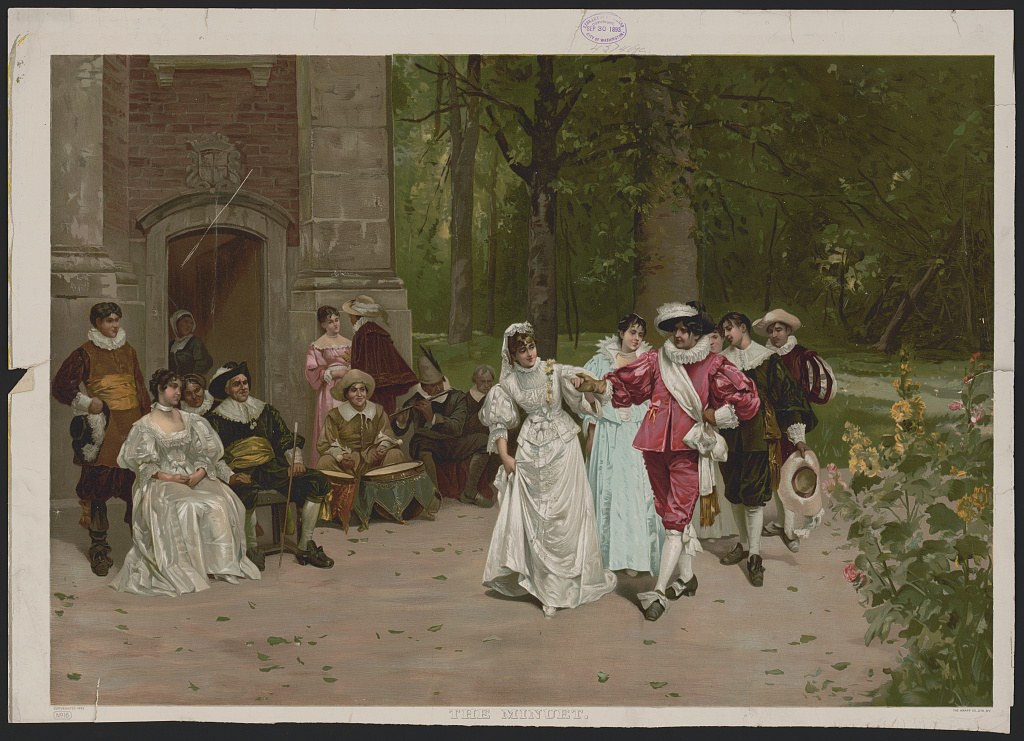
For dancers and historians, this image captures how the minuet was remembered and idealized nearly 200 years after its heyday—not as a living practice but as a symbol of grace, order, and lost refinement. The work reveals the late 19th-century fascination with historical dance and courtly ceremony as touchstones of elegance, a fascination that shaped revival movements and period-dance pedagogy.
What you are looking at
A formal gathering in a neoclassical garden or courtyard, where elegantly dressed figures enact a minuet. The setting combines architecture—a brick building with arched doorways visible on the left—with mature trees creating a shaded arcade on the right. The ground is a pale courtyard or plaza scattered with fallen leaves. The composition divides into two groups: on the left, seated and standing figures in jewel-toned velvets and golds observe the action; on the right, the dancers themselves move in the open space, the women in white and pale blue gowns with elaborate headdresses, the men in deep red and burgundy silks with plumed hats. The lighting is soft and dappled, suggesting late afternoon. The scene captures a moment of performance within courtly leisure—this is a dance staged for an audience rather than a spontaneous social event.
The dancing
The dancers occupy the right two-thirds of the composition. The central pair—a woman in white with an elaborate headdress and a man in red—appear to be in or near a closed hold, with their bodies oriented toward each other in the formal frame of the minuet. Their posture is upright and controlled, the woman's gown falling in classical folds. Several other dancers wait nearby in similar dress: two women in pale gowns cluster behind the central couple, and further right stand additional figures in plumed hats. The overall frame is vertical and formal, with no sprawling or athletic extension—every body holds an aristocratic composure. The footwork is not sharply visible, but the stance suggests weight on the balls of the feet and a lifted carriage throughout.
The dance depicted
This is a minuet, almost certainly a Baroque or early 18th-century court minuet represented as a historical or fanciful revival. The minuet was the dominant courtly dance across Europe from the 17th through 18th centuries and remained fashionable in aristocratic circles well into the 19th century. The formal hold, the upright posture, the ornate dress, and the presence of onlookers all align with minuet performance in court settings. The painting appears to be a 19th-century Romantic evocation of earlier court life rather than a record of actual contemporary practice—the style and composition suggest nostalgia for a perceived golden age of courtly ceremony. The dancers display the controlled elegance and measured pacing the minuet demanded.
How it was made
This is a color lithograph or chromolithograph, evident from the soft transitions between hues, the flat but luminous greens of the foliage, and the ability to render both delicate fabrics and architectural detail without line-work dominating. The technique allowed for wide circulation as a fine art print in the late 19th century, suggesting this was a popular image—something a middle-class household might own to display historical or romantic sentiment about court life. Lithography enabled the artist to build tone through multiple stone passes, achieving the atmospheric depth and the jewel-like quality of the costumes.
About this work
This is a chromolithograph from 1893 depicting a minuet performed in a formal courtyard setting. The work is an imagined recreation of 18th-century court dance, rendered in the Romantic idiom of the late Victorian era—a period of intense nostalgia for aristocratic forms and courtly ritual. The composition balances observation and participation: some figures dance while others watch, establishing the minuet as a social performance as much as a choreographic event. The work belongs in a dance archive both as a historical document of how the minuet was understood and aestheticized in the 1890s and as evidence of the Romantic period's appetite for visualizing earlier modes of courtly life.
How to look at it
Attend to the stillness and formality of the pose: the minuet was not a dance of large movements or partnered travel across the floor, but rather a carefully choreographed sequence of small steps, turns, and bows performed in a relatively fixed area. The artist has frozen the dancers in an upright, facing moment—likely a révérence or the beginning of an advancing phrase. Notice how the onlookers position themselves: they frame the dancers and establish this as a performance, not a social partner dance. The jewel-toned velvet against the pale gowns, and the plumed hats against the elaborate headdresses, signal the courtly context through color and texture.
The period
In 1893, European ballroom dancing was undergoing rapid change: the waltz and newer Latin dances were displacing older court forms. Simultaneously, a wave of historicism swept through the arts, with painters and printmakers reviving medieval, Renaissance, and Baroque subjects as expressions of cultural longing during rapid industrialization. The minuet, already defunct as a living social dance for most of Europe, became a symbol of refinement and aristocratic order. Lithography was at its commercial peak, allowing popular art to circulate widely, and scenes of historical courtly life were frequent subjects for middle-class consumption.
Where it lives
The work is held in the Prints & Photographs collection of the Library of Congress, a major repository of 19th-century popular imagery. It is a color lithograph, a commercial print medium that circulated in editions, suggesting it was intended for a broad audience.
Dance in this work
Questions about this work
Was this a real event, or did the artist imagine it?
This is almost certainly an imaginative recreation. By 1893, the minuet had not been danced as a living social practice for over a century. The artist created a Romantic vision of 18th-century court life, combining accurate historical details of dress and setting with an idealized vision of courtly refinement. Such historical fantasies were enormously popular in late-Victorian art.
How do you know this is a minuet and not another Baroque dance?
The title of the work is "The Minuet," and the formal upright posture, the paired dancers in a close frame, the presence of onlookers, and the courtyard setting all match contemporary records of minuet performance. The minuet was also far more widely represented in art and popular imagination than other Baroque forms.
Why did people in the 1890s care about the minuet?
The minuet had come to represent an idealized past of grace, order, and aristocratic refinement at a time when industrial society felt chaotic and new. Reviving it—in art, in historical pageants, and in some dance instruction—allowed the middle and upper classes to imagine themselves connected to an older, more ordered world.
More dance artwork





