49 works in this view — arrow keys or swipe to move between them.
Dance in Art
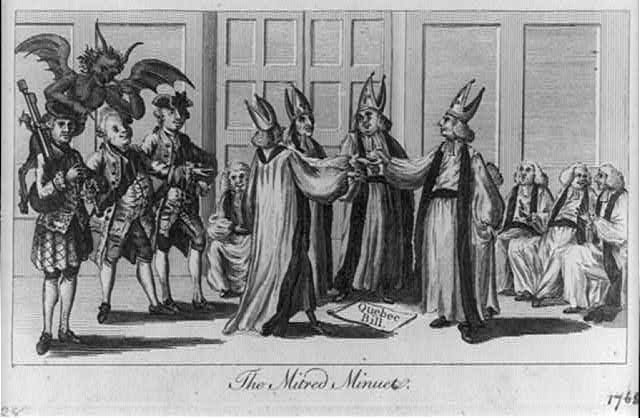
The mitred minuet
Unknown artist
- Collection:
- Prints & Photographs
- Source:
- Library of Congress
- Rights:
- Rights vary by item — check the source record before reusing this image. Source record ↗
- Recorded as:
- Library of Congress — no known restrictions (verify per item)
This print reveals how deeply the minuet was embedded in 18th-century political consciousness as a symbol of authority and hierarchy. The fact that a satirist could use the pose and title of the minuet as a weapon against the church demonstrates the dance's central role in elite culture and its vulnerability to ridicule. For historians of dance and visual culture, it shows how formal dance notation and performance were inseparable from questions of power, class, and institutional legitimacy.
What you are looking at
A satirical engraving depicting an ecclesiastical procession masquerading as a minuet. At left, three figures in elaborate clerical dress—bishops or high churchmen identifiable by their mitres (tall ceremonial headdresses) and rich vestments—gesture and posture as though leading or participating in a formal dance. Their poses are exaggerated and absurd: one leans back with arm extended, another gestures expansively. At right, a group of seated onlookers in 18th-century dress observes the spectacle with evident amusement or derision. The setting is an interior with tall paneled doors and windows visible in the background. The entire composition reads as political or religious satire, mocking the pretension of ecclesiastical ceremony by framing it as courtly dance—a collision of sacred and secular worlds rendered ridiculous through their juxtaposition.
The dancing
The three clerical figures adopt balletic or courtly poses that parody formal dance carriage: high arm positions, exaggerated weight shifts, and theatrical extensions of limbs. Their bodies are stiff and grotesque rather than graceful, suggesting mockery rather than skillful execution. The pose most resembles a minuet's formal presentation stance rather than active stepping or turning. The onlookers sit passively, their posture and expressions suggesting they are audience to a performance or spectacle rather than participants.
The dance depicted
The work presents the minuet—the most formal and hierarchical of 18th-century court dances—as a vehicle for satire. The minuet was danced in pairs in strict geometric patterns and was central to aristocratic social life and court ceremony. Here, the substitution of bishops for courtiers and the grotesque rendering of formal dance pose suggests the engraver is mocking either ecclesiastical pomposity, court pretension, or both. The title directly names the minuet, but the execution is purely satirical; no actual minuet instruction or technique is demonstrated.
How it was made
This is an engraving, executed with fine parallel lines and cross-hatching to create tone and texture. The technique allows for sharp, precise delineation of costume detail—the bishops' mitres, robes, and insignia are rendered with careful attention—and for the exaggerated facial expressions and gestures that drive the satire. The date 1774 and the style place it within the tradition of political and social satire that flourished in 18th-century prints, which relied on engraving's ability to circulate widely and inexpensively. The composition and execution suggest this was created for broad public consumption rather than as a private commission.
About this work
"The Mitred Minuet" is an 18th-century satirical engraving that weaponizes the minuet—the most formal of court dances—against ecclesiastical authority. By positioning bishops in balletic poses and framing their gestures as dance, the engraver collapses the boundary between sacred ceremony and frivolous courtly display, rendering both ridiculous. The work belongs in a dance gallery not because it documents actual minuet practice, but because it exploits the minuet's symbolic weight as a marker of aristocratic refinement and social order. Satire was one of the most important contexts in which the minuet appeared in visual culture; attacks on it were attacks on the class structure it embodied.
How to look at it
Attend first to the poses of the three bishops: their exaggerated arm positions and theatrical stances are meant to be read as simultaneously balletic and absurd. The artist has chosen a moment of formal presentation rather than stepping or turning—the pose that would be held at the beginning of a minuet when partners acknowledged one another. Notice how the careful rendering of their ecclesiastical dress (the mitres, the heavy robes) makes their adoption of courtly dance posture seem even more incongruous. The watching figures on the right frame the scene as a performed spectacle, inviting the viewer to share their perspective of mockery.
The period
The minuet reached its apex of social and cultural importance during the 18th century, dominating court life across Europe and serving as the foundation of all formal dance training. By the 1770s, when this print was made, the minuet had already begun to seem old-fashioned to younger, more radical thinkers; faster, more passionate dances (the waltz, the contredanse) were gaining ground. Satirical prints were a major medium for political and social critique in 18th-century Britain and the continent, and attacks on the clergy and on aristocratic pretension were common subjects. This engraving sits at the intersection of anti-clerical satire and mockery of outdated courtly manners.
Where it lives
Held by the Prints & Photographs collection at the Library of Congress. The work is catalogued as a print from 1774, though the artist is not recorded. It is a single-sheet engraving intended for distribution and sale.
Dance in this work
Questions about this work
Is this actually about the minuet as a dance?
Not in the sense of documenting how it was danced. The minuet here is a symbol—a shorthand for courtly refinement and social hierarchy. The engraver uses the minuet's name and formal poses to mock the pretension of the clergy, not to celebrate or explain the dance itself. If you want to see how the minuet was actually performed, you would need to look at dance notation, instructional books, or paintings that document actual balls.
What does 'mitred' mean?
A mitre is the tall, pointed ceremonial headdress worn by bishops and other high-ranking clergy. It is one of the most distinctive symbols of ecclesiastical authority. By calling this "The Mitred Minuet," the engraver is naming the figures by their most recognizable attribute and using that attribute to make the satire work: the clash between sacred vestment and secular courtly dance is the joke.
Who would have seen this print and understood it?
Anyone literate in the visual language of 18th-century court and church. The minuet was not obscure—it was the dance that every aristocrat and aspiring middle-class person learned. Anti-clerical sentiment was widespread in the 1770s, especially in France before the Revolution. A person viewing this would have immediately grasped that the artist was mocking both ecclesiastical pomposity and the artificiality of court ritual.
Why would someone satirize the minuet?
The minuet was not just a dance; it was a system of social order. It taught hierarchy, formality, and subordination of individual will to collective decorum. To mock the minuet—or to mock figures adopting minuet poses—was to question the entire social structure it embodied. Satire of the minuet was satire of the class system itself.
More dance artwork





