49 works in this view — arrow keys or swipe to move between them.
Dance in Art
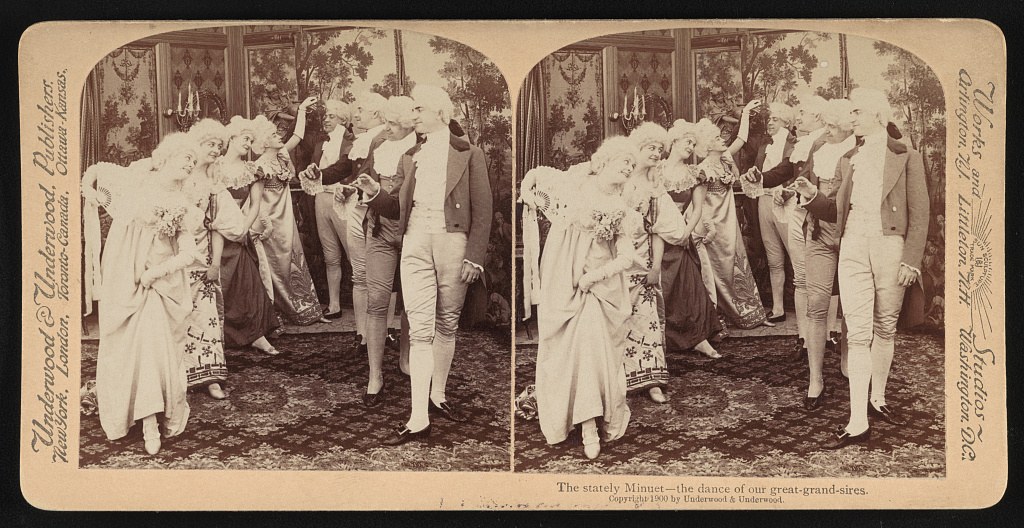
The stately minuet - the dance of our great-grand-sires
Unknown artist
- Collection:
- Prints & Photographs
- Source:
- Library of Congress
- Rights:
- Rights vary by item — check the source record before reusing this image. Source record ↗
- Recorded as:
- Library of Congress — no known restrictions (verify per item)
This work documents a crucial moment in dance history: the minuet's transition from living tradition to historical reconstruction. It shows how performers and photographers collaborated in the 1890s–1900s to resurrect and stage historical dances for popular consumption, a practice that shaped modern understanding of court dance. The stereograph's mass circulation meant that thousands of viewers encountered this image of formal historical dance, influencing how subsequent generations imagined the past.
What you are looking at
This is a stereoscopic card—a paired photograph designed to create a three-dimensional effect when viewed through a stereoscope—showing an elaborate indoor ball or cotillion. The setting is a grand salon with tall windows framed by draped curtains and decorated with potted plants and flowering vines. A chandelier hangs above. The floor appears to be polished parquet. Two couples occupy the center foreground: they stand in a formal closed position with the men in light-colored breeches, waistcoats, and dark coats, the women in long white gowns with floral wreaths or garlands in their hair. Additional couples mill about in the background, some standing, some apparently in motion. The lighting is soft and even, typical of studio photography of the period. The caption reads: "The stately Minuet—the dance of our great-grand-sires."
The dancing
The two nearest couples occupy the center of attention. In the foreground left, a couple stands in the closed ballroom position: the man's right arm is around the woman's waist, their left hands joined at about shoulder height; her right arm rests on his shoulder. Her long skirt falls in a straight line from the waist. The opposing couple mirrors this arrangement. Their posture is upright and formal, with no visible bend at the knee or rise on the ball of the foot. The bodies are held at a slight distance from each other, consistent with period deportment for the minuet. Background figures are less distinct but appear to observe the dance or wait their turn.
The dance depicted
The image depicts the minuet, a court dance of the 17th and 18th centuries that remained a ceremonial fixture of formal balls well into the 19th century. The caption explicitly claims this as "the dance of our great-grand-sires," positioning it as a historical or retrospective performance. The closed frame, the formal dress, and the salon setting all confirm this. However, the photograph is dated 1900—a moment when the minuet had been obsolete as a living social dance for decades. This appears to be a nostalgic or theatrical recreation rather than documentation of an actual ballroom practice. The still pose freezes the dance at a moment of formal stance rather than capturing motion, which may reflect both the technical limitations of photography and the minuet's characteristic measured, processional quality.
How it was made
This is a stereoscopic photograph, printed on card stock with two side-by-side images that, when viewed through a stereoscope (a handheld binocular device), created an illusion of depth. Stereoscopic cards were mass-produced and widely distributed as popular entertainment and educational material in the mid-to-late 19th century, reaching middle-class households across Europe and North America. The printing appears to be albumen print or gelatin silver, processes that allowed fine tonal gradation and detail. The paired format and the text printed at the bottom indicate this is a commercial product—one of a series—rather than a unique artwork. This format democratized access to theatrical and social scenes.
About this work
This stereoscopic card captures a choreographed recreation of the minuet circa 1900, presenting it to viewers as a historical curiosity—'the dance of our great-grand-sires'—at a moment when the dance had vanished from living practice. The image shows the formal closed position, the upright bearing, and the ceremonial setting that defined the minuet in courtly tradition. As a mass-produced stereograph, it participated in the widespread late-Victorian appetite for historical costume drama and nostalgia, making 18th-century court culture available for domestic viewing. The work is historically significant as evidence of how the minuet was remembered and reconstructed in the modern era, and as an example of how photography was used to preserve or simulate historical dance practice.
How to look at it
Notice first the frozen formality of the pose—no one is actually stepping or turning, but rather holding a position of readiness. This reflects both the photographic medium's demand for stillness and the minuet's own characteristics as a slow, processional dance built around careful placement and small, precise movements rather than large gestures. The stereoscopic format demands that you view this through a stereoscope to see the intended three-dimensional effect, which adds spatial depth to the salon and the figures within it. The caption's phrase 'of our great-grand-sires' signals to the 1900 viewer that this is a historical reconstruction, not a contemporary ballroom scene—an appeal to nostalgia and antiquarianism.
The artist
The creator is not recorded. The card is published by Underwood & Underwood, a major American stereoscopic publishing house founded in 1882. Underwood & Underwood produced thousands of stereographic subjects annually, including historical and theatrical scenes, and employed staff photographers and scenic recreators to stage scenes for the camera. The company pioneered the mass marketing of stereographs as both entertainment and education.
The period
At 1900, the minuet had been absent from the ballroom for over a century, superseded by the waltz, quadrille, and polka. However, the fin de siècle saw a broader revival of historical dances and 'old-fashioned' cotillions in aristocratic and upper-middle-class social circles, often framed as elegant alternatives to modern popular dances. Simultaneously, theatrical representations of 18th-century court life proliferated in opera, ballet, and pageantry. Photography, still a young medium in the 1880s–1900s, was increasingly used to document and preserve performance and social customs. Stereoscopic cards were at peak popularity and cultural reach during this period, before being displaced by postcards and film.
Where it lives
This work is held in the Prints & Photographs collection of the Library of Congress. It is a stereoscopic card, a commercial mass-produced object designed for domestic viewing with a stereoscope. The presence of the publisher's imprint (Underwood & Underwood) and printed caption indicates its status as a published edition rather than an experimental or unique photograph.
Dance in this work
Questions about this work
Was the minuet actually still danced in 1900?
Not as a regular social dance. The minuet had been fashionable in the 18th century and survived into the early 19th century in elite circles, but by 1900 it was entirely historical. What this stereograph shows is a staged recreation—a performance of historical dance for an audience. This was common practice: by the 1890s, historical balls and costume events revived old dances, and photographers documented them.
Why use the closed ballroom position if this is a minuet?
The minuet of the 18th century actually used a much looser frame—typically hands connected or near without firm hold, and considerable space between partners. By 1900, the closed position (waltz hold) had become the default for any formal couple dance in the photograph's cultural context. This suggests the recreators may have conflated or modernized the historical dance, or that photographic convention demanded a more legible, recognizable image of 'formal dance.'
What is a stereoscopic card?
A stereoscope is a handheld device with two lenses that lets you look at a paired photograph through both eyes, creating an illusion of three-dimensional depth. Stereoscopic cards were the dominant form of home entertainment in the 1850s–1920s, sold in series by the thousands. Underwood & Underwood was the largest publisher. Viewing one requires a stereoscope, which is no longer common, so the 3D effect is lost if you view the card with the naked eye.
Why did people want to see historical dances?
Nostalgia, curiosity, and a sense that modern life was too fast or shallow. By 1900, the 18th century was seen as more refined and orderly. Historical costume balls and theatrical revivals of old dances were fashionable among the wealthy. Stereographs made these events available to ordinary middle-class viewers who could not attend in person, positioning historical dance as cultured entertainment.
More dance artwork





