49 works in this view — arrow keys or swipe to move between them.
Dance in Art
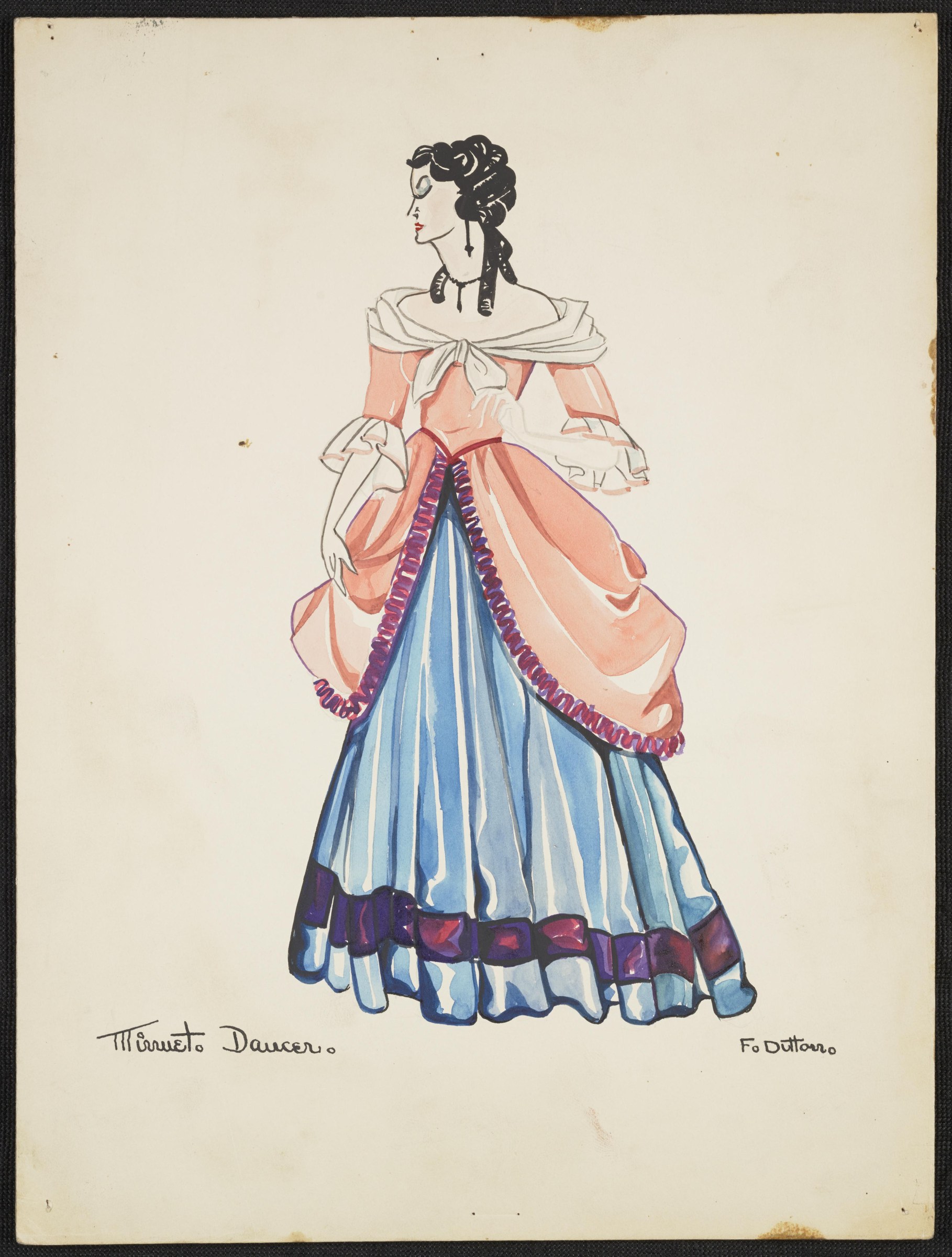
[Valley Forge: Minuet Dancer. Pink gown with blue underskirt and white shawl.]
Unknown artist
- Collection:
- Prints & Photographs
- Source:
- Library of Congress
- Rights:
- Rights vary by item — check the source record before reusing this image. Source record ↗
- Recorded as:
- Library of Congress — no known restrictions (verify per item)
The work captures the relationship between formal dance and elite fashion in the 19th century—what you wore mattered as much as how you moved, and a fashionable silhouette was part of the performance. It also demonstrates how dance was used as a framework for selling dress: the label 'Minuet Dancer' was marketing, associating the garment with sophistication, tradition, and courtly grace.
What you are looking at
A fashionably dressed woman stands in three-quarter profile against a plain ground, her body angled to her right. She wears an elaborate early 19th-century gown: a pale pink silk overdress with voluminous sleeves trimmed in white, worn off the shoulder with a draped shawl collar. Beneath it, a striking blue underskirt with vertical pleating dominates the lower half, trimmed at the hem with deep purple silk ribbon. The skirt's rich color and disciplined pleating suggest movement—the kind of controlled, stately motion characteristic of formal court dance. Her dark hair is arranged in an elaborate upswept style with long ringlets falling down the back, and she wears pendant earrings. The pose is static but poised, the weight evenly distributed, the carriage erect and dignified.
The dancing
The single figure occupies the center of the composition in a relaxed standing position, neither mid-movement nor in a dance frame. Her head is turned in profile; her arms hang naturally at her sides. The posture is that of a model displaying costume rather than executing a step. There is no partner, no dynamic tension in the body, no indication of weight transfer or the muscular engagement visible in active dance portraiture. This is a fashion illustration using a dancing body as its vehicle.
The dance depicted
The inscription 'Minuet Dancer' identifies the dance explicitly. The minuet was the dominant courtly dance of the 17th and 18th centuries and remained fashionable in formal contexts well into the 19th century. The costume—the pale silks, the off-the-shoulder drape, the elaborate pleating—is consistent with Romantic-era ball dress of the 1830s. However, the figure is posed for display, not captured in the characteristic movement of the minuet, which required specific arm positions, a particular carriage of the head, and the distinctive sideways glide of the step itself. This is a costume study of a minuet dancer rather than a dynamic representation of the dance.
How it was made
The work is a hand-colored fashion illustration, most likely a lithograph or lithograph-derived print based on the line quality and the way the composition reads. The black line work defining form and detail is precise and assured; the color is applied by hand in translucent washes—pink, blue, and purple dominate, with careful shading to suggest fabric weight and volume. This technique was standard for high-end fashion illustration of the 1930s and before, allowing for both linear precision and the nuanced rendering of fabric. The style suggests professional commercial production, likely from a fashion house, a tailor's pattern book, or an illustrated periodical aimed at an affluent audience.
About this work
This is a fashion illustration of a woman in ball dress posed as a 'minuet dancer'—a costume study for formal Romantic-era evening wear, circa the 1830s. The artist has used the figure of a dancer as a vehicle for displaying luxury textiles and high-fashion silhouette, the key selling points of the garment. The inscription claims the minuet as the context for the dress, yet the figure is static, engaged in display rather than dance. The work sits at the intersection of fashion history and dance iconography: it documents both the costume worn to dance and the conventions of fashion illustration, but it is only incidentally a record of the minuet itself.
How to look at it
Look first at the silhouette: the off-shoulder drape, the narrow waist, the volume of the skirt, and the contrast between the pale overdress and the vivid blue underskirt. These are the selling points of the design. Then observe the still, frontal-but-turned pose—this is display, not action. The artist has chosen a moment of rest, appropriate to a pattern or costume record. The detailed rendering of the pleats in the underskirt and the careful shading of the fabric folds show technical skill at representing luxury textiles, which was as much the point of fashion illustration as conveying movement or the occasion itself.
The artist
The artist is not recorded. The style and technique are consistent with commercial fashion illustration of the early 20th century, produced for circulation among dressmakers, tailors, and affluent patrons. The signature on the lower left appears to read 'Margueto' or similar, though it is not clearly legible. This may be a professional fashion illustrator working in a European style capital or a fashion house in-house artist. The precision of the line work and the assured handling of color suggest trained draughtsmanship and familiarity with textile representation.
The period
The 1930s saw a sustained nostalgic interest in historical costume and 'period' dress, especially formal evening wear. The Romantic era (roughly 1820–1850) was frequently referenced as a symbol of elegance and refinement. At the same time, the minuet itself was a historical curiosity—the dominant social dance had long given way to the waltz and modern ballroom forms—but it retained prestige as a marker of old-world courtliness. Fashion illustration of this era often invoked historical dances and costumes to lend authority and allure to contemporary designs. The catalogue identification as Valley Forge material suggests this may be a costume study prepared for a theatrical or historical pageant production.
Where it lives
The work is held in the Library of Congress Prints & Photographs collection and is catalogued as Valley Forge material, suggesting it may derive from a costume archive or theatrical collection related to historical pageantry or reenactment. The early 20th-century date, commercial production, and hand-coloring are consistent with fashion illustration prepared for a professional or institutional client.
Dance in this work
Questions about this work
Is this actually a minuet being danced?
No. The figure is posed statically for costume display. While the inscription names the minuet and the dress is appropriate to Romantic-era formal wear, there is no indication of active movement or the specific arm and head positions the minuet required. This is a fashion illustration using the label 'minuet dancer' to suggest elegance and historical refinement, not a representation of the dance in action.
When was the minuet danced, and why would it still be relevant in the 1930s?
The minuet was the primary courtly dance of the 17th and 18th centuries and remained fashionable into the early 19th century. By the 1930s it was historical, but it retained symbolic value as a marker of refinement and old-world propriety. It was revived for costume balls, historical pageants, and theatrical productions—contexts where historical authenticity or aristocratic prestige was desired.
What was the purpose of fashion illustrations like this?
Such illustrations served as pattern records for dressmakers and tailors, as marketing materials for fashion houses, and as inspiration for affluent clients commissioning custom garments. They combined technical precision in rendering fabric and construction with aspirational imagery—the figure posed as a 'minuet dancer' elevated the dress from mere clothing to an object of cultural significance.
Can you identify the artist?
The signature is not clearly legible and the artist is not recorded in the catalogue. The style and technique are consistent with professional fashion illustration of the 1930s, but without clearer documentation, no attribution can be made with confidence.
More dance artwork





