49 works in this view — arrow keys or swipe to move between them.
Dance in Art
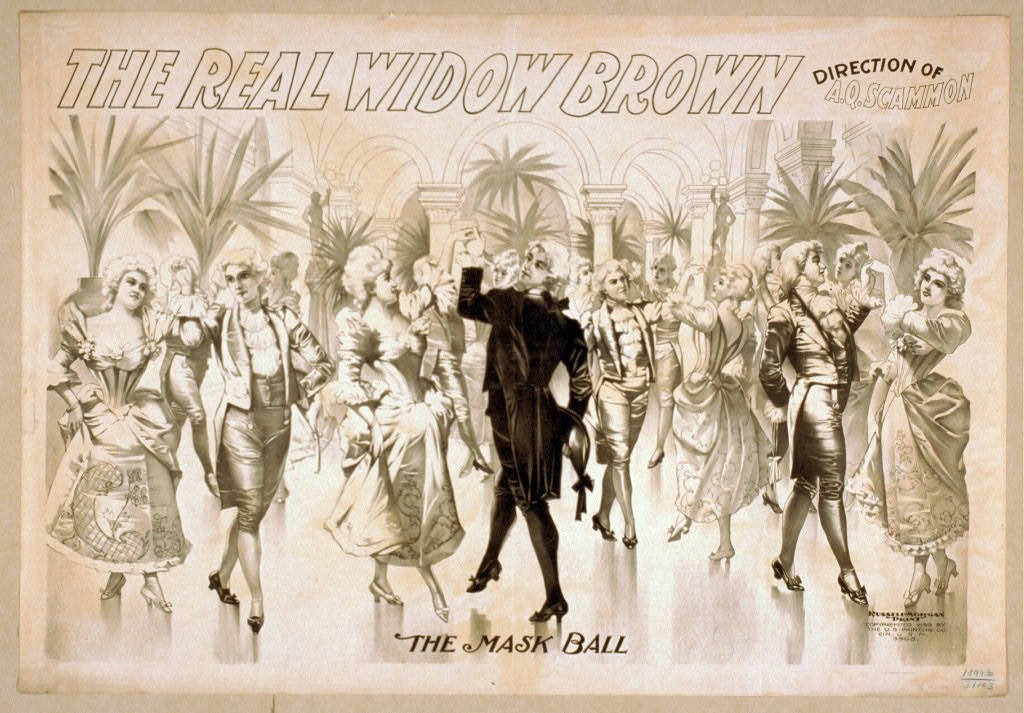
The real Widow Brown
Unknown artist
- Collection:
- Prints & Photographs
- Source:
- Library of Congress
- Rights:
- Rights vary by item — check the source record before reusing this image. Source record ↗
- Recorded as:
- Library of Congress — no known restrictions (verify per item)
Masquerade balls were a distinctive feature of elite social life in the late nineteenth century, combining ballroom dancing with theatrical costume and narrative. This image captures the cultural logic of the form—the interplay of identity, disguise, and revelation that made such events distinct from ordinary ballroom gatherings. For dance historians and curators, the work documents both the architectural setting in which ballroom dance took place and the social and theatrical dimensions of the practice.
What you are looking at
A masquerade ball in an opulent neoclassical interior, rendered in sepia tones with careful attention to architectural detail. Tall Corinthian columns frame a spacious gallery with palm trees in decorative urns—a fashionable Orientalist touch common to gilded-age ballrooms. Two dozen or more elegantly dressed figures occupy the space; the majority wear light-colored gowns and suits, while a single figure in the center wears a striking black costume with a dramatic cape or cloak. This dark-dressed figure, apparently masked or in costume, stands out sharply against the pale surroundings and appears to be the focal point of attention. The composition suggests the moment of revelation or drama—possibly the arrival or unmasking of this mysterious figure. Women's dresses show the characteristic silhouettes of the 1890s: corseted, with full skirts and leg-of-mutton sleeves. The ballroom is crowded but not chaotic, with small groups distributed across the floor, some facing the central figure, others in conversation.
The dancing
The figures are upright and formal, posed in the stilted manner typical of late-nineteenth-century ballroom etiquette. Most stand in small clusters or pairs, bodies angled toward one another in conversation or observation. The women hold their arms at their sides or with hands folded; the men stand at ease or with one hand at the waist. The solitary black-clad figure in the center adopts a more dramatic stance—legs apart, arms extended—suggesting movement or theatrical gesture rather than the restrained deportment of the other guests. No couple is shown in a closed dance hold; this appears to be a gathering rather than an active dance in progress, though the setting and context make clear that dancing is the event's purpose.
The dance depicted
This is a masquerade ball scene from the 1890s, a social and theatrical institution that combined ballroom dancing with costume, performance, and intrigue. The image captures the liminal moment characteristic of such events: the pause between dances, or the arrival of a costumed guest whose identity is unknown. The title *The Real Widow Brown* suggests a narrative of disguise and revelation—possibly a comic or scandalous figure has arrived incognito. Masquerade balls featured both formally choreographed dances (quadrilles, waltzes, cotillions) and promenading, but this image freezes the social performance rather than the kinetic dance itself. The artist has captured the theatrical aspect of the event: costume, mystery, and the performance of identity that made masquerade balls distinct from ordinary ballroom dancing.
How it was made
This is a lithograph or photomechanical print, established by the crayon-work shading, the pale sepia tone, and the fine linear precision of the architectural and figural detail. The technique allowed rapid reproduction for theatrical posters and popular illustration, suggesting this was created as promotional material or as a published illustration for a theatrical production or society newspaper. The careful rendering of architectural and costume detail suggests the image was intended for a relatively affluent audience familiar with both the luxury ballroom setting and the theatrical conventions of masquerade. The hand-drawn quality and tonal range indicate skilled commercial draftsmanship rather than photographic reproduction.
About this work
This is a masquerade ball scene dating to 1899, depicting the moment of social and sartorial drama that defines the genre. The image captures the ballroom not in the act of dancing but in the theatrical performance surrounding it: the costume, the disguise, the revelation. It is a work about the spectacle and social transgression made possible by masked events—the temporary dissolution of identity and status that the masquerade permits. The composition is theatrical in its staging: the black-clad figure at the center draws the eye and the attention of the surrounding guests, organizing the space and the narrative. For dance historians, the image is valuable less for its depiction of choreography than for what it reveals about the social context and meaning of ballroom dance in the 1890s: it was an occasion for performance, transgression, and the deliberate construction and dissolution of identity.
How to look at it
Attend to the composition's clear division between the black-clad central figure and the pale, formal crowd surrounding him or her. This is a deliberate staging of social drama: the eye is drawn to the center, and the surrounding figures function as an audience to the masked guest's arrival or revelation. Note the absence of active dancing: the artist has chosen the social moment before or between dances, when the ballroom functions as a stage for identity and performance. The architectural detail—the columns, the urns, the perspective—anchors the scene in material luxury and establishes the social status of the occasion. The women's silhouettes and the men's formal dress place the scene precisely in the 1890s and signal the historical specificity of this form of entertainment.
The period
The 1890s were a period of theatrical innovation and elaboration in social dance. The masquerade ball, a form inherited from eighteenth-century courtly entertainment, persisted as a fashionable vehicle for elite amusement, often adapted for theatrical productions and elaborate private events. The Orientalist elements visible in this image—the palm trees, the exotic decor—reflect the period's fascination with non-Western aesthetics and the use of costume and set design to create fantasy and distance from ordinary social life. Lithographic printing and theatrical illustration were booming industries in this decade, and images like this one were circulated widely through theatrical programs, newspapers, and popular prints. The 1890s also saw increasing professionalization and codification of ballroom dances (waltz, quadrille, cotillion, lancers), even as masquerade balls remained spaces where social convention could be playfully suspended.
Where it lives
This print is held in the Library of Congress Prints & Photographs collection, indicating it was created for mass circulation—likely as theatrical promotion, a magazine illustration, or a popular print for sale. The Library of Congress online database identifies it as part of its historical American prints collection.
Dance in this work
Questions about this work
What is a masquerade ball and why did it matter in the 1890s?
A masquerade ball combined formal ballroom dancing with costume, masks, and theatrical narrative, allowing participants to temporarily adopt disguised identities. In the 1890s, such events were fashionable among the elite as occasions for social transgression, flirtation, and entertainment. They offered a licensed space in which ordinary social hierarchies and decorum could be suspended through costume and anonymity. Masquerade balls were celebrated in literature, theater, and visual culture as sites where identity became theatrical and malleable.
What dances would have been performed at a ball like this?
The formal dances of the 1890s ballroom included the waltz, quadrille, cotillion, lancers, polka, and galop—all partner dances performed in closed or semi-closed holds with prescribed steps and figures. The lancers and cotillion were particularly popular for the narrative and theatrical possibilities they offered, as they involved multiple couples and complex geometric patterns. Between these formal dances, guests would promenade, converse, and flirt—the social performance that this image captures.
Who is the Widow Brown and why is she 'real'?
The catalogue record does not identify the source or narrative context of the title. 'The Real Widow Brown' suggests a character identity or theatrical plot—possibly a reference to a play, novel, or scandal of the period. The title hints at masquerade's central play with truth and deception: the 'real' widow is revealed beneath the costume or disguise. Without further documentation, the specific reference cannot be established, but the phrasing emphasizes the revelatory drama characteristic of masquerade narratives.
Why is this image valuable to dance history if it does not show people actually dancing?
This image is valuable precisely because it captures the social context and meaning of ballroom dance, not just its steps. It shows the architecture, the dress codes, the gender dynamics, and the theatrical possibilities that gave ballroom dance its cultural significance. For historians, understanding what ballroom dance *meant* to its practitioners—as a social performance, a space for transgression, a display of status—is as important as understanding how the waltz was executed.
More dance artwork





