49 works in this view — arrow keys or swipe to move between them.
Dance in Art
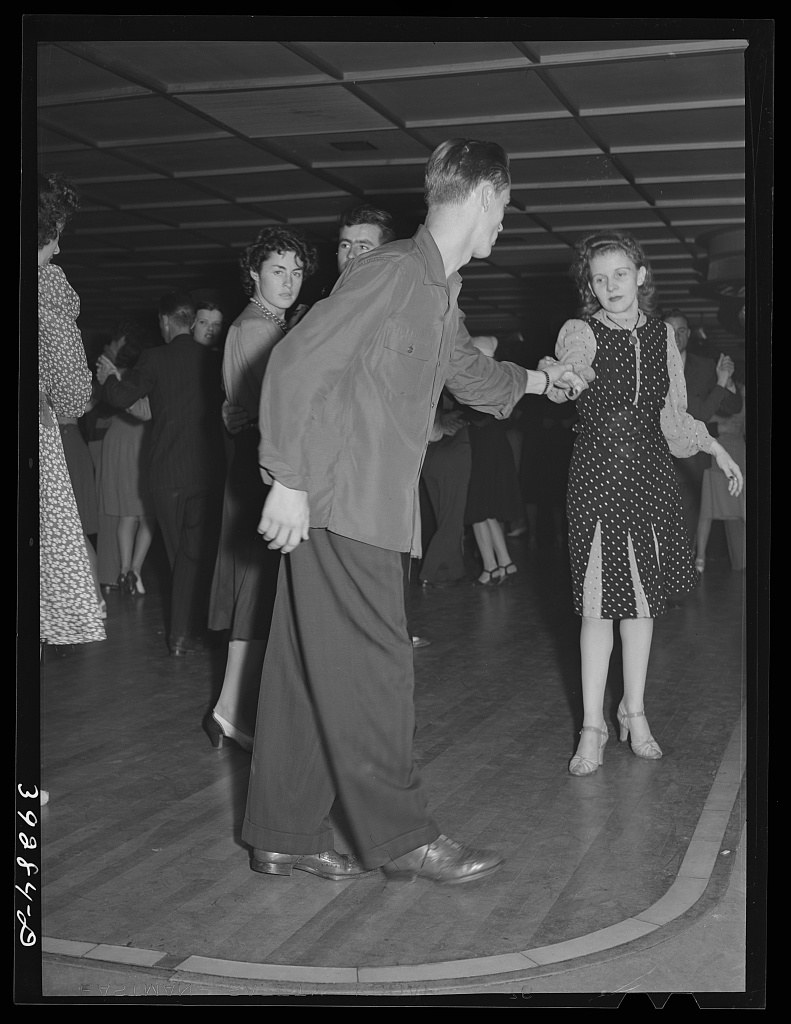
Dancers at large dance hall in San Diego, California
Unknown artist
- Collection:
- Prints & Photographs
- Source:
- Library of Congress
- Rights:
- Rights vary by item — check the source record before reusing this image. Source record ↗
- Recorded as:
- Library of Congress — no known restrictions (verify per item)
This photograph preserves the look and practice of social ballroom dancing at a specific historical moment—the early 1940s, when partner dancing was still a primary form of public social life in America. It shows the actual technique, dress, and setting of vernacular ballroom dancing rather than the theatrical or competitive versions that often dominate the historical record. For dancers and historians, it is direct evidence of how the closed ballroom frame was actually executed in lived practice, by ordinary people, in the venues where most Americans encountered partner dancing.
What you are looking at
A crowded dance hall in San Diego, 1941, photographed from ground level during an active dance. The composition captures a moment of social dancing in a large indoor space with a substantial wooden floor and a gridded ceiling of structural beams and recessed lighting typical of mid-century American public venues. In the foreground, a man in a tan or gray suit jacket dances with a woman in a dark polka-dot dress with a light collar; both are in closed position. Around them, other couples and individuals occupy the frame—some dancing, some standing at the margins—creating a sense of busy, continuous social activity. The photograph's black-and-white palette and the formal dress of the dancers (women in day dresses with collars and cuffs, men in suit jackets) establish the occasion as a respectful public dance event, not a nightclub or casual venue. The lighting is even and bright, suggesting either natural light or the hall's own illumination; shadows are soft. The crowd includes both active dancers and onlookers, with some figures visible in the background partially obscured by the press of bodies.
The dancing
The lead couple in focus holds a closed ballroom position: the man's right hand rests on the woman's back, and their other hands are clasped at roughly shoulder height. Both dancers face the same direction, their bodies aligned in a standard ballroom frame. The woman's weight appears to be forward, and her skirt moves with the motion of the dance. The surrounding dancers adopt similar closed positions, though some are partially obscured; the overall posture is upright and controlled rather than loose or casual. Footwork is not clearly visible from this angle, but the dancers' stance suggests the deliberate technique of a structured social dance rather than free movement.
The dance depicted
This is social ballroom dancing, almost certainly an American smooth dance of the early 1940s—either a foxtrot, waltz, or similar partner dance common to public dance halls of the period. The closed position, the formal dress, the structured posture, and the evidence of a well-maintained public venue all point to the codified partner dances that dominated American social dancing in this era. The photograph documents the lived practice of ballroom dancing as a mainstream social activity open to the working and middle classes, not an elite or theatrical pursuit. The presence of multiple couples dancing simultaneously in the same space confirms this was an organized social venue—likely a public dance hall, possibly a USO facility or similar establishment given the 1941 date.
How it was made
This is a black-and-white gelatin silver print, typical of documentary photography from the 1940s. The technical qualities—sharp focus in the foreground with adequate depth of field, even exposure, and the naturalistic composition from a low vantage point—indicate professional or semi-professional photographic practice. The photograph was likely taken with available light in the venue, or with supplementary flash; the soft shadows suggest the latter. As a print housed in the Library of Congress, it is part of a documentary archive rather than a fine art collection, which shapes what it was meant to record: social fact and lived practice, not artistic composition.
About this work
This photograph documents American social ballroom dancing in the early 1940s, captured in a public dance hall in San Diego at the moment of active dancing. The image is a straightforward record of working- and middle-class leisure: couples in street clothes executing the closed-position partner dances—most likely American smooth styles such as the foxtrot or waltz—that were the mainstream social dance of the era. The venue, the lighting, the dress, and the composition all mark this as vernacular social dance rather than theatrical or competitive dancing, and the presence of multiple couples confirms it as a documented social practice rather than a performance. It belongs in a dance history collection as evidence of how ordinary Americans danced together in public spaces, and what technical standards they maintained for that social practice.
How to look at it
Look first at the closed position of the lead couple: the alignment of the bodies, the placement of the hands, and the forward carriage of the woman's weight all demonstrate a technique that was taught and practiced. Notice how the surrounding dancers adopt the same frame and posture, indicating this was a standardized dance form known to all participants. The photograph's low vantage point and the play of light on the figures emphasize the physical commitment of the dancers—upright carriage, controlled movement, and the evidence of practiced steps. The crowded composition shows this was a popular, accessible, and socially normal activity; no one is dressed up beyond street wear, and the venue is functional rather than luxurious.
The artist
The photographer is unrecorded in the catalogue. The print bears the Library of Congress accession number (visible as the reference code in the image margin), indicating it was part of a government or state-sponsored documentary project, most likely the Farm Security Administration (FSA) or a related New Deal-era initiative that documented American life. The style and technical quality are consistent with WPA-era documentary photography of the 1940s, which often recorded vernacular social practices with a sociological rather than artistic intent.
The period
In 1941, partner ballroom dancing—foxtrot, waltz, and variations—was at the height of its popularity as a mainstream social practice in America. Dance halls were ubiquitous public venues in every significant city, and partner dancing was one of the primary forms of heterosocial leisure available to working-class and middle-class Americans. The United States had not yet entered World War II when this photograph was taken (December 7, 1941, was the attack on Pearl Harbor), but the military buildup and the presence of servicemen and defense workers in cities like San Diego would soon intensify the demand for public dance venues. The ballroom dancing documented here—technically sound, formally dressed, and practiced in purpose-built venues—reflects a moment in American social life when this form of dance still carried prestige and was understood as a skill worth acquiring and performing in public.
Where it lives
This photograph is held by the Library of Congress Prints & Photographs Online Catalog and is catalogued as a document from 1941, most likely from a New Deal-era documentary project. The accession number visible in the image margin and the documentary nature of the photograph suggest it was captured as part of a systematic record of American social life during the 1940s, rather than as a work of fine art or portraiture.
Dance in this work
Questions about this work
What kind of dance is this?
This is social ballroom dancing, almost certainly American smooth style—most likely a foxtrot, waltz, or similar partner dance that was the standard social dance in American public dance halls in the 1940s. The closed position, the upright carriage, and the controlled movement are all characteristic of ballroom technique from this era.
Why was ballroom dancing so popular in 1941?
Ballroom dancing was the primary form of heterosocial leisure available to working- and middle-class Americans in this period. Dance halls were public venues in every city, and partner dancing was a skill that adults were expected to know. It was affordable, accessible, and socially respectable—a way for unmarried and married couples to socialize and enjoy music and movement together.
What does this photograph tell us about how ballroom dancing was actually practiced?
It shows that the closed ballroom frame—the specific positioning of the hands, the alignment of the bodies, and the weight distribution—was a standardized technique known to multiple dancers. The presence of several couples all executing the same frame and posture indicates this was a learned, codified dance form, not improvisational movement. The formal dress and the public venue also show that ballroom dancing was treated as a respectable social practice requiring appropriate attire.
More dance artwork





