49 works in this view — arrow keys or swipe to move between them.
Dance in Art
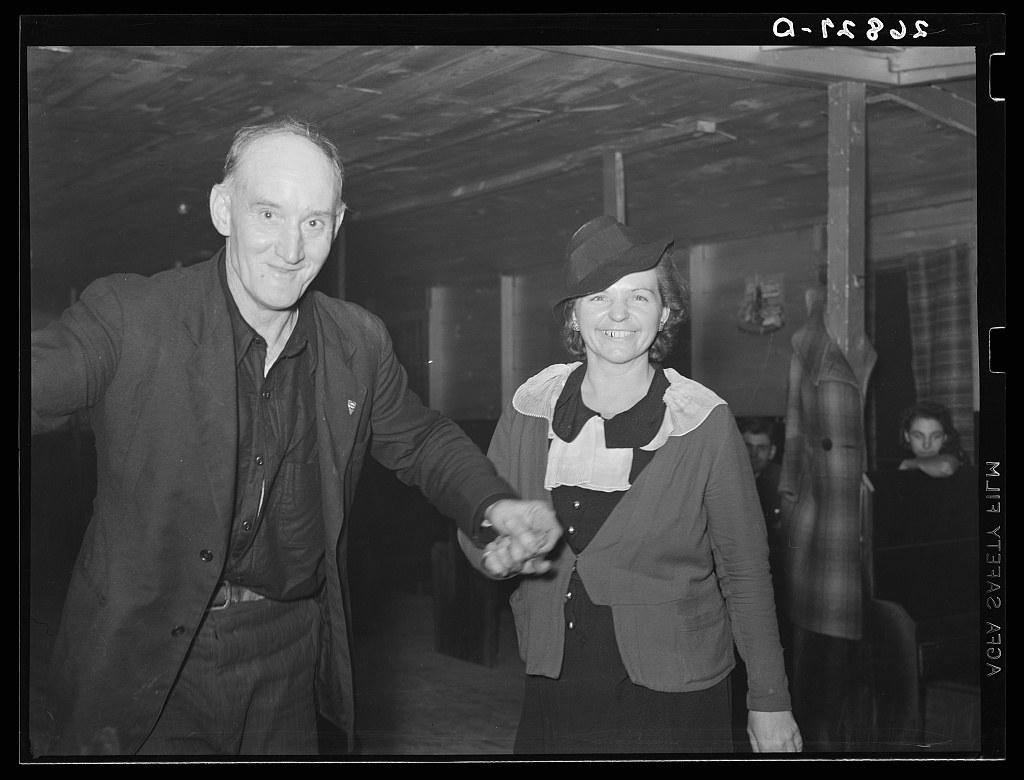
Couple dancing in Oke-Doke dance hall. Williamson County, Illinois
Unknown artist
- Collection:
- Prints & Photographs
- Source:
- Library of Congress
- Rights:
- Rights vary by item — check the source record before reusing this image. Source record ↗
- Recorded as:
- Library of Congress — no known restrictions (verify per item)
This photograph is historically significant as a record of how ordinary Americans danced in the late 1930s, outside the contexts of formal ballroom instruction or theatrical performance. It documents the social fabric of rural Midwestern life and provides visual evidence for the history of American vernacular dance and working-class leisure. The informality and directness of the image—the dancers' comfort with the camera and each other—reveal attitudes toward dance and courtship in Depression-era America.
What you are looking at
A black-and-white photograph captures two dancers in a casual, social setting—likely the interior of a dance hall. The man, on the left, wears a dark suit jacket over a buttoned shirt, with a thin tie; he is bald or balding and appears to be in his sixties or older. The woman, slightly shorter and to his right, wears a dark dress with a contrasting white collar and a dark hat with a brim, typical of working-class or rural American dress of the late 1930s. Both are smiling directly at the camera, and their posture suggests they have paused mid-dance or are posing for the photograph. The setting appears to be an unfinished interior space with exposed wooden beams and posts visible in the background, consistent with a rural or small-town dance hall. A third figure is visible in soft focus to the right. The photograph is printed in grainy black and white, characteristic of documentary photography of the period.
The dancing
The two dancers stand close together in what appears to be a social dance hold, though the pose has been interrupted or struck for the photograph. The man's left arm is at the woman's back or side, and they face the camera rather than each other. Both display relaxed, open postures without the formality of a closed ballroom frame. Their expressions are warm and unguarded, suggesting comfort with each other and with being photographed. The stance indicates a partner dance of the social rather than theatrical kind, with emphasis on ease and informality rather than technique.
The dance depicted
This appears to be a snapshot of social dancing at a rural American dance hall, most likely Lindy Hop, swing, or a regional variation of partner dancing popular in the American Midwest during the late 1930s. The "Oke-Doke" reference suggests a working-class venue, and the casual dress and relaxed posture indicate this is vernacular social dancing rather than exhibition work. The setting—a small-town Illinois dance hall—and the age and attire of the dancers suggest this is documentary evidence of how ordinary Americans danced during the Depression era, outside the formal ballroom or theatrical contexts. The photograph captures a moment of leisure and courtship in rural America.
How it was made
This is a black-and-white photograph, likely taken with available light or flash, showing the characteristic grain and tonal range of documentary photography from the 1930s. The image comes from the Library of Congress Prints and Photographs collection, suggesting it is part of a broader documentary project—possibly the Farm Security Administration (FSA) or similar New Deal-era documentation of American life. The photographic medium allowed rapid, objective capture of everyday moments, making it an invaluable record of vernacular dance practice and social life in rural America during a period when such documentation was uncommon.
About this work
This photograph documents social dancing in a rural Illinois dance hall in 1939, capturing a moment of partner dancing between two working-class dancers who pause to face the camera. The image is part of the Library of Congress collections and serves as documentary evidence of vernacular American dance practice during the Depression era. It belongs in a gallery of dance in art because it represents not the performance or exhibition of dance, but its lived social reality—dance as courtship, recreation, and community gathering in ordinary American life.
How to look at it
Notice the unpretentious ease of the dancers' posture and their direct, unselfconscious engagement with the camera—this is not a rehearsed or formal pose. Observe the simple, serviceable clothing and the rough interior of the dance hall, which speak to the economic and social context of Depression-era rural America. The photograph's grain and tonality are consistent with news photography or documentary work of the period, suggesting it was taken as a record rather than as art. The moment captured is a pause rather than a peak of movement, yet it conveys the warmth and social ease of the dance.
The period
In 1939, American social dancing was dominated by swing and its regional variants. Rural dance halls were central to community life in small towns, and dancing was a primary form of courtship and entertainment for working-class Americans. The late 1930s saw the height of swing music's popularity, though regional and older styles persisted in rural areas. This photograph was likely taken as part of a documentary impulse to record American life during the New Deal era, when photographers were funded to document social conditions and everyday experience across the nation.
Where it lives
This photograph is held in the Library of Congress Prints and Photographs Online Catalog and is catalogued as documentation of American life. The holding reflects a tradition of documentary photography undertaken during the New Deal era to record conditions and daily life across the United States.
Dance in this work
Questions about this work
What kind of dance is this?
The photograph most likely documents social swing dancing or a regional variant of partner dancing popular in the American Midwest during the late 1930s. The casual posture and setting—a small-town Illinois dance hall—indicate this is vernacular social dancing rather than formal ballroom or theatrical dance. The specific style cannot be definitively identified from a single posed moment.
Why were photographs taken at dance halls?
This photograph was likely taken as part of the New Deal-era documentary impulse to record American life, work, and leisure. Photographers working for agencies like the Farm Security Administration were sent across the country to document social conditions and everyday experience. Dance halls and social gatherings were important subjects because they revealed how ordinary Americans lived and spent their leisure time.
What does the Oke-Doke dance hall tell us?
The Oke-Doke was a working-class or rural venue, not a formal ballroom. The name and setting indicate a casual, community-oriented space where dancing was part of everyday social life. Such halls were especially important in rural areas as centers of courtship, entertainment, and social bonding during the Depression era.
More dance artwork





