49 works in this view — arrow keys or swipe to move between them.
Dance in Art
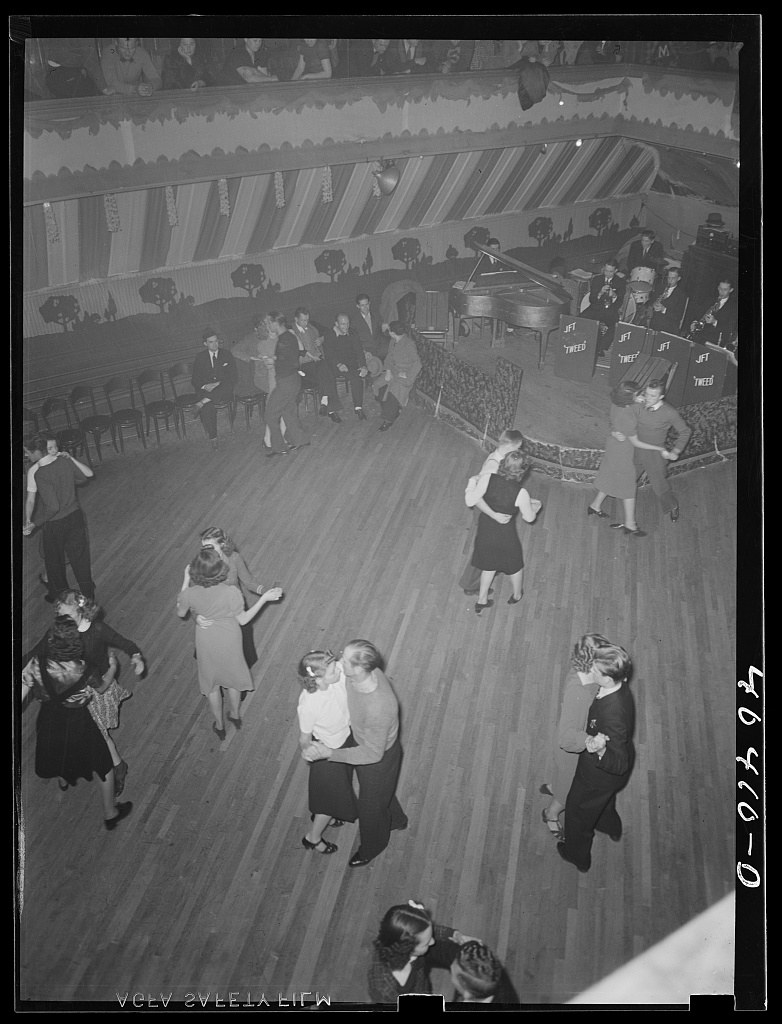
Shenandoah, Pennsylvania. Maher's dance hall, showing orchestra platform and dancers
Unknown artist
- Collection:
- Prints & Photographs
- Source:
- Library of Congress
- Rights:
- Rights vary by item — check the source record before reusing this image. Source record ↗
- Recorded as:
- Library of Congress — no known restrictions (verify per item)
This photograph is one of the few detailed records of working-class ballroom dancing in its actual setting—not staged, not performed, but documented in situ. It captures the social reality of how Americans danced in public venues before the rise of nightclubs and DJ culture, preserving both the architecture and the ordinary bodies that inhabited it. For dance historians, it provides evidence of what 'ballroom dancing' meant in practice in a small industrial town rather than in competition halls or instruction manuals.
What you are looking at
A photograph captures a lively dance hall scene in Shenandoah, Pennsylvania, shot from an elevated vantage point looking down at the wooden dance floor. The space is a working-class ballroom with a striped decorative canopy or tent-like ceiling structure hung with draped fabric. An orchestra platform with a grand piano is visible in the background, staffed by musicians. The floor is crowded with couples and small groups dancing, while observers stand around the perimeter. The photograph is shot in black and white with clear detail and good tonal range, catching the informal, energetic atmosphere of social dancing at what appears to be a public dance hall or community venue. The dress of the dancers—men in dark suits and jackets, women in dresses and coats—and the architecture suggest the late 1930s.
The dancing
The dancers visible on the floor move in couples and small clusters rather than in formal formation. Most adopt a closed or semi-closed ballroom hold with upright posture, though from this overhead angle the precise hand and arm positions are difficult to distinguish with certainty. The women's skirts are caught mid-motion, suggesting swaying or turning movement. The figures are distributed across the floor in a social arrangement typical of open-floor ballroom dancing rather than formations. Several dancers appear to be in forward-and-back motion rather than stationary turns.
The dance depicted
This is a record of American social ballroom dancing in the late 1930s—most likely Foxtrot, Waltz, or general 'Ballroom' dancing as those styles dominated working-class dance halls of the era. The hall setting, the orchestra with piano, the couples dancing in closed holds on a sprung wooden floor, and the informal mixed-ability crowd all point to social dancing rather than competitive or theatrical dance. No specific movement or styling distinguishes one ballroom form from another in this photograph. The scene documents the lived reality of how ordinary Americans danced together in their communities.
How it was made
This is a black-and-white photograph, likely taken with a large-format camera and printed as a gelatin silver print or similar period photographic process. The elevated angle and sharp focus throughout suggest the photographer positioned themselves on a balcony or gallery overlooking the dance floor. The technical quality—good tonal separation, even lighting despite the indoor venue, and clarity of detail—indicates professional or semi-professional photography. The image is part of the Library of Congress Prints & Photographs Online Catalog and may have been taken as documentary or press photography of social conditions and leisure activities.
About this work
This is a documentary photograph of an American ballroom dance hall in 1938, captured from above to show the full social scene—the musicians, the dancers in their street clothes, the architecture, and the informal public nature of dance in working-class communities. It is neither a performance nor a training session but a record of how social dancing actually happened: mixed generations and abilities, live music, the floor crowded and casual. The photograph sits at the intersection of dance history and social history, showing the ballroom not as an elite or theatrical space but as a community venue where ordinary people came to dance together.
For historians of American dance and leisure, this image documents a specific moment in ballroom culture before World War II and the social upheaval that followed. It shows the persistence of the ballroom tradition in industrial towns like Shenandoah, and the continuity of forms—the closed hold, the orchestra, the public floor—that had evolved over decades. It is one of countless such halls that existed across America but few of which are now visually recorded.
How to look at it
Look at the composition: the photographer chose a bird's-eye view that lets you see the entire social ecology of the hall at once—the band, the dancers, the spectators, the architecture—rather than isolating individual dancers. This choice tells you something about what mattered: the hall as a social space, not any individual's technique. Notice the range of body sizes and apparent ages on the floor; this was not a competitive or elite space but a public one. The overhead angle also flattens the movement, making it difficult to see footwork or weight transfer—suggesting this was documentary photography aimed at record rather than analysis of dance technique.
The period
In 1938, ballroom dancing remained a major form of public entertainment and social participation in America, sustained by dance halls in nearly every town of size. The Foxtrot, Waltz, and Quickstep were the dominant forms, taught in studios and danced socially in halls like this one. The architectural style—the tent-like canopy, the grand piano, the sprung wooden floor—was standard for the era. The late 1930s were the tail end of the swing era and the height of the big-band era, which supplied live music for such venues. Shenandoah, a mining and industrial town in anthracite Pennsylvania, would have had several dance halls serving its working-class population. The Library of Congress photograph collections include many such documentary photographs from the 1930s and early 1940s, often taken by photographers working for the FSA (Farm Security Administration) or other New Deal agencies.
Where it lives
This photograph is held in the Prints & Photographs Online Catalog of the Library of Congress, which indicates it entered an institutional collection, likely through donation, purchase, or agency records. The presence of a reference code suggests it was catalogued within a specific series or collection, possibly related to Pennsylvania, industrial communities, or leisure activities. The archival context suggests it may have been taken as part of a documentary or journalistic project rather than commissioned dance documentation.
Dance in this work
Questions about this work
What kind of dancing is happening in this photograph?
This is American social ballroom dancing, most likely Foxtrot or Waltz, as practiced in public dance halls in the 1930s. The couples dance in closed hold on a sprung wooden floor with live orchestral accompaniment. Without seeing specific footwork details, the exact style cannot be pinned down, but the format—open floor, mixed couples, orchestra—is unmistakably ballroom.
Where is Shenandoah, Pennsylvania, and why does it matter?
Shenandoah is a town in Luzerne County in the anthracite coal region of northeastern Pennsylvania. During the 1930s it was a working-class industrial community with a significant immigrant population. The fact that it supported a dance hall of this size shows that public ballroom dancing was not a luxury activity but a normal form of social entertainment in ordinary towns.
How do we know the date is 1938?
The catalogue record provided with the photograph states the date as 1938. The photograph's style, the clothing visible on the dancers and musicians, the dance hall architecture, and the photographic technique are all consistent with the late 1930s.
Why was this photograph taken?
The record does not indicate the original purpose. It may have been documentary photography for a newspaper, an agency record, or part of a cultural survey. The technical quality and compositional care suggest it was made deliberately to document the scene rather than taken casually.
More dance artwork





