49 works in this view — arrow keys or swipe to move between them.
Dance in Art
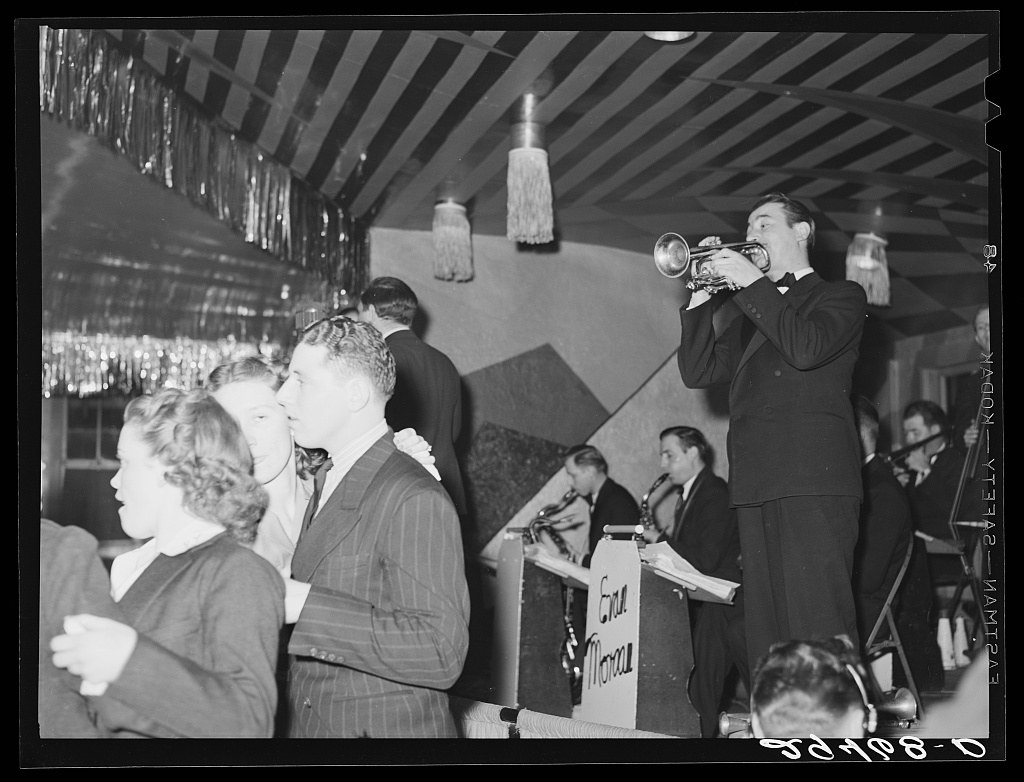
Dance hall, Saturday night. Marshalltown, Iowa
Unknown artist
- Collection:
- Prints & Photographs
- Source:
- Library of Congress
- Rights:
- Rights vary by item — check the source record before reusing this image. Source record ↗
- Recorded as:
- Library of Congress — no known restrictions (verify per item)
This image is a rare documentary record of how ordinary Americans actually danced in the 1930s–40s, in the venues where most ballroom dancing occurred. It shows the gap between the formal ballroom technique taught in studios and the looser, more conversational style of actual social practice—the held position, the relaxed frame, the integration of standing and moving. For dancers and dance historians, it is evidence of a vernacular tradition that was seldom photographed or preserved, making it invaluable for understanding the social and physical reality of American dance outside theater and competition.
What you are looking at
A lively dance hall in full swing: couples and solo dancers occupy a wooden floor beneath a decorative barrel-vaulted or coffered ceiling from which tasseled hanging lamps (possibly fringed paper lanterns) are suspended. The walls are lined with what appears to be a decorative border or frieze. In the foreground, a smartly dressed couple—the woman in a dark dress with a corsage, the man in a pinstriped suit—dance in close proximity, their bodies angled toward each other. Behind them, other dancers mill and move; at the far right, a musician in a dark suit plays a trumpet, while other band members are visible with instruments in the middle distance. The photograph is shot in black and white, with strong available light that casts shadows and creates depth, revealing the texture of the wooden floor and the fabric of clothing. The overall mood is one of organized, respectable social dancing—not raucous, but energetic and well-attended.
The dancing
The couple in the foreground are in a modified closed position, though the frame is looser and more social than competitive ballroom; their bodies face each other at a slight angle rather than in strict alignment. The woman's posture is upright, her arm visible on the man's shoulder or arm. The man leans slightly toward his partner. Around them, other couples and individuals stand or move with the ease of people at a social dance rather than a performance; weight appears distributed for conversational dancing rather than travelling movement. The band is clearly visible, suggesting a live music venue rather than a recording. The dress—formal day suits and modest day dresses—indicates this is a respectable public dance hall rather than a nightclub.
The dance depicted
This is a social ballroom or dance-hall setting typical of American small-town weekend entertainment in the 1930s–1940s. The dance style cannot be determined precisely from the static frame, but the posture, hold, and social context suggest American Smooth or social swing dancing—the relaxed closed position is consistent with foxtrot or waltz as danced in public ballrooms of the era, not the tight, Latin-inflected positioning of competitive modern ballroom. The photograph documents vernacular social dancing as it was actually practiced in a Midwestern venue, where live music and proper dress were expected for Saturday-night outings. The presence of a trumpet suggests jazz or swing-influenced music rather than strict waltz timing.
How it was made
This is a black-and-white photograph, evidently taken on film stock and printed as a positive print on paper. The lighting is natural or available—likely tungsten from the suspended lamps, possibly supplemented by flash—which creates strong shadows and a sense of immediacy. The camera angle is roughly at eye level, taken from within the crowd, giving an embedded documentary quality. The print quality and framing suggest professional or semi-professional documentation rather than casual snapshot photography. As a photograph from the Library of Congress, it is part of a systematic documentary project (likely the Farm Security Administration or similar New Deal-era recording of American life), which shaped both the choice of subject and the method of capture.
About this work
This photograph documents a Saturday night at a small-town dance hall in Marshalltown, Iowa, showing social ballroom dancing as it was actually practiced in American small towns during the late 1930s or early 1940s. The image captures a moment of organized leisure—a respectable, supervised public venue where couples dressed formally and danced to live music. Rather than depicting a named choreography or theatrical performance, it records the vernacular ballroom tradition: the foxtrot, waltz, and swing dancing that formed the social fabric of American towns. It belongs in a gallery about dance because it documents the ordinary practice of social dance at a specific moment and place, preserving the bodily, sartorial, and social conventions of ballroom dancing outside the theater or competition circuit.
How to look at it
The photographer has chosen the moment of active dancing, not the pause or assembly—the couple in the foreground are mid-movement, their bodies in conversation. Notice the formality of dress and the orderliness of the scene, which tells you this is a sanctioned public venue, not a private or underground dance. Look at the posture and frame of the visible dancers: no extended leg lines or exaggerated holds, but a relaxed, responsive connection between partners, consistent with social rather than performance dancing. The lighting reveals the wooden floor and the architectural setting, grounding the dance in a specific, modest American interior rather than an idealized ballroom. The presence of the live band in the same frame reminds us that the dancing and music were simultaneous and interdependent—the band was playing for the dancers in real time, not the dancers performing for a photograph.
The artist
The photographer is not recorded in the catalogue. The image is held by the Library of Congress Prints & Photographs division, and the provenance and method suggest it was part of a systematic documentary project, possibly the Farm Security Administration's photography program (1935–1943) or a similar New Deal initiative to record American life. If so, the photographer was a trained professional working within a government-sponsored initiative to document regional and social conditions. The style—embedded, available-light photography at social events—is consistent with FSA practice.
The period
In 1940, ballroom dancing was a central form of respectable American social life, particularly in small towns where public dance halls provided weekend entertainment. The Big Band era (late 1930s–1940s) had made swing music and jazz-influenced dancing mainstream, though traditional foxtrot and waltz remained the standard couple dances. In art and photography, the late 1930s and early 1940s saw intense documentary interest in American life—Dorothea Lange, Walker Evans, and others were recording the nation's people and practices as part of New Deal cultural projects. Dance was seldom the primary subject of such photography, but social scenes (celebrations, gatherings, leisure) were frequently captured. This image sits at the intersection of two currents: the documentary impulse to record American social practice, and the cultural prestige of ballroom dancing as a marker of respectability and modernity.
Where it lives
The image is part of the Library of Congress Prints & Photographs Online Catalog. The catalogue record indicates it was taken in Marshalltown, Iowa, and dated 1940, but does not attribute it to a named photographer or specify the sponsoring project. The print is of the quality and style consistent with professional documentary photography of the New Deal era.
Dance in this work
Questions about this work
Is this a performance or a social dance?
This is a social dance at a public dance hall. There is no stage, no audience, no costume or theatrical framing—the dancers are dancing for themselves and each other in a commercial venue. The photograph documents social ballroom dancing as a leisure activity and courtship ritual, not as a theatrical art.
What dance are they doing?
The photograph does not capture enough footwork or movement to identify the specific dance with certainty. The relaxed closed position and upright posture are consistent with foxtrot, waltz, or social swing as danced in American ballrooms of the 1940s. The exact style would have depended on the music the band was playing in that moment.
Why is this photograph a document of dance history?
Social ballroom dancing in small-town America is seldom recorded in photographs or archives. This image preserves evidence of how ordinary people danced, how they dressed for dance, what venues they used, and what live music accompanied the dance. It shows the vernacular practice of ballroom dance outside the studio and the competition circuit.
What does the setting tell us about American dance culture in 1940?
The formality of dress, the orderly venue, the live band, and the respectability of the scene indicate that ballroom dancing was a mainstream, supervised, family-friendly activity in American small towns. It was not marginal or transgressive, but a normal weekend outing for young couples and respectable citizens.
More dance artwork





