49 works in this view — arrow keys or swipe to move between them.
Dance in Art
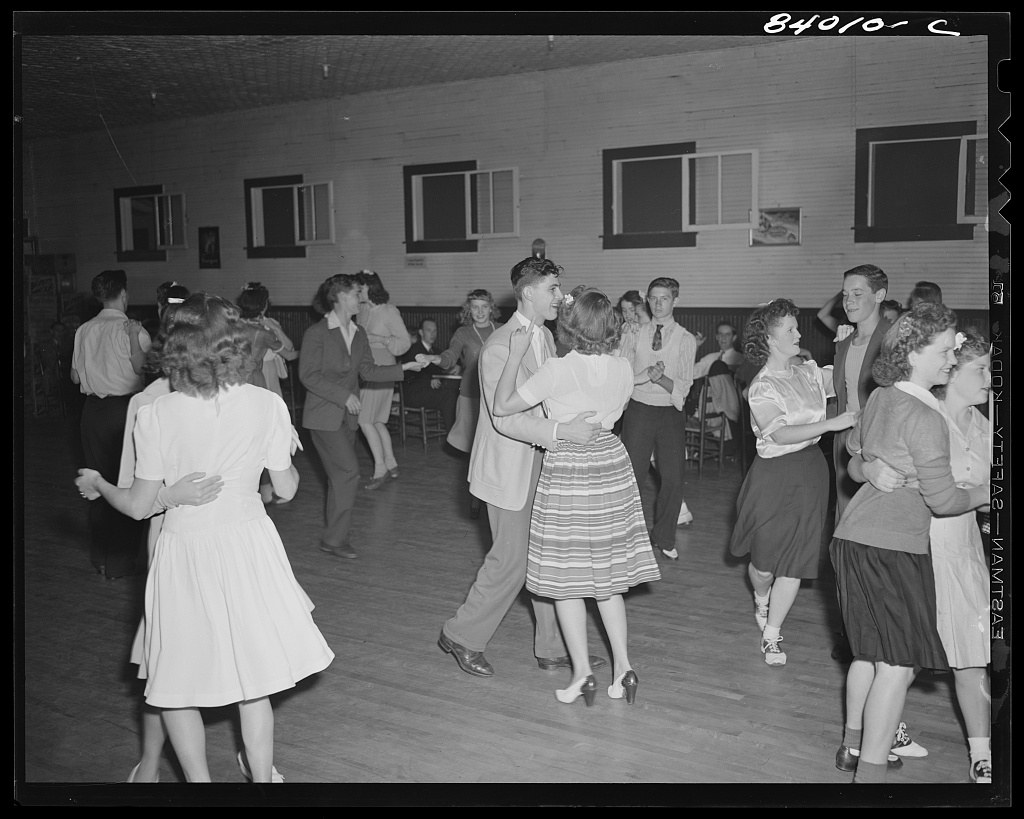
Richwood, West Virginia. Local dance hall
Unknown artist
- Collection:
- Prints & Photographs
- Source:
- Library of Congress
- Rights:
- Rights vary by item — check the source record before reusing this image. Source record ↗
- Recorded as:
- Library of Congress — no known restrictions (verify per item)
This image is one of the few systematic visual records of how ordinary Americans actually danced in the early 1940s, outside the formal contexts of competition or theater. Dancers and dance historians studying vernacular American ballroom practice in the wartime period have very few documentary photographs of this kind; most surviving images are either theatrical, staged for publicity, or produced by dance studios and competitions. The photograph's casual, unidealized character makes it more historically reliable than more polished sources.
What you are looking at
A crowded dance hall in wartime America captures a moment of social dancing among young servicemen and civilians. The hall is a plain brick building with a low ceiling and regular windows set high on the walls, lit by overhead fixtures that cast even light across the wooden floor. Roughly thirty people fill the space in pairs and small groups, most engaged in partner dancing while others stand in conversation. The dancers wear 1940s dress: men in suits and military uniforms, women in simple day dresses and skirts with period-appropriate hairstyles—rolled waves and pin curls. The energy is casual and social rather than formal; the dancers hold each other at varying distances and angles, and some appear mid-conversation rather than focused on the footwork. This is a snapshot of local American recreational dancing, the kind that sustained communities during wartime.
The dancing
The dancers move in pairs using a relaxed closed or semi-closed position, typical of American social ballroom dancing of the period. Most couples maintain moderate distance, with the man's right hand on the woman's back or waist and her left hand on his shoulder; their other hands are joined at chest height. No dancer exhibits the rigid posture or precise frame of competition ballroom—bodies lean slightly together, arms bend naturally, and the overall impression is of comfort rather than technical precision. The crowd's density and the mixed focus (some watching, some talking while dancing) suggests this is social dancing rather than performance or instruction. Most visible dancers appear to be moving in a simple traveling pattern, walking through the steps rather than executing elaborate footwork.
The dance depicted
This is American social ballroom dancing, most likely Foxtrot or Waltz, the standard partner dances taught in American dance halls and USO venues during World War II. The Foxtrot would be the more probable style given the relaxed frame and walking action; the Waltz's three-beat rotational pattern is harder to confirm from still photography. The setting—a small-town or community hall—and the mix of military personnel and civilians is characteristic of wartime social dancing in America, where USO dances and local venues served as meeting places for servicemen and local populations. The photograph captures dancing as a recreational and social activity rather than an artistic or competitive practice.
How it was made
This is a black-and-white photograph, likely taken by a documentary or press photographer. The image exhibits the characteristics of mid-20th-century photojournalism: fast film stock, available indoor lighting, and composition that prioritizes scene capture over aesthetic arrangement. The focus is soft and even across the frame, and the photographer positioned themselves to show the crowd and activity rather than isolate individual subjects. As a Library of Congress archival photograph, this is one of thousands produced by the Federal Writers' Project and other New Deal-era documentation programs that systematically recorded American life during the 1930s and 1940s.
About this work
This is a photograph of a community dance in Richwood, West Virginia, taken in 1942 during World War II. It documents the ordinary social dancing that formed a central part of American recreational life during the period—the kind of informal gathering that sustained courtship, leisure, and community bonds among civilians and servicemembers. The photograph is valuable precisely because it is unexceptional: it shows not a staged performance or a special event, but the routine use of the local dance hall as a social space. The ease and informality of the dancing—the relaxed posture, the mixing of conversation and movement, the absence of any sense of performance—marks this as the lived culture of dance rather than its theatrical representation.
How to look at it
Attend to the informality: the varied distances between partners, the relaxed hand positions, the mixture of dancers and watchers, the complete absence of synchronized movement or anyone appearing to lead or teach. This is the opposite of a demonstration or a formal quadrille. Notice also the clothing and the setting—the plainness of the hall, the everyday dress, the mix of military and civilian personnel—which together document what dance meant in a small American town rather than what it meant in ballrooms, theaters, or competitions. The photographer chose to capture the crowd and activity rather than isolate any couple, which tells us their interest was in the social and communal aspects of the dancing rather than its technical or aesthetic content.
The period
During World War II, the American dance hall was a crucial social institution, particularly in smaller towns. The presence of military personnel in this photograph reflects the war's impact on even isolated communities; servicemen stationed at or passing through bases sought entertainment and social contact, and local venues accommodated them. The photograph was taken during the New Deal documentation era, when federal programs systematically recorded American life. The Federal Writers' Project and related agencies produced thousands of photographs of everyday American scenes, including leisure and cultural practices. By 1942, the swing era had peaked and was beginning to transition; the big bands and swing dancing had dominated the late 1930s, but partner ballroom dancing remained the standard social form in smaller communities and local dance halls. This photograph sits at the intersection of that transitional moment and the social upheaval of wartime.
Where it lives
This photograph is held by the Library of Congress Prints & Photographs Division. It is one of thousands of images produced by federal documentation projects during the New Deal and World War II era that recorded American communities and everyday life. The Library of Congress catalog entry identifies it as Richwood, West Virginia, and dates it to 1942, but does not identify the photographer or provide additional provenance details.
Dance in this work
Questions about this work
What dance is this?
The dancers are doing American social ballroom dancing, most likely Foxtrot, which was the standard partner dance in American dance halls during the 1940s. The relaxed frame, walking action, and the absence of complex footwork or rotational patterns are consistent with Foxtrot dancing of the period. The Waltz is also possible, but harder to confirm from a still photograph.
Who took this photograph?
The photographer's name is not recorded in the Library of Congress catalog. The image was produced during the federal documentation programs of the 1930s and 1940s, but the specific photographer remains unidentified.
Why were there servicemen in a small West Virginia town?
World War II had stationed military personnel throughout the United States, and servicemen traveled to and were based in smaller towns and rural areas. Local dance halls and USO venues became important social spaces where servicemembers could meet civilians and participate in recreational dancing. This photograph captures that wartime social mixing.
How was this dance hall used?
Local dance halls in the 1940s were community gathering spaces for social dancing, usually on weekend evenings. They served local populations, and during wartime they also accommodated servicemembers. The dancing was recreational—for courtship, leisure, and community bonding—rather than competitive or theatrical.
More dance artwork





