49 works in this view — arrow keys or swipe to move between them.
Dance in Art
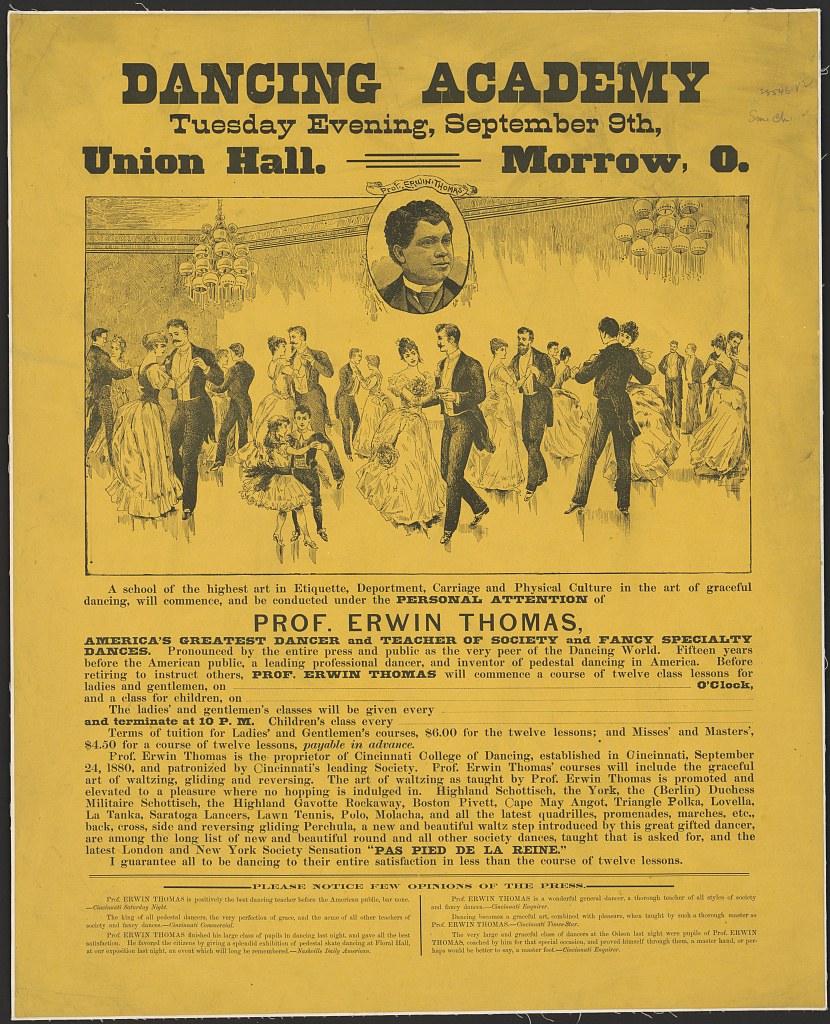
Dancing Academy Union Hall, Morrow, O., Tuesday evening, September 9th
Unknown artist
- Collection:
- Prints & Photographs
- Source:
- Library of Congress
- Rights:
- Rights vary by item — check the source record before reusing this image. Source record ↗
- Recorded as:
- Library of Congress — no known restrictions (verify per item)
The image documents the professionalization of social dance instruction in late-nineteenth-century America and the emergence of the dancing academy as a commercial enterprise. It reveals how ballroom dancing was marketed to provincial American towns, with emphasis on deportment and propriety rather than artistry or entertainment—establishing dance as a social technology for class aspiration.
What you are looking at
A crowded ballroom scene depicting a social dancing event at Union Hall in Morrow, Ohio, scheduled for Tuesday evening, September 9th. The composition shows roughly twenty figures in evening dress—men in dark suits and women in light-colored gowns with full skirts—arranged across a decorated dance floor. Chandeliers hang from the ceiling, and the interior space suggests a public assembly hall typical of late-nineteenth-century small-town America. The figures are distributed in pairs and small groups; some are actively dancing while others stand conversing or observing. The style is a wood engraving with fine crosshatching and careful attention to the play of light on fabric and bodies. At the top center, a portrait medallion shows Professor Erwin Thomas, the dance master who will lead the academy's instruction.
The dancing
The dancers visible in the composition hold each other in closed ballroom positions characteristic of the era—men's right hands on women's backs, left hands joined at shoulder height. Several couples are captured mid-stride, their bodies angled as if moving through a turning figure. The women's skirts are rendered with particular attention to volume and movement, suggesting both the weight of the fabric and the dynamics of rotation. The postures are upright and formal, with visible separation between partners typical of Victorian-era ballroom propriety. The standing figures maintain composed, attentive stances, reinforcing the structured social nature of the event.
The dance depicted
This image documents a social ballroom dancing academy of the Gilded Age, likely featuring the waltz, polka, and other popular partner dances of the 1880s. The text identifies Professor Erwin Thomas as the instructor, advertising his expertise in "Etiquette, Department, Carriage and Physical Culture in the art of graceful dancing." The scene captures the public, commercial side of dance instruction in late-nineteenth-century America—a democratization of ballroom technique that had previously been the preserve of the wealthy. The composition emphasizes simultaneous instruction of multiple couples in a single space, a teaching method that required clarity and formal positioning from all dancers present.
How it was made
This is a wood engraving, a technique that allows fine detail and high contrast suitable for newspaper and periodical reproduction. The engraver has achieved considerable subtlety in rendering the fabrics, with careful parallel lines suggesting the sheen of silk and the volume of gathered skirts. The technique was economical for mass production and would have allowed this advertisement to reach a wide audience through local or regional printing. The precision of the line work suggests professional execution, likely by a commercial engraver commissioned specifically for this promotional material.
About this work
This wood engraving functions as an advertisement for a social dancing academy, announcing a public instruction event and showcasing both the dance master's credentials and the refined, orderly nature of the instruction he offered. The image captures a pivotal moment in American dance history—the formalization and commercialization of ballroom technique through proprietary academies that served the aspirational middle class. The composition emphasizes decorum, proper form, and social inclusion; the message is that grace and skill in dancing were now attainable goods, available for purchase from a professional instructor.
How to look at it
Observe the careful attention to the women's skirts and the way the engraver has rendered their movement through line alone—the pleating, the volume, the suggestion of rotation. Notice how the couples are positioned at different points in a turning figure, suggesting the moment captured is mid-lesson, with multiple dancers executing the same step. The portrait of Professor Thomas at the top anchors the advertisement, establishing authority and personality; the busy ballroom below illustrates the product—instruction in refined, synchronized movement.
The artist
The artist is not recorded. The work is a commercial wood engraving, likely produced by a professional engraver working for a printing firm in or near Ohio. The level of technical competence suggests established practice in periodical illustration, but without signature or attribution this remains anonymous labor typical of nineteenth-century commercial printing.
The period
The 1880s saw the rise of the professional dancing academy in American towns, as the middle class sought to acquire the social refinements previously limited to the wealthy. The waltz had become the dominant ballroom dance, and instruction in proper form—hold, frame, posture—was considered essential to social advancement. Simultaneously, wood engraving was reaching its peak as a reproductive technology, before being displaced by photographic processes. This advertisement sits at the intersection of these trends: commercial social aspiration and the last flourishing of engraved illustration in print media.
Where it lives
This is an ephemeral printed advertisement, reproduced from the Library of Congress Prints & Photographs Online Catalog. It represents the class of promotional materials that announced local cultural and commercial events in small American towns during the Gilded Age.
Dance in this work
Questions about this work
What dances would have been taught at this academy?
The waltz was the dominant ballroom dance of the 1880s, but Professor Thomas's advertisement mentions instruction in "graceful dancing" broadly. Polkas, schottisches, and quadrilles were also popular partner dances of the period. The emphasis on "Carriage and Physical Culture" suggests the academy taught posture and deportment as much as specific choreography.
Why was dancing instruction a commercial business in small towns?
The late nineteenth century saw a rapidly expanding middle class seeking the social credentials of the wealthy. Dancing skill was understood as a marker of refinement and was necessary for participation in respectable social events. Professional instructors made it accessible for payment rather than limiting it to families of inherited wealth.
What is the connection between this print and Professor Erwin Thomas?
Professor Thomas is identified as the proprietor of a Cincinnati College of Dancing and as a society dance instructor. This advertisement announces his visit to Morrow, Ohio, to conduct a twelve-lesson course. The portrait establishes his identity and authority; the busy ballroom scene below is the product he is selling—the transformation of unrefined dancers into graceful, coordinated couples.
How does the engraving technique affect what we see?
Wood engraving allowed fine detail and high contrast, making it ideal for reproduction in newspapers and periodicals. The technique required the artist to work in black line only, so movement and grace are conveyed entirely through pose, line work suggesting fabric texture, and the careful arrangement of figures—not color or soft modeling.
More dance artwork





