49 works in this view — arrow keys or swipe to move between them.
Dance in Art
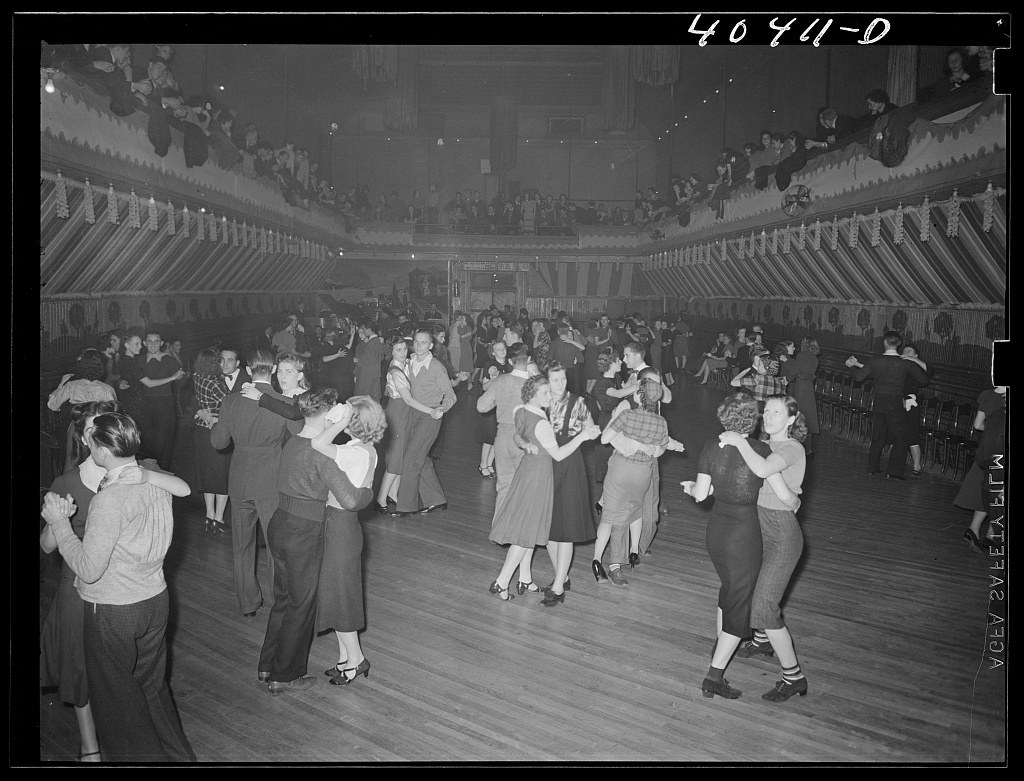
Shenandoah, Pennsylvania. Maher's dance hall, showing a great number of dancers
Unknown artist
- Collection:
- Prints & Photographs
- Source:
- Library of Congress
- Rights:
- Rights vary by item — check the source record before reusing this image. Source record ↗
- Recorded as:
- Library of Congress — no known restrictions (verify per item)
This image is one of relatively few photographs documenting how ordinary American working people actually danced in the 1930s, in their own social spaces and dress. It contradicts any notion that ballroom dancing was confined to the formal or upper-class; it shows a crowded, mixed-age, casual social venue in a small industrial town. For historians of dance and social history, it is direct evidence of the reach and informality of ballroom culture during the Depression.
What you are looking at
A crowded dance hall in full swing, photographed from an elevated vantage point that captures the entire floor. Dozens of couples and individuals occupy a large wooden dance floor marked by striped canvas or fabric bunting draped along both long walls, creating a festive enclosure. The ceiling is high and industrial, and spectators line the galleries above on both sides, looking down at the dancers. The photograph is taken at night under artificial light, which casts sharp shadows across the floor. The dancers wear Depression-era clothing—men in suits and fedoras, women in dresses and heeled shoes, many in casual daywear rather than formal attire. The crowd is mixed in age and energy; some couples dance in close embrace, others stand talking or watching. The scene conveys the informality and accessibility of a working-class social venue, busy but not chaotic.
The dancing
The dancers adopt a variety of postures. Most couples visible are in a closed or semi-closed ballroom hold—one hand joined, the other placed at shoulder or waist—though the holds vary in formality and closeness. Some dancers face each other directly; others stand side by side or in three-quarter position. The women's weight appears centered, their posture upright but not rigid. The men's frames are variable—some rigid and leading firmly, others more relaxed. No visible pointe work or extreme flexibility; all dancers wear street shoes or ordinary heels. The dance floor is so crowded that movement is constrained; most dancers cover small amounts of ground, suggesting the venue's social rather than performance function.
The dance depicted
This is a social ballroom dance session, most likely a Foxtrot, Waltz, or generic Swing-era ballroom dancing. The era (1938) and the informal dance hall setting point to American social dancing of the Swing and early Big Band period. The open embrace, the casual dress, and the crowded social context all align with vernacular ballroom dancing in a public dance hall rather than a formal ball. The photograph documents how ordinary working people danced, not exhibition or theatrical dance. No specific choreography is visible; the dancing is improvised social movement within the constraints of the packed floor.
How it was made
This is a black-and-white photograph, likely gelatin silver print, taken by available light or with flash—the evenness of exposure and the sharp shadows suggest artificial lighting. The elevated angle and wide field of view indicate a large-format camera positioned in the gallery or balcony. The photograph's tonal range and contrast are consistent with 1930s documentary or press photography. This is a document created by a photographer hired to record the scene, not a posed or artistic composition; its value lies in capturing a moment of lived social practice. The print is housed in the Library of Congress Prints & Photographs division, indicating its archival and historical status.
About this work
This photograph documents a working-class social dance in Shenandoah, Pennsylvania, a coal-mining town, in 1938. It captures the interior of Maher's dance hall in full operation—dozens of couples dancing in close quarters under artificial light, watched from above by spectators. The image is a record of American vernacular ballroom dancing at a moment of economic hardship (the Great Depression), when public dance halls remained accessible entertainment for working people. The photographer has chosen an angle that emphasizes the crowd and energy—the packed floor, the multiple simultaneous couples, the mixed ages and levels of formality—rather than focusing on any single dancer or moment. It is a document of social practice, not art or performance.
How to look at it
Attend first to the scale of the crowd and the constraint of space—dancers cannot move freely, suggesting that social dancing in a hall meant moving within a crowded social context, not displaying technique. Notice the variation in hold and posture: no two couples dance identically, indicating that this was improvised social movement within a loose convention, not choreography. Look at the dress and ages: the dancers range from young to middle-aged, and their clothes are everyday street wear, not costume. The elevated angle captures the scene as a system—a complete social event—rather than focusing on technique or individual beauty.
The artist
The photographer is not recorded. The image is part of the Library of Congress Prints & Photographs Online Catalog and is likely from a Depression-era documentary or WPA-related photographic project, though this is not confirmed by the record. The style and content align with documentary photography of the 1930s—straightforward, wide-angle, designed to capture social fact rather than aesthetic form.
The period
In 1938, American ballroom dancing was at a transitional moment. The Foxtrot and Waltz remained dominant, but Swing and Lindy Hop were emerging in youth culture and jazz contexts. Dance halls were ubiquitous in industrial towns and cities, serving as the primary public entertainment for working-class people. This was before television, and dancing remained a major social activity—casual, affordable, and accessible. The photograph dates to the tail end of the Great Depression, when such public venues were still economically viable. In art and photography, the late 1930s saw increasing documentary interest in working-class life, partly through government-sponsored programs.
Where it lives
The photograph is held by the Library of Congress, Prints & Photographs Online Catalog. It is part of documentary photography recording American life during the Depression era, though the specific collection or project is not identified in the catalogue record provided. It is a historical record rather than an artwork created for exhibition.
Dance in this work
Questions about this work
Was Maher's dance hall in Shenandoah, Pennsylvania a famous venue?
The record does not indicate its fame or significance. The hall is identified only by name and location. It was likely a typical working-class social dance venue of the kind that existed in most industrial towns during the 1930s. The photograph suggests it was substantial enough to accommodate large crowds and to attract a photographer's interest, but nothing in the image or record confirms broader historical prominence.
What dances are being performed?
The specific dances cannot be identified with certainty from the photograph. Based on the era (1938), the hold, and the social context, the dancers are most likely performing Foxtrot, Waltz, or a social Swing variant. The crowded floor and informal postures suggest improvised social dancing within conventional ballroom forms rather than any single named dance or choreography.
Why is the photographer shooting from above?
The elevated angle—from a gallery or balcony—captures the entire social scene at once, emphasizing the scale and density of the crowd. This compositional choice is typical of documentary photography of social events; it presents the dance as a collective activity rather than isolating individual dancers or couples. The angle also accommodates the large number of dancers in a small space.
More dance artwork





