49 works in this view — arrow keys or swipe to move between them.
Dance in Art
Volunteer Fireman's Dance
Unknown artist
- Collection:
- Prints & Photographs
- Source:
- Library of Congress
- Rights:
- Rights vary by item — check the source record before reusing this image. Source record ↗
- Recorded as:
- Library of Congress — no known restrictions (verify per item)
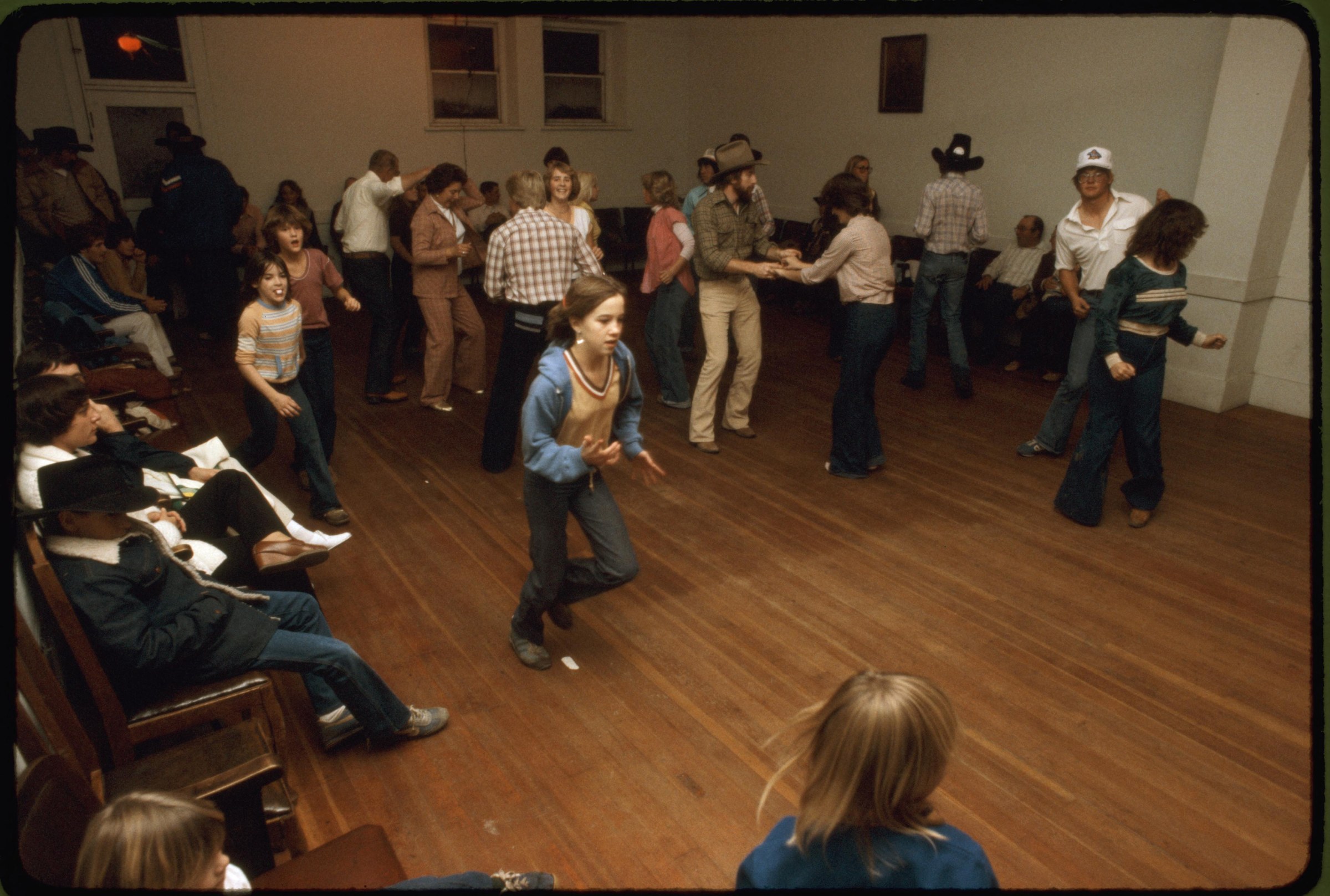
This image captures American folk dance not as a theatrical or competitive form, but as it actually happened in community life. It is rare documentary evidence of the volunteer and participatory culture of square dance and contra dance during the folk revival era, and it shows dance as an intergenerational, egalitarian social practice.
What you are looking at
A large group of people, approximately 30–40 adults and children, fills a wood-floored gymnasium or community hall. The space has cream-colored walls, tall windows, and radiators. Most of the figures stand in loose clusters or pairs around the room's perimeter and center, wearing casual 1970s clothing: plaid shirts, denim, earth-toned knits, wide-leg jeans, and cowboy hats on several men. A few people sit in wooden folding chairs on the left side, watching. The central floor is largely empty, creating an open dancing space. The lighting is flat and institutional, with a single red lamp or exit sign visible at top left. The atmosphere suggests a community gathering or participatory dance event rather than a performance—people are oriented toward the open floor, some mid-movement, others standing ready, creating the sense of a moment during an active social dance.
The dancing
Bodies are relaxed and upright, with no formal frame or closed hold visible. Several figures in the center of the floor stand with weight distributed evenly, shoulders loose, a few with arms at their sides or gesturing naturally. A girl in a blue shirt and tan vest stands prominently in the central floor space, her posture open and her gaze downward, mid-step. The overall impression is of casual, grounded movement rather than ballroom technique or lifted carriage. People are scattered in an informal circle, watching and waiting to join, which is typical of participatory folk or community dance.
The dance depicted
This is almost certainly a square dance, contra dance, or community social dance event. The wood floor, gymnasium setting, casual dress including Western wear, the participatory structure with musicians or callers not visible, and the large mixed group of adults and children are all hallmarks of American folk dance gatherings. The title 'Volunteer Fireman's Dance' suggests a community event hosted by or for a fire department, which is consistent with the rural or small-town character of the group and setting. The 1979 date places this in the era of square dance revival and recreational folk dancing in America.
How it was made
This is a color photograph, likely taken during the event itself, shot on film stock typical of documentary photography in the late 1970s. The image appears to be a 35mm color transparency or slide, evidenced by the warm color palette, slight color shift, and the rounded corners typical of mounted slides of that era. The photographic medium allows the photographer to capture the informal, candid moment of a living dance event, with natural grouping and gesture frozen mid-action. The image's presence in the Library of Congress Prints & Photographs collection suggests it is part of a documentary series on American folk culture or community life.
About this work
This photograph documents a community social dance—almost certainly a square dance or contra dance—held by or for a volunteer fire department, captured in 1979. The image shows the participatory, inclusive character of American folk dance as a community event, with people of all ages and both genders gathered in a gymnasium to dance together. The casual dress, informal groupings, and mixed-age participation are typical of the folk dance revival movement that was active in rural and small-town America during the 1970s and 1980s. The photograph belongs in a dance gallery as evidence of how social dance functioned as lived community practice, not as spectacle but as shared recreation.
How to look at it
Observe the scattered, informal groupings around the room and the central open floor—this is not a line dance or a formation dance in a choreographed pattern, but rather a participatory event where dancers enter and exit the floor. Notice the relaxed postures and downward gazes of some figures, suggesting they are listening to music or a caller not visible in the frame. The presence of children and elderly people among adults suggests this is a family and community event, not an age-specific gathering. The gymnasium setting and folding chairs reinforce that this is a community occasion, not a formal dance hall.
The period
The 1970s saw a significant revival of American folk dance, particularly square dancing and contra dancing, driven by growing interest in 'authentic' American culture and participatory recreation. Volunteer fire departments, VFW posts, church halls, and community centers across rural and small-town America hosted regular dances. The informality and accessibility of these events—open to all ages and abilities, no special dress required—stood in contrast to competitive ballroom dancing and reflected changing cultural values around community, inclusion, and anti-establishment sentiment. The photograph documents this moment when folk dance was very much a living, participatory practice rather than a museum artifact.
Where it lives
This photograph is held in the Library of Congress Prints & Photographs Online Catalog. It is part of the Library's collections of documentary photography documenting American life and culture, likely acquired as part of a larger series on folk culture, community gatherings, or American social life.
Dance in this work
Questions about this work
Is this a square dance or a contra dance?
The photograph does not show clear formation or caller-led patterns that would definitively identify it as one or the other. Both square dances and contra dances were common at volunteer fire department events in the 1970s, and both use similar open-floor, participatory structures. The title alone does not clarify which form was danced.
Why are people standing around the edge instead of dancing?
In participatory folk dances, not everyone dances continuously. Some stand out to watch, rest, or wait for the next dance. The loose groupings and mixed ages suggest this is a moment during the event when some dancers have finished a round or are preparing for the next one.
Who is the photographer?
The Library of Congress record does not identify the photographer. The image is credited only to the Library's Prints & Photographs collection.
What is a volunteer fireman's dance?
Volunteer fire departments across the United States have historically hosted community dances as social events and fundraisers. These gatherings, common especially in rural and small-town America, brought together families and neighbors for dancing, music, and community socializing. The dances were typically folk dances like squares or contras.
More dance artwork





