49 works in this view — arrow keys or swipe to move between them.
Dance in Art
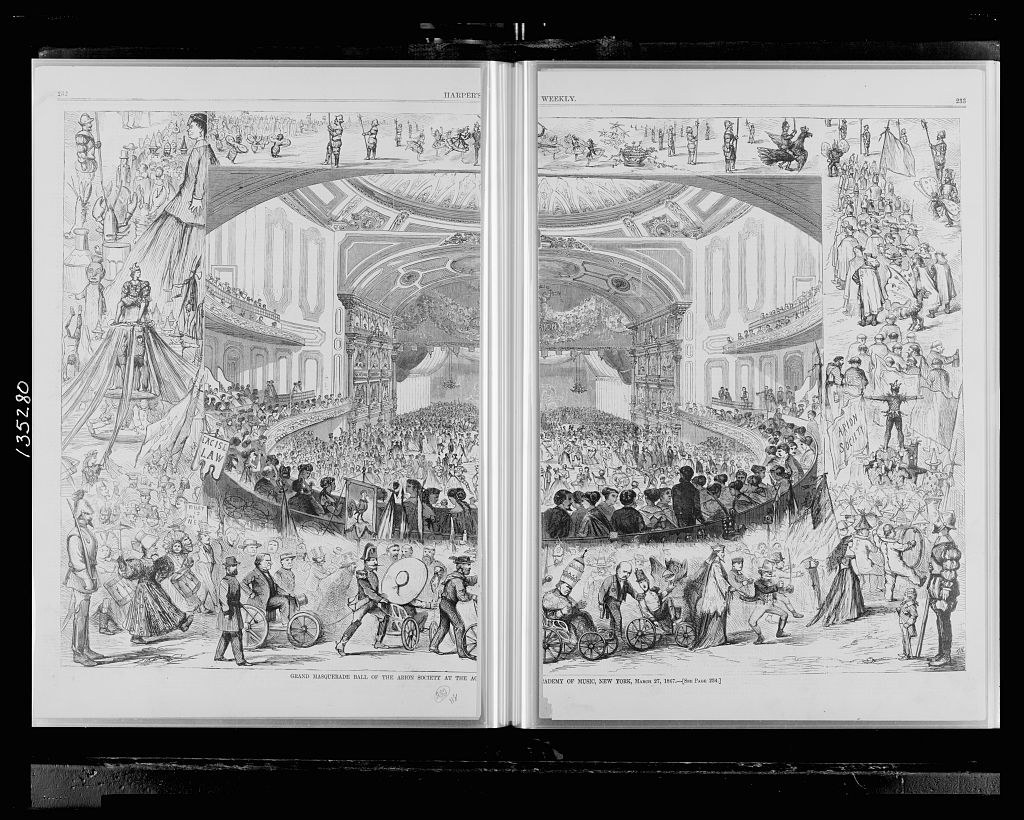
Grand masquerade ball of the Arion Society at the Academy of Music, New York, March 27, 1867
Unknown artist
- Collection:
- Prints & Photographs
- Source:
- Library of Congress
- Rights:
- Rights vary by item — check the source record before reusing this image. Source record ↗
- Recorded as:
- Library of Congress — no known restrictions (verify per item)
The image documents American ballroom dance as a social practice at a specific moment, showing the formal structures and elaborate context that framed quadrilles and cotillions in urban elite society. It is one of few contemporary visual records that captures the ballroom not as an isolated dance form but as a total social event, with its hierarchies of participation and its theatrical embellishment. For dance historians, it reveals how masquerade—costume, anonymity, fantasy—coexisted with strict choreographic convention.
What you are looking at
A densely populated masquerade ball fills a vast interior space with soaring architectural features—tall fluted columns, elaborate ceiling treatments, and what appears to be a mezzanine or gallery level. The ballroom is crowded with costumed revelers in extravagant dress: dominos with feathered headdresses, elaborate gowns, military uniforms, and theatrical costumes circulate through the space. In the center-left, a formal group of dancers occupies the floor in what appears to be a set dance formation. The composition divides attention between the choreographed dancers at the center and the surrounding throng of spectators, musicians, and idle guests. An orchestra or band is visible, and small groups form throughout—some dancing, many observing or socializing. The engraving captures the layered chaos of an elite social event: simultaneous activities, multiple focal points, and the mixing of formal dance participation with informal mingling.
The dancing
The central dancers appear to be in a formal social dance formation, likely a quadrille or cotillion given the grouping and the era. Their postures show upright carriage and structured arm positions consistent with 1860s ballroom etiquette. Surrounding figures display the gestures of conversation, promenade, and spectation—some women fan themselves, men gesture in talk, and several figures stand in the relaxed observation typical of ballroom margins. The engraver has differentiated the trained, composed bearing of active dancers from the varied, informal poses of the crowd.
The dance depicted
This is a depiction of the ballroom social dances of the Gilded Age American elite, specifically a masquerade ball—a format that allowed for theatrical costume and anonymity while maintaining strict choreographic convention on the dance floor. The central formation suggests a quadrille or cotillion, the dominant set dances of American ballrooms in 1867. The Arion Society was a German-American singing society, and their annual masked balls were celebrated New York social events attracting the fashionable and wealthy. The image documents not just the dance but the ritual: the separation of dancers from observers, the hierarchy of participation, and the theatrical excess that characterized such events.
How it was made
This is a wood engraving or steel engraving—established from the fine cross-hatching, the delicate line work, and the characteristic reproduction of tone through parallel and intersecting lines. The medium allowed for detailed, legible reproduction in newspapers and periodicals of the era. The density of incident and the careful articulation of distant and foreground figures suggest a skilled engraver working from a drawn source (likely a sketch or painting), translating a crowded moment into a printable image through selective emphasis and tonal control. Such engravings were the primary vehicle for visual journalism and social documentation of major New York events in the 1860s.
About this work
This is a journalistic engraving documenting a specific social event—the 1867 masquerade ball of the Arion Society at the Academy of Music in New York—reproduced in what was likely a contemporary newspaper or weekly. It belongs in a dance archive because it captures the ballroom social dances of the American Gilded Age in their actual social context: the formal dances (quadrille, cotillion) at the center, surrounded by the spectation, costume, and social theater that framed them. The work is both a portrait of a specific night and a document of how dance functioned in elite American culture—as ritual, display, and social technology.
How to look at it
Look first at the central group of dancers: they are frozen in a formation moment, caught between figures of the quadrille or cotillion, their bodies aligned and their bearing formal. Note how the engraver has differentiated them from the surrounding crowd through composition—they occupy the clearest space and the most resolved line work. Then follow the eye outward: observe the diversity of costume, the groups in conversation, the musicians, the spectators at the mezzanine. The engraver has used density of line and fineness of detail to create atmosphere and space. The masquerade costumes—the feathered dominoes, the theatrical dress—are rendered with particular care, suggesting contemporary excitement about the event's theatrical excess.
The period
The masquerade ball was a luxury entertainment imported from European aristocratic tradition and adapted by American urban elites in the mid-19th century. By the 1860s, such events were major social occasions covered in newspapers and illustrated weeklies (likely Harper's Weekly, given the style). The Arion Society was among the most prominent German-American cultural organizations in New York, and its balls were fashionable draws. Simultaneously, the ballroom dances themselves—quadrilles, cotillions, waltzes—were at their height of popularity and formal complexity in American society, before the social dances of the early 20th century (foxtrot, one-step) would displace them. The theatrical excess of masquerade was also a licensed space for social play and costume that allowed temporary role-reversals within a formally structured event.
Where it lives
The work is held in the Library of Congress Prints & Photographs collection, likely as a clipping from a contemporary periodical or as an independent print. It is a documentary engraving of a specific historical event, the kind of social journalism that was the primary mode of visual reporting in mid-19th-century American illustrated newspapers.
Dance in this work
Questions about this work
What dance is being performed in the center?
The formal dance formation in the center appears to be a quadrille or cotillion—the set dances that dominated American ballroom society in 1867. The grouping and upright postures are consistent with these highly structured, choreographed formations. Masquerade balls featured quadrilles and cotillions as their main events, with waltzes and other dances filling out the evening.
What was the Arion Society?
The Arion Society was a prominent German-American musical and social organization founded in New York in 1847. Their annual masquerade balls were among the most fashionable social events in the city, attracting the wealthy and socially prominent. The balls combined musical performance, costume theater, and formal ballroom dancing.
Why were masquerade balls important?
Masquerade balls offered elite society a licensed space for theatrical display and social play while maintaining strict formal protocols on the dance floor. The costume and anonymity created a temporary zone of role-play and fantasy, but the actual dances—quadrilles, cotillions—were highly regulated and choreographed. They were major social events, status markers, and occasions for conspicuous display of wealth and fashion.
How do we know this depicts a real event?
The title and date identify this as a specific event: the Arion Society's masquerade ball on March 27, 1867, at the Academy of Music. The location and date are inscribed on the print. The work is a piece of contemporary journalism—visual reporting of a major New York social event that would have been published in an illustrated weekly newspaper or as a standalone print.
More dance artwork





