49 works in this view — arrow keys or swipe to move between them.
Dance in Art
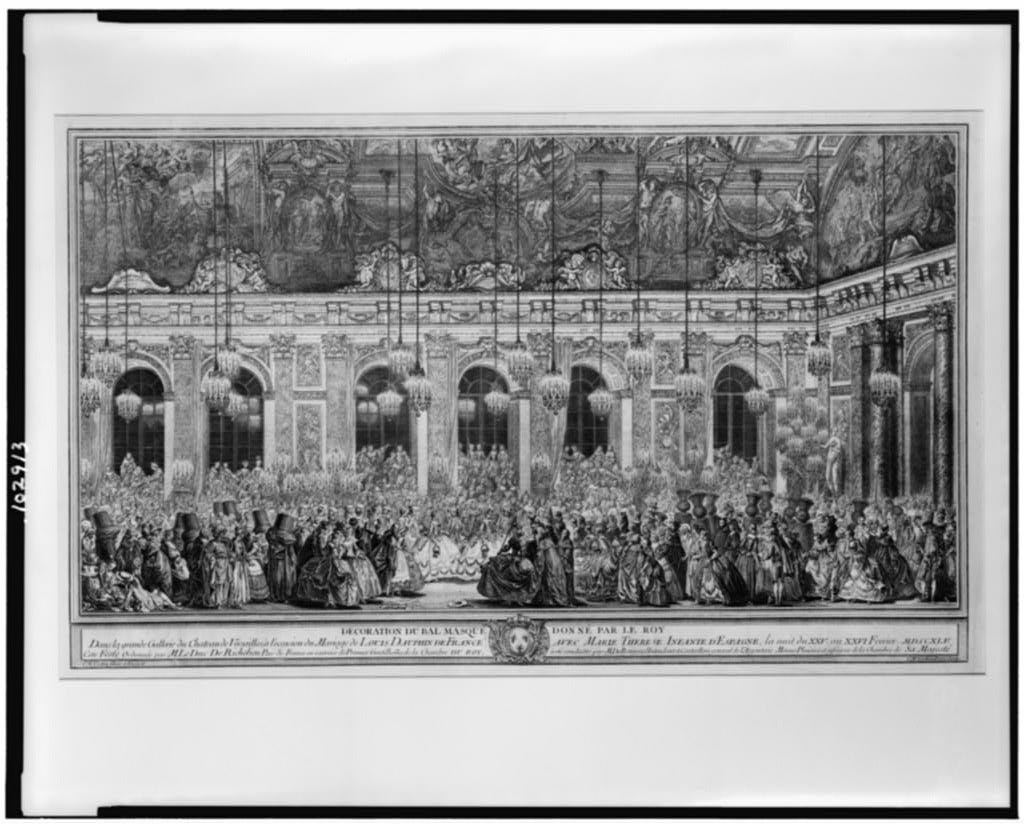
Decoration du Bal Masqué donné par le roy ...
Unknown artist
- Collection:
- Prints & Photographs
- Source:
- Library of Congress
- Rights:
- Rights vary by item — check the source record before reusing this image. Source record ↗
- Recorded as:
- Library of Congress — no known restrictions (verify per item)
This engraving is rare visual documentation of an actual royal ball and the real conditions under which Baroque court dances were performed—the crowded floor, the mixture of dancers and observers, the elaborate dress that constrained movement, and the integration of dance within formal court ritual. No choreographic notation or written description of such an occasion survives with comparable detail, making this a crucial primary source for understanding how the dances of the period actually functioned in social practice rather than in dance manuals.
What you are looking at
This engraving depicts the interior of a grand palace ballroom during an elegant masked ball given by the king. The space is vast and formal, with a coffered or decorated ceiling from which hang multiple chandeliers, and the walls are articulated by tall arched windows separated by pilasters and ornamental relief panels. The floor is crowded with dancers and courtiers in full formal dress—women in voluminous gowns and men in justaucorps and breeches—many wearing masks and dominoes (hooded cloaks). The composition is organized in rough tiers: in the foreground, figures cluster in small groups and pairs; the middle ground shows the active dancing floor where couples are scattered across the space; and the background recedes to the far end of the room where more figures congregate. The artist emphasizes the density and formality of the occasion, capturing the mingling of dance, conversation, and spectacle that characterized aristocratic masquerade.
The dancing
The dancers are shown in closed holds appropriate to 18th-century court dance, with men and women paired face-to-face or in side-by-side position. Many figures stand at rest or in conversation rather than actively dancing, which is typical of ballroom etiquette where dancing alternated with promenading and socializing. The women's skirts are enormous, decorated, and clearly a structural challenge to movement; men maintain upright posture with arms controlled. Groups are scattered across the floor rather than organized in lines, suggesting either a figured dance in progress or the moment between figures.
The dance depicted
This is almost certainly a representation of one or more dances from the Baroque court repertoire—most likely a minuet, gavotte, or contredanse, the dominant social dances of formal French court occasions in the 1740s. The masked ball setting and the mix of active dancers with idle spectators is consistent with grand balls where dancing was one element of an evening's entertainment. The title states this was given by the king, placing it within the most formal aristocratic contexts. The visible pairs in closed holds and the spacing suggest stately, regulated movement rather than folk or vigorous stepping.
How it was made
This is a copperplate engraving, identifiable from the fine parallel hatching lines used to create tone and shadow, the precise linear detail in architectural elements and costume, and the overall clarity of line typical of 18th-century French printmaking. The technique allowed for wide circulation of a record of the event, and the inscription below (though difficult to read fully) suggests this was a documented commemorative print, likely sold to courtiers or published as a record of a notable royal occasion. Engraving was the standard medium for such official or semi-official court documentation.
About this work
This is a commemorative engraving of a masked ball at the French royal court, dated 1745 and held in the Library of Congress. It documents both a specific social event and the conventions of aristocratic ballroom life in the Baroque period—the architecture, the dress codes, the mix of activity and display, and the dances that structured such occasions. The work is valuable as a visual record of how court dancing was integrated into ceremony, sociability, and spectacle, and as evidence of the scale and formality of royal entertainments during the reign of Louis XV. For dance historians, it is a primary source for understanding the physical space, the bodies, the holds, and the social dynamics of 18th-century court dance.
How to look at it
Attend first to the spatial organization: note how dancers are distributed across the floor and how the architecture frames them, creating a sense of grandeur and formality. Look at the posture of individual figures—their upright carriage, the constraint of the women's skirts, the controlled arm positions—to understand how bodies moved in this period. Notice the balance between active pairs and idle spectators, which reveals that dancing was not continuous but punctuated by conversation and rest. The masks and dominoes are a key detail: they are worn but visible, suggesting masquerade as a social performance rather than true anonymity.
The artist
The artist is not recorded in the catalogue. The style and inscriptional format suggest this was produced by a professional Parisian engraver working in the commercial or official print market of the 1740s, where such commemorative or documentary prints of royal occasions were standard products. The quality of the engraving and the architectural precision indicate a skilled practitioner, likely working from a drawing made at or shortly after the event.
The period
In the 1740s, French court dance was dominated by the minuet and by contredanses—social dances performed in pairs or small groups within the formal setting of the ballroom. This was the height of the Baroque period in dance; the dances were codified, elegant, and governed by strict rules of deportment and positioning. Masquerade balls themselves were fashionable entertainment among the nobility, offering a degree of anonymity and transgressive possibility within formal social structures. Engraving was the primary medium for circulating images of court life and royal ceremony to a wider audience of courtiers, nobles, and the educated public; such prints served both documentary and celebratory functions.
Where it lives
Held in the Prints & Photographs collection of the Library of Congress, this is a copperplate engraving of the type produced for documentary or commemorative circulation among the nobility and educated public. It was likely issued shortly after the event it depicts, as was standard practice for royal court documentation.
Dance in this work
Questions about this work
Can you identify which specific dances are being performed?
No single dance is identifiable from the image alone. The paired, face-to-face positioning and the mixing of active dancers with observers suggests minuet or contredanse, the dominant social dances of the 1740s court. The title indicates this was a masked ball given by the king, so the dances would have been drawn from the formal aristocratic repertoire of the period.
Why are so many people standing rather than dancing?
This reflects the actual social practice of 18th-century ballroom life. Dancing was performed by select couples in turn; others waited, watched, and socialized. The evening was structured in alternating moments of music and dance followed by promenade and conversation. Standing and being seen was as much a part of the occasion as dancing itself.
What are the masked figures wearing?
The masks and hooded cloaks (dominoes) are typical costume for masquerade balls, which were fashionable among European nobility in the 18th century. Underneath, the men wear justaucorps (fitted coats), breeches, and stockings; the women wear elaborate gowns with panniers (side hoops) that created the wide skirts visible in the engraving. The costumes are formal court dress modified with the addition of masks for the masquerade convention.
Is this a real event or an imaginary scene?
The title states this was a masked ball given by the king, and the presence of an inscribed plate suggests it commemorates a specific occasion. However, the engraver may have taken some liberties with details or composition for artistic effect. It is best understood as a documentary print that captures the general character and conditions of such balls rather than a photograph-like record.
More dance artwork





