49 works in this view — arrow keys or swipe to move between them.
Dance in Art
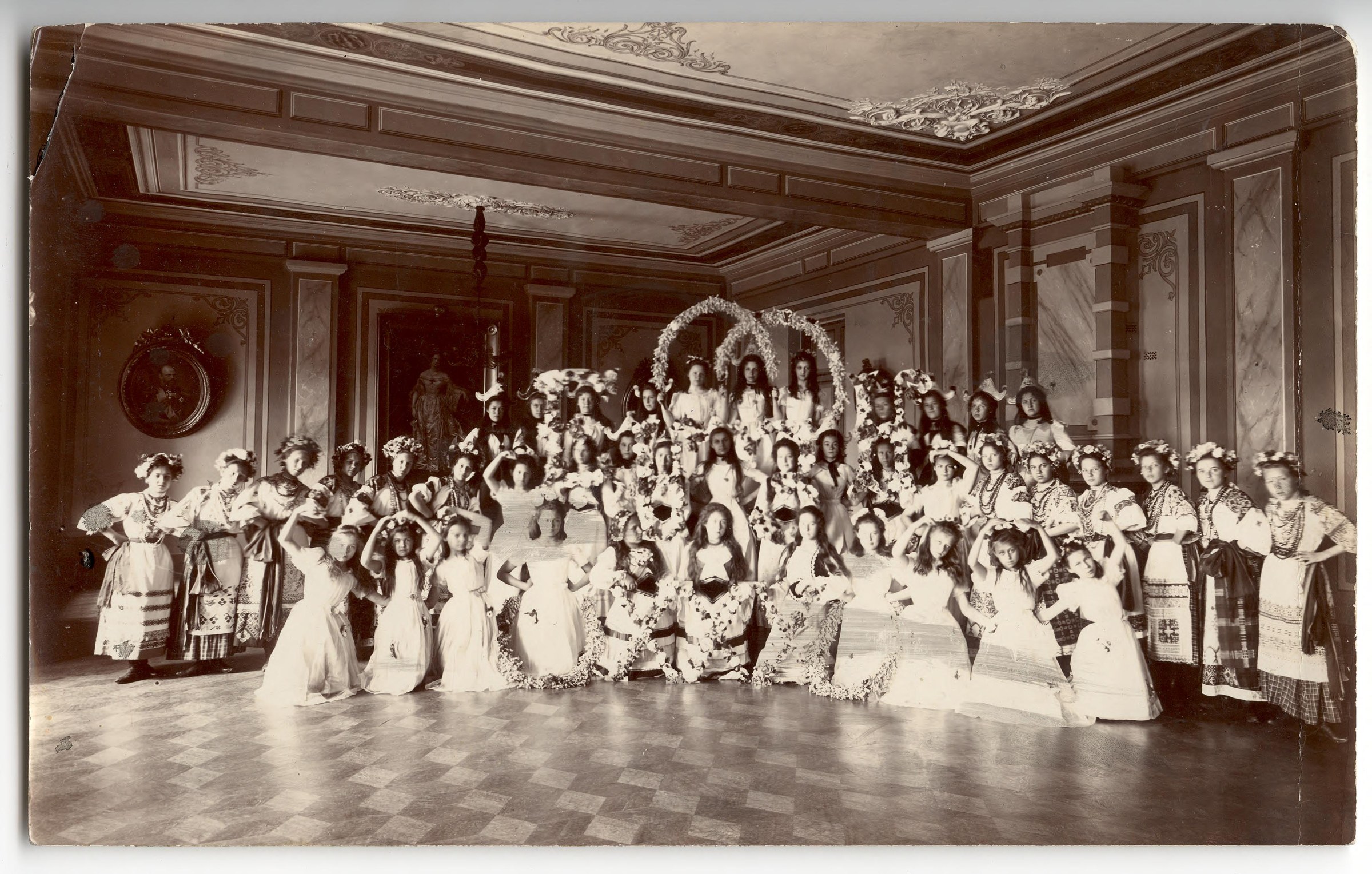
Bal-maskarad v Irkutskom institute blagorodnykh devit︠s︡ imeni Imperatora Nikolai︠a︡ I.
Unknown artist
- Collection:
- Prints & Photographs
- Source:
- Library of Congress
- Rights:
- Rights vary by item — check the source record before reusing this image. Source record ↗
- Recorded as:
- Library of Congress — no known restrictions (verify per item)
This image shows dance as social institution rather than art form—how a formal dance functioned as a site of national identity, gender formation, and class display in Imperial Russia. For historians, it documents the survival of Russian national costume (kokoshniki, embroidered garments) within European ballroom practice, a cultural negotiation visible in no written account. The photograph is rare evidence of an institutional dance ritual that shaped generations of women but left almost no other visual record.
What you are looking at
A formal masked ball in a grand neoclassical interior, likely early 20th century. The ballroom has a coffered ceiling with ornamental plasterwork, paneled walls with classical relief medallions, and a polished parquet floor. Approximately sixty figures in formal white evening dress and elaborate costume—the women in long white gowns with detailed embroidery, decorated kokoshniki (traditional Russian headdresses), and floral garlands, the men in white tunics and tailored jackets—are arranged in a loose, celebratory formation around a large floral arch or pergola festooned with flowers. The figures are densely clustered in the center and edges of the frame, many facing the camera, some in mid-gesture with arms raised. The lighting is even and bright, typical of early photography or theatrical documentation. The scene captures a moment of organized revelry: formal enough to require professional documentation, playful enough to allow costume and masks.
The dancing
The bodies are generally upright and frontal, rarely caught mid-step or in partnered holds. Arms are often raised or extended outward in gestures of celebration or acknowledgment rather than in closed ballroom frames. Most figures stand at rest or in loose clusters, oriented toward the camera and the central floral installation. The pose is that of a formal group portrait interrupted by play—costume balls prioritize display of dress over continuous movement. The headdresses and embroidered garments are the focal point of the body's presentation.
The dance depicted
This is a masked ball (bal-maskarad) held at a Russian girls' institute, almost certainly a social dance event rather than a choreographed performance. The title identifies the venue as the institute named for Emperor Nicholas I, a prestigious institution for noble girls. The formal dress, kokoshniki, and elaborate embroidery suggest Russian national costume, but the ballroom setting and evening dress of the men point to European social dance conventions—waltz, quadrille, cotillion—as the probable dances of the evening. No active dancing is visible; the photograph documents the occasion and participants rather than capturing the dance itself. This is evidence of how dance operated in elite Russian institutions: as a marker of refinement, nationality, and social standing, choreographed by tradition more than by active movement.
How it was made
This is a photograph, not a painting or print as the record states. The even lighting, formal composition, and documentary quality are consistent with early 20th-century studio or ballroom photography, likely taken during or immediately after the event. The photograph was almost certainly commissioned—such institutional dances would be officially documented. The medium allowed the artist to capture the group at scale and in daylight or with artificial light balanced across the entire scene, a feat impossible in painting and seldom attempted in engraving. The technical clarity and the way figures are arranged for visibility suggest professional theatrical or social documentation photography.
About this work
This is a photograph of a formal masked ball at a Russian imperial girls' institute, likely from the early 20th century (circa 1900–1920). The scene documents an elite social dance event—a ritual performance of nationality, refinement, and institutional belonging. The photograph captures not choreographed dance but the mise-en-scène of dance: the costumed bodies, the formal interior, the ritual gathering. It is a record of how dance functioned in Russian aristocratic education as performance of identity rather than as movement.
How to look at it
Attend to the tension between the formal European ballroom interior and the Russian national costume. Notice how the kokoshniki and embroidered garments transform the evening dress into a statement of national identity. Observe that the photograph documents the gathering and display rather than the actual dancing—no couples are captured mid-waltz, no movement is frozen. The central floral arch suggests this was the focal point of the evening, perhaps the moment of presentation or the beginning of dancing. The camera position and the arrangement of figures for visibility confirm this is a commissioned documentary record, not a candid capture of an actual dance.
The artist
Unknown. The photograph was almost certainly commissioned by the institute itself, taken by a professional photographer of social events. No signature is recorded. The practice of official documentation of such events was standard in elite Russian institutions by the early 20th century.
The period
The early 1900s saw a flourishing of institutional dance in Russia as part of aristocratic education. Girls' institutes (particularly the Smolny Institute and institutions named for imperial figures) made ballroom dancing mandatory as preparation for social life and courtship. Simultaneously, the Russian Imperial ballet was at its height internationally; yet institutional social dance and theatrical ballet were entirely separate spheres. The photograph's documentary style is consistent with the era's growing use of photography to record and validate social life. The costume visible here—kokoshniki paired with European gowns—reflects a moment of cultural negotiation between Russian national identity and European sophistication.
Where it lives
Held in the Library of Congress Prints & Photographs collection. The photograph is identified in the record by the Russian title of the event and venue, suggesting it came to the U.S. collections through emigration or acquisition from Russian sources.
Dance in this work
Questions about this work
What was a Russian imperial girls' institute and why did it matter for dance?
Institutions like the one named for Emperor Nicholas I were boarding schools for aristocratic and noble girls, where ballroom dancing was a mandatory part of education. Dancing taught deportment, courtship, and the rituals of elite social life. These schools produced generations of women for whom formal dance was a key skill and social marker. The photograph documents one such institutional ceremony.
Why are the women wearing kokoshniki with European evening gowns?
This mixing of Russian national costume with European formal dress was typical of Russian aristocratic balls in the early 1900s. The kokoshniki and embroidered garments expressed Russian national identity while the white evening gowns and European ballroom setting expressed European sophistication and imperial prestige. The combination was not contradiction but negotiation—a way of being both Russian and cosmopolitan.
Is this a performance or a social event?
Officially a social event, though all formal institutional dances were performances in the sense that participants were on display. The photograph documents the gathering, not the actual dancing. Unlike a theatrical ballet or a choreographed pageant, a masked ball was an occasion for social interaction and the demonstration of refinement, not for executing a predetermined sequence of movements.
What dances would have been performed at such a ball?
Most likely waltzes, quadrilles, cotillions, and other European salon dances standard in aristocratic circles. The formal interior and European dress of the men suggest ballroom conventions of the period. Russian national dances (like the troika or kamarinskaya) might have been performed as entertainment, but the core evening would have followed European ballroom practice.
More dance artwork





