49 works in this view — arrow keys or swipe to move between them.
Dance in Art
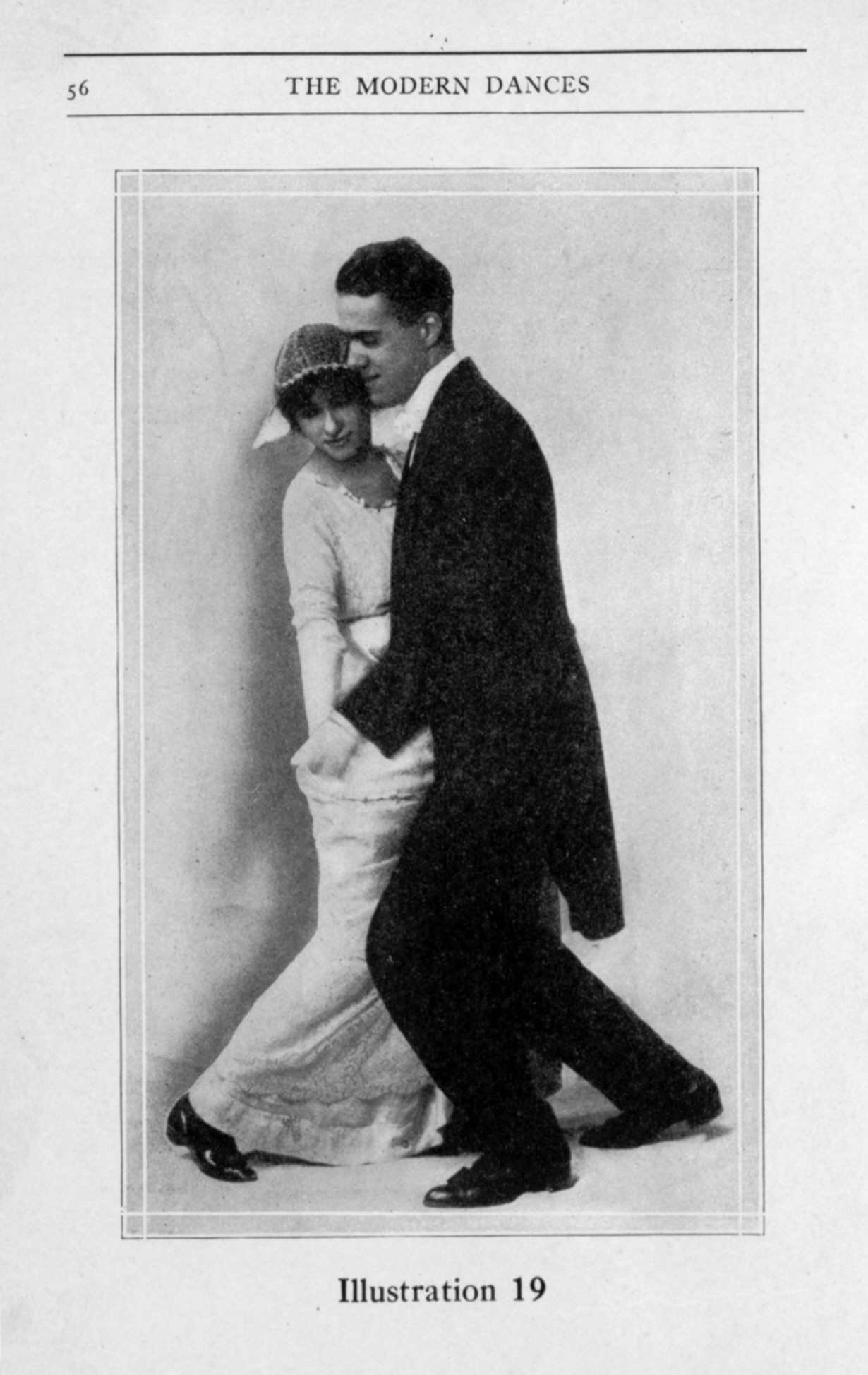
The Modern Dances - How to Dance Them (1914) - Illustration 19 HQ - Dream Waltz
Archibald Studio, Chicago, published by Saul Brothers, Chicago
- Source:
- Wikimedia Commons
- Rights:
- Public domain — free to use, share and adapt.
- Recorded as:
- public_domain
This image documents a critical moment in the professionalization of ballroom dance in America: the shift from inherited social practice to taught, standardized technique. The backward lean of the follower and the formal closed frame shown here were being actively promoted by dance teachers as modern and correct—a technology of the body that would eventually be institutionalized in competitive ballroom standards. For historians of dance instruction, gender, and the commercialization of leisure, this photograph is a primary source.
What you are looking at
A couple in ballroom dress performs the Dream Waltz in what appears to be a studio or neutral interior space, photographed against a plain background. The man, in dark tail coat and white shirt, stands behind and slightly to the side of the woman, who wears a white or cream ankle-length dress with a beaded headband across her forehead—fashionable accessories of the 1910s. The woman's weight appears to be supported primarily by the man; her body leans back and into his frame in a posture of trust and dependence characteristic of early 20th-century ballroom instruction. The photograph is crisply lit and formally composed, suggesting it was made specifically for instructional purposes. No other dancers, musicians, or elaborate setting is visible; the focus is entirely on demonstrating the hold and carriage of this particular dance.
The dancing
The couple stands in a closed ballroom hold, the man's right arm extended to support the woman's left side, his left hand presumably at her waist or back. The woman's posture is notably reclined—her upper body tilts away from vertical and into the man's frame, creating the visual hallmark of early waltz technique. Her right arm rests along his left arm. Both dancers appear to be captured mid-stride, with weight distributed in a way consistent with the gliding, continuous motion of waltz. The woman's dress reveals slender legs and small dark shoes; the man's bearing is upright and controlling.
The dance depicted
This is explicitly identified as the Dream Waltz, a social dance of the early 20th century. The waltz was the dominant ballroom dance of the era, and the Dream Waltz appears to have been one of its named variations or interpretations. The image demonstrates the characteristic closed frame and the pronounced backward lean of the follower—a feature of waltz technique from the late 19th and early 20th centuries, before the more upright frame of later standardized ballroom waltz was codified. The notation of this as a 'modern dance' in the book's title indicates that in 1914, the waltz was still grouped with contemporary social dances rather than historic ones.
How it was made
This is a photographic print, likely made using standard gelatin dry-plate or equivalent silver gelatin process typical of the 1910s. The image has been published as an illustration in a bound instructional book, suggesting it was reproduced by photomechanical printing (halftone or similar). The photograph's crispness, formal composition, neutral background, and lighting suggest studio work—deliberately created as instructional material rather than documentation of a social occasion. The choice of photography over illustration or drawing indicates an intent toward anatomical accuracy and realism in teaching ballroom technique to a mass audience.
About this work
This is one of nineteen illustrations in a 1914 instructional manual for modern ballroom dances published in Chicago by the Archibald Studio. It documents the Dream Waltz—a named variation of the waltz, the era's most popular social dance. The photograph captures both the posture and the partnership dynamic that defined early 20th-century waltz: a close, supported frame in which the follower (typically the woman) leans visibly back into the leader's control. As an instructional image, it was designed to teach prospective dancers not just the steps but the carriage, the hold, and the physical relationship between partners.
The work belongs in a dance history archive because it preserves a moment in ballroom pedagogy—a specific technique and aesthetic that was already becoming standardized and codified as social dance was professionalized and commercialized in the early 20th century. It shows us not what people did in their parlors, but what a commercial dancing studio wanted people to aspire to do.
How to look at it
Look first at the woman's posture: the backward lean is pronounced and deliberate, supported entirely by the man's frame. This is not a natural standing position—it is a technical choice, a demonstration of trust and controlled partnership. Notice the height differential and the positioning of the man's upper body: he is slightly behind her, his frame solid and his bearing vertical, creating a counterbalance. The moment captured is likely mid-stride in the walking pattern of the waltz, though without seeing the feet in full it is difficult to say whether this shows the characteristic rise-and-fall of Viennese waltz technique or the smoother motion of the slower American waltz.
The artist
The Archibald Studio was a Chicago-based dance school and photography studio operating in the early 20th century. The studio produced this instructional manual in partnership with Saul Brothers, a Chicago publisher, suggesting a professional operation aimed at the middle-class market for dance instruction. The studio's choice to commission or produce photographs rather than illustrations reflects both the resources available to a successful commercial dance school and the period's faith in photography as a medium of truth and instruction.
The period
In 1914, the waltz was at the height of its reign as the primary ballroom dance in the United States and Europe, though the decade saw rapid innovation in jazz-influenced dances and the emergence of new competitive ballroom forms. The publication of instructional manuals with photographic illustrations was becoming common as dance schools sought to professionalize and commercialize leisure and courtship. The early 20th century saw the systematic codification of ballroom technique—what had been local, variable, and learned by imitation became standardized, teachable, and photographable. The Dream Waltz, as a named variation, suggests the period's appetite for novelty within a conservative form; waltz was the safe, respectable choice, but marketing benefit came from variation and naming.
Where it lives
This illustration is taken from 'The Modern Dances – How to Dance Them,' a 1914 instructional manual published in Chicago by Saul Brothers, with photographs credited to the Archibald Studio. It appears in the source as a numbered halftone plate (Illustration 19). The object is part of a complete teaching manual, not an autonomous artwork.
Dance in this work
Questions about this work
Is this the same Dream Waltz that Strauss or another composer wrote?
That cannot be determined from the image or the basic catalogue record. The Dream Waltz may refer to a specific composition, or it may be a studio's name for their own interpretation of waltz technique. Without additional research into the Archibald Studio's archives or period dance publications, it is not possible to say whether this was set to a named musical composition or was simply a branded variation marketed by the studio.
Why does the woman lean back so far?
In early 20th-century ballroom technique, the backward lean of the follower was considered elegant, dependent, and correct. It demonstrated the follower's trust in the leader and created a visual line that was fashionable. Modern ballroom technique moved toward a more upright frame and shared weight; this image documents an older aesthetic of partnership in which the follower's weight was visibly supported by the leader's frame.
How many couples are shown?
One couple only—a man and a woman—posed in the studio for instruction.
What is the difference between the Dream Waltz and an ordinary waltz?
That cannot be determined from this image alone. The photograph shows the frame and posture of a waltz-like dance; without access to the text of the instructional manual or other documentation from the Archibald Studio, we cannot say what specific steps or timing distinguished the Dream Waltz from other waltz variations.
More dance artwork





