49 works in this view — arrow keys or swipe to move between them.
Dance in Art
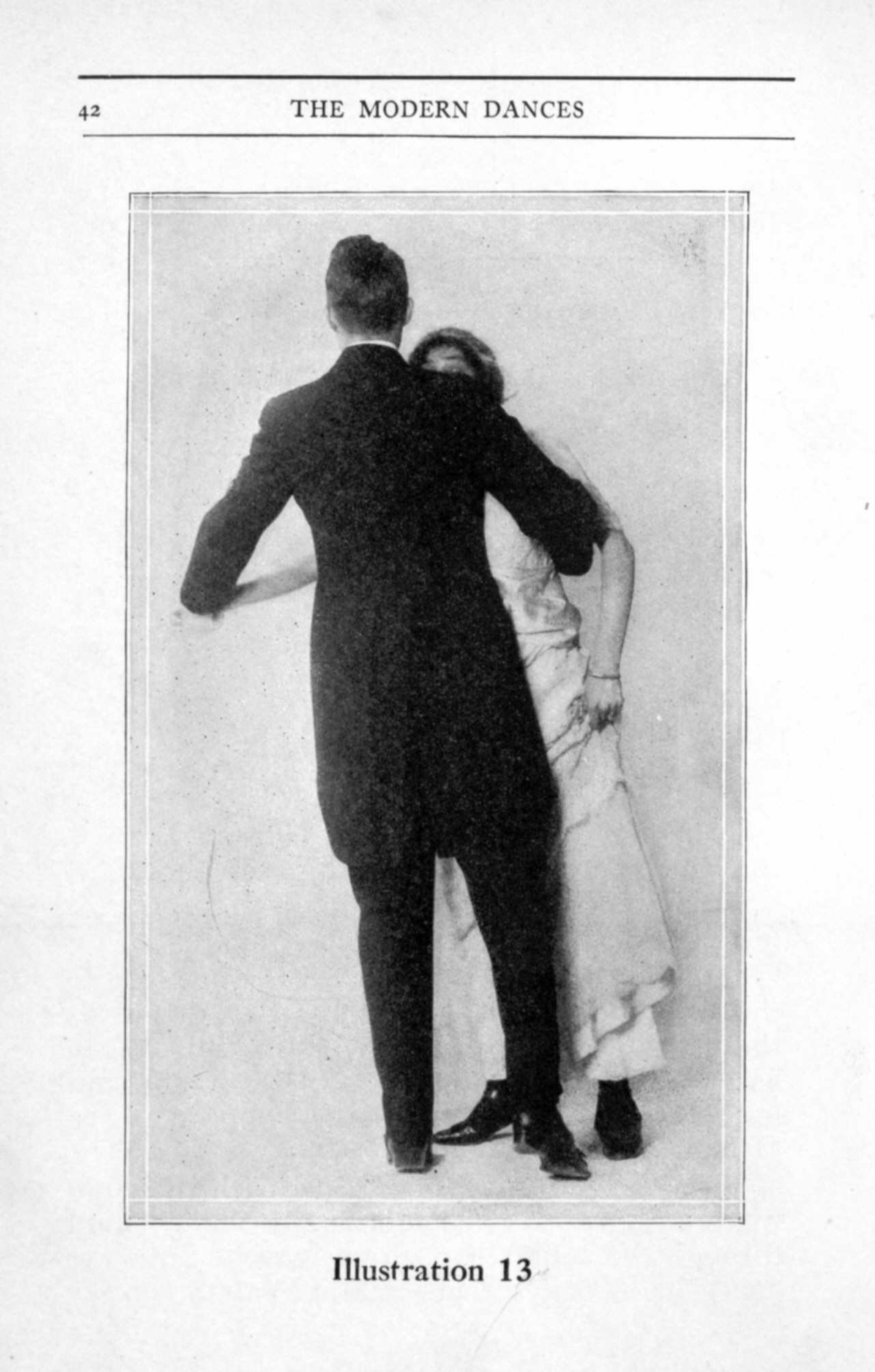
The Modern Dances - How to Dance Them (1914) - Illustration 13 HQ - Hesitation Waltz
Archibald Studio, Chicago, published by Saul Brothers, Chicago
- Source:
- Wikimedia Commons
- Rights:
- Public domain — free to use, share and adapt.
- Recorded as:
- public_domain
The Hesitation Waltz was a transitional moment in American ballroom dance—modern enough to seem daring and contemporary, yet rooted in the waltz tradition that had dominated 19th-century social dancing. This photograph documents how the dance was actually taught and understood in its moment, showing the specific partnership, frame, and posture that dancers were expected to master. For historians of early 20th-century dance pedagogy, this image is a primary source that shows how photography was enlisted to make invisible technique visible and teachable to a mass audience.
What you are looking at
A couple dances in close ballroom hold, photographed from behind and slightly above. The man wears a dark formal suit with his back to the camera; the woman, partially visible on his right, wears a light-colored (white or cream) dress with what appears to be a draped or gathered skirt. The photograph is shot against a neutral light background with no visible setting or props—the focus is entirely on the bodies and their relationship in space. The woman's head rests near the man's shoulder, and her right arm is visible at his side, suggesting an intimate, supported frame typical of early 20th-century ballroom dance. The image is printed in black and white halftone, consistent with photographic reproduction in a 1914 instructional publication.
The dancing
The man stands nearly upright with squared shoulders, his left arm extended to his side at approximately shoulder height to hold the woman's hand; his right arm curves around her back in a closed position. The woman leans slightly into him, her body angled to his right, her head positioned close to his shoulder in a dependent posture characteristic of the follower's role. Both dancers appear to be mid-step or in a suspended moment of the dance. The composition emphasizes the vertical line of the man's body and the supported, leaning quality of the woman's frame, which was a hallmark of the Hesitation Waltz.
The dance depicted
This is explicitly identified in the publication as the Hesitation Waltz, a modern ballroom innovation of the 1910s that combined waltz timing with syncopated hesitation steps—moments of suspension or pause that created a staccato effect against the fluid 3/4 meter. The Hesitation Waltz was popularized in the United States and Europe during the 1910s and was considered a more sophisticated variation of the standard waltz, often taught in ballroom studios and performed in social dancing and theatrical contexts. The image captures the characteristic moment of suspension and close partnering that defined the dance, showing the woman fully supported and dependent on the man's frame—a posture that would be impossible without the specific partnership and weight-sharing that the Hesitation Waltz demanded.
How it was made
This is a photograph reproduced as a halftone in a bound instructional manual. The halftone process—using dots of varying density to simulate continuous tone—was the standard method for incorporating photographs into printed books by 1914, allowing mass circulation of dance instruction to a broad domestic audience. The photograph itself appears to be studio work, lit evenly and shot against a plain backdrop to isolate the dancers' bodies and positioning. This technique was ideal for instructional purposes: the clean, uncluttered frame allows readers to study the hold, posture, and frame without distraction. The quality and clarity suggest professional studio photography, likely by a dance photographer or photographer familiar with instructional work.
About this work
This is one page from a 1914 instructional manual published in Chicago that used photography to teach modern ballroom dances to a home audience. The Hesitation Waltz—a syncopated innovation that had recently swept American and European ballrooms—required precise partnering and a distinctive moment of suspension that a still photograph could capture and preserve for study. The image shows not a performance or social scene but a posed demonstration: the couple is arranged to make their frame, contact, and weight distribution visible to a reader studying the steps at home. It belongs to a rich tradition of dance instruction manuals that used still images to freeze movement and allow careful analysis of technique, a pedagogical strategy that predates video by decades and remains visually distinct from performance documentation.
How to look at it
The photograph arrests the Hesitation Waltz at the moment of suspension—the hesitation itself—when the dancers pause before moving forward again. Notice the woman's complete dependence on the man's frame; her weight appears to be supported by his right arm and the connection through their joined hands. The man's upright posture and the woman's lean create a diagonal line that is the hallmark of the closed ballroom position. The photographer has positioned both dancers so their frame is visible from behind, making clear the distance between their bodies, the angle of their hips, and the quality of their connection—details that would be impossible to see from the front and that were crucial for dancers learning from the page.
The artist
Archibald Studio was a Chicago-based photographic studio. The studio's work on this manual demonstrates the growing market for instructional dance photography in the 1910s, a period when ballroom dancing was becoming professionalized and democratized through published instruction. The studio's name appears as credit on the image, suggesting a reputation significant enough to lend authority to the instruction. Little is documented about the studio's broader practice beyond this publication.
The period
The Hesitation Waltz emerged in the early 1910s as part of a wave of modern ballroom innovations that challenged the staid conventions of 19th-century social dance. It arrived during a period of rapid social change in America—urbanization, the emergence of commercial dance halls, the ragtime and jazz crazes, and growing female independence all reshaped how and where people danced. Ballroom dancing became professionalized: dancers trained in studios, competitions were held, and instructional manuals flooded the market. Photography had only recently become fast and accessible enough to freeze movement reliably, making it possible to use still images for dance instruction. This manual—published by Saul Brothers, a Chicago printing and publishing house—was part of a broader commercial effort to standardize and teach modern ballroom technique to an American middle-class audience.
Where it lives
This illustration is from *The Modern Dances: How to Dance Them*, published by Saul Brothers of Chicago in 1914. The image comes to us through Wikimedia Commons. The book was a commercial publication aimed at middle-class home dancers and ballroom students, suggesting it had wide circulation in its time.
Dance in this work
Questions about this work
What is the Hesitation Waltz?
The Hesitation Waltz was a modern variation of the traditional waltz that incorporated syncopated pauses or hesitations—moments when the dancers suspended their motion—into the standard 3/4 waltz time. It was fashionable in the 1910s and represented a more contemporary, sophisticated alternative to the basic waltz. The hesitations created a staccato, almost ragtime-influenced effect that reflected the modernist musical taste of the period.
Why is this couple photographed from behind?
A rear view shows the frame and frame quality—the angle of the man's arm around the woman's back, the supported lean of the woman's body, and the overall posture of both dancers—details that would be hidden or unclear from the front. For instructional purposes, this angle made the partnership and weight-sharing mechanics visible to a student learning from the page.
How were people supposed to learn ballroom dance from a book?
Instructional manuals used sequential photographs (and sometimes diagrams) to break down the steps, frame, and progression of a dance into a series of frozen positions. Readers would study the photographs carefully, often practicing with a partner, and return to the manual to check their positioning and alignment. This method was the primary way ballroom technique was taught and standardized before film and video became common.
Who published this book and why?
Saul Brothers was a Chicago printing and publishing house. They published this instructional manual to capitalize on the explosive popularity of ballroom dancing in the 1910s. As ballroom became professionalized and commercialized—with studios, competitions, and standardized technique—there was a ready market for books that could teach the latest dances to eager home learners and social dancers.
More dance artwork





