49 works in this view — arrow keys or swipe to move between them.
Dance in Art
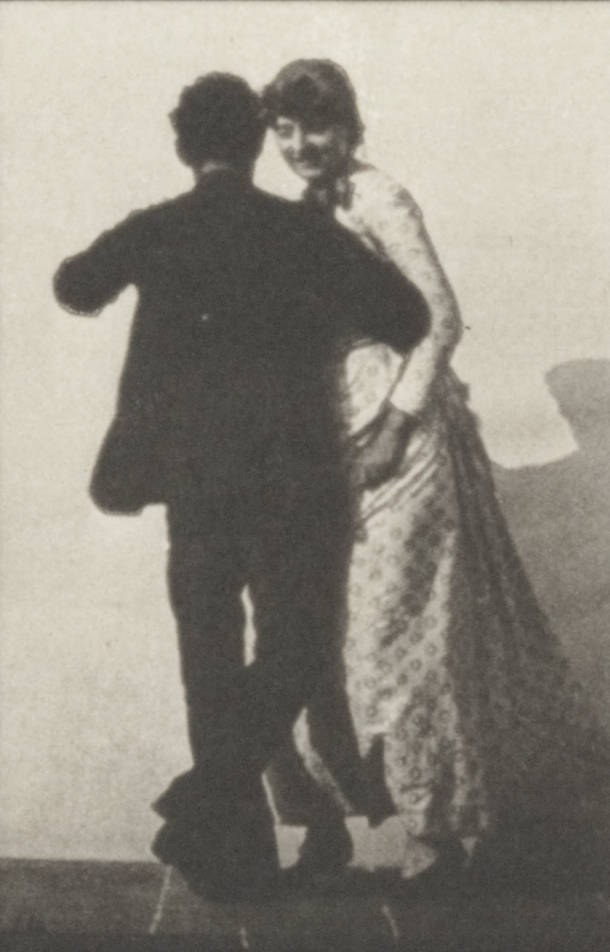
Man and woman dancing a waltz (rbm-QP301M8-1887-197a~14)
Muybridge, Eadweard, 1830-1904
- Source:
- Wikimedia Commons
- Rights:
- Public domain — free to use, share and adapt.
- Recorded as:
- public_domain
Muybridge's waltz photographs are rare evidence of how the dance was actually held and postured in the studio, untransformed by artistic convention or theatrical exaggeration—a document of the body rather than an interpretation of it. They sit at a crucial moment when photography began to supersede illustration as the authoritative record of human movement, reshaping both scientific understanding and artistic practice.
What you are looking at
A single photograph from Muybridge's sequential motion studies shows a man and woman in formal dress performing a waltz. The man wears a dark suit and is seen from behind; the woman wears a light-colored dress with a fitted bodice and full skirt. They are positioned in a close embrace characteristic of ballroom dancing, with the woman's body angled toward the camera so her face and upper torso are visible. The photograph is taken against a plain, neutral background typical of Muybridge's studio practice. The image is printed as a photogravure, rendering it in black and white with the soft tonal range and fine detail characteristic of that process. This is plate 197 from the *Animal Locomotion* sequence, one of dozens devoted to human movement and gesture.
The dancing
The pair are in a closed ballroom hold: the man's left arm around the woman's waist, his right hand clasping hers at shoulder height. The woman's left arm rests on his right shoulder. Their frames are upright and aligned, weight forward into the partnership. The woman's skirt is full enough to show movement, and her posture is poised and attentive. The photograph captures the vertical line and front-facing orientation typical of ballroom waltz position, not the rotational momentum of the dance itself—this is a held pose rather than a moment of motion.
The dance depicted
This is the waltz, the dominant couple dance of the 19th century and still central to ballroom technique today. The catalogue identifies it as such, and the closed position, formal dress, and upright frame are consistent with late–19th-century ballroom waltz. Muybridge's *Animal Locomotion* was commissioned to study human and animal movement through sequential photography, yet this image, like many in the dance section, appears to be a single posed moment rather than part of a true motion sequence. The waltz in 1884 was both a social dance and a theatrical spectacle, performed in ballrooms and on stage; this image documents the formal hold and posture rather than the characteristic rotating motion across the floor.
How it was made
This is a photogravure reproduction, a photomechanical process that translated Muybridge's original gelatin-plate photographs into a printed image suitable for large-scale publication. Photogravure allowed fine tonal gradation and detail reproduction impossible in woodcut or lithography, making it ideal for anatomical and movement study. The process required significant technical infrastructure and expertise, positioning *Animal Locomotion* as an ambitious, well-funded scientific and artistic enterprise. Each plate was printed in a limited edition and distributed to institutions, medical schools, and artists, ensuring wide circulation among both scientific and artistic communities.
About this work
This is a studio photograph of a waltz couple from Eadweard Muybridge's monumental 1872–1885 project *Animal Locomotion: an Electro-Photographic Investigation of Consecutive Phases of Animal Movements*, published in 1887 by the University of Pennsylvania. Though Muybridge's name is chiefly associated with action sequences—racehorses, jumping dogs, walking men—he devoted substantial effort to documenting human social and theatrical gesture, including dance. This waltz image is one of dozens in the publication devoted to couple dances and solo movement, made at a moment when the waltz itself was at the height of its cultural authority and when photography was beginning to challenge painting and drawing as the primary means of recording movement and form.
The work belongs to the intersection of three histories: the scientific study of motion (the stated purpose of *Animal Locomotion*), the documentation of ballroom dance as a formal social practice, and early photography's role in establishing new visual languages for the body. For dance historians, it offers a precisely dated record of waltz posture and dress from the 1880s; for photography historians, it exemplifies the ambitious use of sequential and posed photography to capture ephemeral human gesture.
How to look at it
Attend to the hold: the closed position, the height of the hands, the alignment of the spines. Notice the formality and uprightness—this is not a snapshot of motion but a statement of posture and partnership. The woman's skirt and the man's suit convey the dress code of ballroom dancing in the 1880s. The neutral background and studio lighting (typical of Muybridge's method) remove all context and focus attention entirely on the bodies and their arrangement. The photograph records a moment of poise rather than momentum—the waltz in suspension rather than in rotation.
The artist
Eadweard Muybridge (1830–1904) was an English-born photographer whose innovation in sequential and high-speed photography made him internationally celebrated during his lifetime. Beginning in the 1870s, he undertook a series of projects documenting movement: first the gallop of racehorses (commissioned by railroad magnate Leland Stanford), then the full range of human and animal locomotion. *Animal Locomotion*, his largest and most ambitious work, was sponsored by the University of Pennsylvania and took over a decade to complete. Muybridge was deeply engaged with both scientific inquiry and artistic practice; his photographs were studied by anatomists and artists alike, influencing painters and sculptors throughout the 1880s and 1890s. He presented himself as an investigator of nature, yet his compositions were carefully controlled studio arrangements.
The period
The 1880s were the height of the waltz's cultural dominion. The dance had arrived in European ballrooms in the early 19th century and remained the most prestigious and most danced couple form through the fin de siècle. In the same decade, photography was establishing itself as a primary tool for anatomical and movement study: Étienne-Jules Marey in France was conducting his own sequential photography experiments, and medical schools were beginning to incorporate photographs into instruction. The waltz itself was evolving—becoming more theatrical, more technically demanding, and more codified as ballroom dancing emerged as a competitive and professional discipline. Muybridge's decision to include dance sequences in *Animal Locomotion* reflects both the scientific interest in human movement and the cultural prestige of ballroom dance at the moment.
Where it lives
This is plate 197 from *Animal Locomotion: an Electro-Photographic Investigation of Consecutive Phases of Animal Movements*, published in 1887 by the University of Pennsylvania under the direction of Eadweard Muybridge. The work was printed as a photogravure and circulated in limited editions to scientific institutions, art schools, and private collectors. The copy catalogued here comes from Wikimedia Commons, sourced from the USC Digital Library.
Dance in this work
Questions about this work
Why did Muybridge photograph dancers if he was studying animal locomotion?
Muybridge understood 'animal locomotion' broadly to include all human movement—walking, running, jumping, and also gesture and social movement. Dance was of interest both as a systematic, repeatable human action and as a form that revealed something about the body's capacity for coordination and control. The project was scientific in ambition but artistic in scope.
Is this a single photograph or a sequence?
This appears to be a single posed image. Though *Animal Locomotion* is famous for its sequential photographs (multiple images of the same action), many of the dance and gesture studies are single held poses. This captures the waltz position as a formal arrangement rather than as motion across the floor.
What does this tell us about how people waltzed in the 1880s?
The closed position, upright frame, and formal dress confirm that the waltz was danced with a rigid, ballroom-style frame—not a loose or improvised embrace. The woman's posture shows an active, engaged partner, not a passive figure. The dress and grooming underscore that this was a formal social accomplishment, not casual movement.
How rare is Muybridge's dance documentation?
Dance sequences make up a small but significant portion of *Animal Locomotion*—perhaps 50–100 plates out of over 700. They are far less well known than his studies of walking and running, but they represent one of the earliest photographic records of ballroom dance and social gesture.
More dance artwork





