49 works in this view — arrow keys or swipe to move between them.
Dance in Art
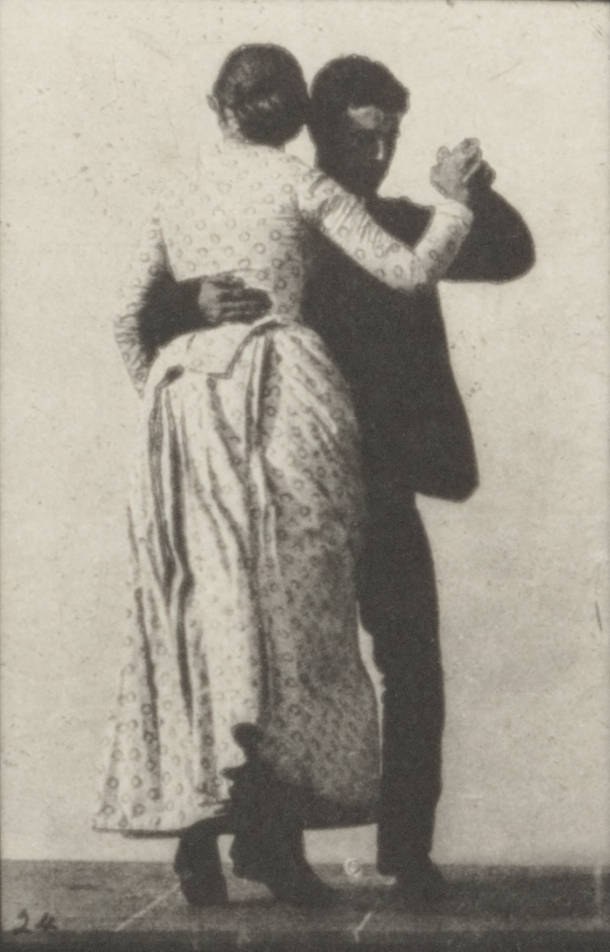
Man and woman dancing a waltz (rbm-QP301M8-1887-197a~24)
Muybridge, Eadweard, 1830-1904
- Source:
- Wikimedia Commons
- Rights:
- Public domain — free to use, share and adapt.
- Recorded as:
- public_domain
For dancers and choreographers, Muybridge's sequential photographs were a revelation: they showed human movement in a way the eye could not isolate. The waltz plate reveals how the ballroom body actually moved—the sway, the counter-poise, the responsive follow—and how partners related in space. For historians, it documents the style and dress of the 1880s ballroom, fixing in time a moment in the evolution of social dance.
What you are looking at
A man in dark formal attire and a woman in a light patterned dress with full skirt stand together in a waltz position, photographed against a plain backdrop. The man stands behind and to the side of the woman, supporting her weight as she leans back in the characteristic swaying posture of the waltz. His right arm is raised, her left arm extended upward in response. The photograph captures a single moment from what must have been a sequence—this is plate 197 from Muybridge's *Animal Locomotion*, his systematic photographic study of human movement. The image is a gelatin silver or photogravure print, rendered in black and white with the flattened tonality typical of late-19th-century sequential photography. The couple occupies most of the frame, their bodies the sole focus.
The dancing
The man's posture is that of a leading partner: his torso upright, his frame supporting the woman who yields into a pronounced back-sway, her weight largely on her back foot. His raised right arm indicates the lead; her left arm follows upward in a relaxed, responsive line. Their hold is the closed ballroom position standard to the waltz. The woman's dress falls in soft folds, showing the silhouette of her body and legs. The moment is mid-motion: neither figure stands square to the camera, and the tilt of both their heads suggests the rotational character of the waltz step.
The dance depicted
This is a waltz, danced in the late 19th-century ballroom style. The catalogue identifies it correctly. The image shows the characteristic sway and counter-poise of the Viennese Waltz in its social form—the couple is not executing a showy turn but dancing in the traveling, rotating manner typical of the period. Muybridge's sequential method captured the couple in what appears to be the middle of a pivoting action, the man leading, the woman following in that yielding, slightly recumbent posture that was considered graceful and correct in the ballroom of the 1880s.
How it was made
This is a photogravure, a photomechanical process that transferred a photograph onto a copper plate for printing. The photogravure allowed Muybridge's sequential studies to be disseminated widely and durably, printed in editions rather than as unique photographs. The process produces a characteristic fine grain and subtle gradation of tone. Muybridge worked with live models in his Philadelphia studio with controlled lighting and plain backdrops, allowing each figure to be read clearly. The photogravure was the gold standard for fine reproductive printing in the 1880s and made *Animal Locomotion* accessible to artists, anatomists, and dancers seeking to understand human movement.
About this work
This plate is one of over 700 sequential photographs from Eadweard Muybridge's *Animal Locomotion* (1872–1887), the most ambitious photographic study of human movement of the 19th century. The work documented not only walking, running, and jumping but also social and theatrical movement—including dance. The waltz as a subject was significant: it was the dominant ballroom dance of the era, and studying its mechanics through successive photographs was a novel way to understand how partners moved together. The image belongs in a dance gallery because it is both a historical record of how the waltz was actually performed and danced, and an artwork in its own right—a formal study of elegance and motion.
How to look at it
Attend to the woman's backward sway: this is the hallmark of the period waltz, in which the follower's weight moves backward into the leader's support, creating that distinctive tilted, almost reclining posture. Notice how the man's frame is steady and upright while hers bends; this is not a symmetrical partnership but a gendered one, where the woman's body yields to the man's guidance. The photograph captures a moment of rotation—neither figure is square to the camera, suggesting the traveling, spinning character of the dance. Muybridge's plain backdrop and controlled lighting allow you to read every detail of posture and dress without distraction.
The artist
Eadweard Muybridge (1830–1904) was a pioneering photographer and motion specialist. Originally trained as a landscape photographer, he turned to the systematic study of animal and human locomotion in the 1870s, supported first by Leland Stanford in California and later by the University of Pennsylvania. His *Animal Locomotion* (1887) was the culmination of decades of work, employing banks of cameras triggered by wires as subjects moved across a gridded stage. Muybridge's work was foundational to the birth of cinema and was studied intensely by artists, anatomists, dancers, and engineers. His photographs were neither purely scientific nor purely artistic—they occupied a liminal space that made them enduringly influential.
The period
The 1880s were the height of the waltz's dominance in European and American ballroom culture. The Viennese Waltz, in particular, had become the standard by which ballroom elegance was measured. Simultaneously, the rise of scientific and mechanical photography was changing how people understood the body in motion. Muybridge's work sat at the intersection: it applied the rigor of scientific inquiry to the grace of ballroom dance, and in doing so, made visible what had been intuitive. The publication of *Animal Locomotion* in 1887 coincided with growing interest in physical culture, eugenics, and the scientific study of aesthetics—all of which animated the late 19th century.
Where it lives
This is plate 197 from *Animal Locomotion: An Electro-Photographic Investigation of Consecutive Phases of Animal Movements* (1887), published under the auspices of the University of Pennsylvania. The plates were printed by the Photo-Gravure Company in Philadelphia. The work exists in multiple copies in archives and museums; this image is sourced from Wikimedia Commons.
Dance in this work
Questions about this work
Why did Muybridge photograph dancers?
Muybridge's goal was to document all forms of human movement, and social and theatrical dance were central to how people moved and expressed themselves. For *Animal Locomotion*, he photographed ballet, clogging, fencing, wrestling, and ballroom dancing alongside everyday movements. Dance was not a side interest but a core subject.
What is a photogravure?
A photogravure is a photomechanical printing process in which a photograph is transferred onto a copper plate, which is then etched and printed like an engraving. It combines photographic detail with the durability and reproducibility of printmaking. Photogravure was the finest method for reproducing photographs in the late 19th century.
Is this a single photograph or a sequence?
This is a single still image from a larger sequence. Muybridge typically photographed movement in series of 12 or more images per action. This plate is numbered 197 and may be part of a sequence of waltz steps; the full publication includes many plates showing the progression of the movement.
What can this tell us about historical dance?
This image documents the waltz as it was actually danced in the 1880s—the posture, the hold, the sway, and the dress. It is more reliable than written descriptions or paintings, which often idealized or distorted movement. It shows the responsive, yielding quality expected of the female partner and the upright, guiding role of the male partner.
More dance artwork





