49 works in this view — arrow keys or swipe to move between them.
Dance in Art
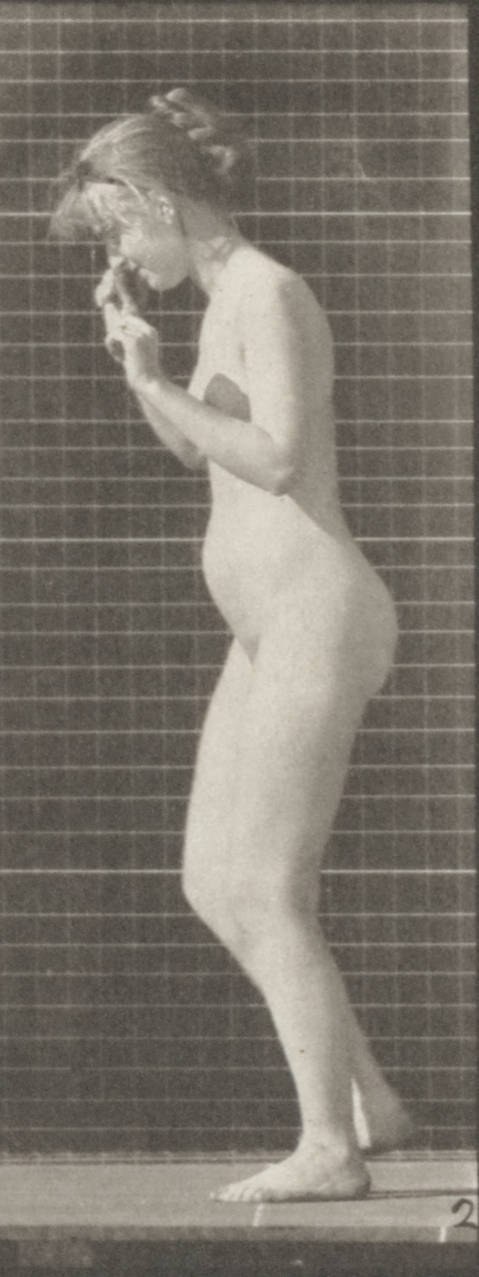
Nude woman dancing a waltz (rbm-QP301M8-1887-195a~2)
Muybridge, Eadweard, 1830-1904
- Source:
- Wikimedia Commons
- Rights:
- Public domain — free to use, share and adapt.
- Recorded as:
- public_domain
Muybridge's motion studies are foundational documents in the history of dance photography, showing how the camera could reveal movement invisible to the eye and creating a new category of dance image—neither the costume drama of academic painting nor the idealized studio portrait, but a clinical record of actual bodies in motion. This plate is also historically significant as evidence of how ballroom dance was taught and analyzed in the 1880s in North America, offering a rare documented record of waltz technique from that era. Finally, the work is important for understanding the development of photographic reproduction technology and its role in making scientific and artistic knowledge public.
What you are looking at
A single female figure stands barefoot in profile against a plain brick wall, captured in what appears to be a sequential motion study. The woman's body is unclothed and her hair is pinned up. She stands on the ground in an upright posture with her weight on her back leg, her front knee slightly bent, and her arms positioned at her sides with some bend at the elbows. The plain gridded background and the plate number visible at the bottom right (marked "2") indicate this is one frame from a multi-image sequence. The lighting is even and clinical, characteristic of motion photography meant to document movement rather than celebrate it aesthetically.
The dancing
The single dancer is shown in a moment of suspension or transition rather than active motion. Her torso is upright and relatively still, but her limbs suggest a preparatory or intermediate position—the weight is distributed between two legs, and the arm carriage is neither fully extended nor tightly controlled. The positioning has a balletic quality in the vertical alignment of the spine and the careful placement of the feet, though the overall frame lacks the tension and elongation characteristic of formal ballet training.
The dance depicted
The catalogue identifies this as a waltz, and the title aligns with Muybridge's documented practice of photographing ballroom dancers. However, the static quality of this single frame makes it difficult to confirm waltz technique visually. A waltz would normally show either a rotational quality in the torso or a clear traveling step, neither of which is legible here. This image may represent a pose held between steps, or it may be one of several images meant to be viewed in rapid sequence to reveal the waltz's characteristic three-beat rhythm and rolling motion. Without seeing the full sequence, the identification rests on the archive's caption rather than independent visual evidence.
How it was made
This is a photogravure from Muybridge's Animal Locomotion series, a large-scale documentation project executed between 1872 and 1885 and published in 1887 by the Photo-Gravure Company in Philadelphia. The photogravure process converts a photographic negative into an intaglio printing plate, allowing the original photograph to be reproduced in quantity on paper. The even gray tones and fine linear texture visible in the image are characteristic of this process. Photogravure was the most sophisticated method available in the 1880s for reproducing photographs in print, permitting wide distribution while maintaining tonal subtlety. This technical choice positioned Muybridge's work as both scientific documentation and fine-art publication, suitable for academic study, library holdings, and private collecting.
About this work
This is one plate from Eadweard Muybridge's monumental Animal Locomotion series, which applied rapid sequential photography to human movement—including dance, athletics, and everyday motion. The series was intended to resolve questions about animal locomotion invisible to the naked eye, but it became equally a study of human form and technique. Plate 195, titled "Dancing a Waltz," captures a moment in a ballroom dance performed by an unidentified professional dancer. The work sits at the intersection of scientific observation and artistic documentation, treating the dancing body as a subject for rigorous visual analysis rather than idealized representation. For historians of dance and of photography, it represents a unique moment when new imaging technology met staged performance, creating a record of how a dance teacher and photographer understood and broke down human motion.
How to look at it
This image is one plate in a sequence; to understand it fully, viewers should ideally see it alongside the preceding and following plates, which would show the progression of the waltz step. In isolation, notice the even distribution of weight and the slight forward tilt of the torso, which suggests preparation for motion rather than a held pose. The brick wall background is not a setting but a standardizing device, ensuring consistent lighting and eliminating visual distraction. The gridlines visible in the background were part of Muybridge's apparatus, helping him and viewers measure changes in body position between frames. The plate number and sequence indicator at the bottom right identify this work as part of a larger archive rather than a self-contained image.
The artist
Eadweard Muybridge (1830–1904) was a pioneering photographer best known for his motion studies. Born Edward James Muggeridge in Kingston upon Thames, he emigrated to America and established himself as a landscape and architectural photographer before turning to sequential photography in the 1870s. His most famous project, Animal Locomotion, grew out of a wager by Leland Stanford about whether all four hooves of a horse leave the ground simultaneously during a gallop—a question Muybridge answered in the affirmative using rapid successive exposures. The success of this work led to the larger Animal Locomotion project, which included not only animals but also human subjects performing various actions, including dance. Muybridge lectured internationally and influenced both scientific and artistic communities; his methods prefigured cinema and his visual language shaped how the twentieth century would understand movement.
The period
The 1880s were a moment of intense innovation in both photography and dance. Photographic technology was advancing rapidly—gelatin dry plates, faster lenses, and improved printing processes made sequential photography feasible. At the same time, ballroom dancing was consolidating into standardized forms; the waltz, which had scandalized conservative society only decades earlier, was now an established social dance taught with increasing formality. Muybridge's project emerged in this context as a scientific tool, but it was also a form of cultural documentation. In Europe and America, professional dancers and teachers were beginning to systematize technique through written notation and now, through photography. The unclothed or near-nude model was already standard in academic art training for anatomy, and Muybridge extended this convention into the study of living motion.
Where it lives
This photogravure is from Animal Locomotion: An Electro-Photographic Investigation of Consecutive Phases of Animal Movements (1887), published under the auspices of the University of Pennsylvania. The original plates were printed by the Photo-Gravure Company in Philadelphia. The work is now held in public collections including the USC Digital Library, from which this digital reproduction derives. As one plate in a bound portfolio or folio, this object has circulated as part of a comprehensive scientific and artistic publication rather than as an independent artwork.
Dance in this work
Questions about this work
Why is the dancer unclothed?
Muybridge followed academic art convention by photographing models without drapery to show the underlying anatomy and musculature. This allowed scientists, artists, and dance teachers to study the mechanics of movement without the visual interference of clothing. It was a standard practice in anatomy teaching and life-drawing studios of the period, extended here to the study of motion.
Is this a photograph or a print?
This is a photogravure, a print made from a photographic original. A photograph was taken, then converted into an intaglio printing plate, allowing multiple copies to be printed on paper. This method gave the image the tonal subtlety of a photograph while enabling mass production and distribution.
What is the brick wall for?
The wall is a neutral backdrop that ensures consistent lighting and eliminates visual distraction. The gridlines overlaid on the image helped Muybridge and viewers measure body position changes between successive frames, making the sequence a tool for precise analysis of movement.
How does this image help us understand waltz?
In isolation, this single frame shows a moment of balance and preparation, but waltz is a three-beat traveling dance best understood as a sequence. Viewing this plate with the others in the series reveals the rolling action, rotation, and step pattern that define the waltz. The series as a whole provides a unique documentary record of how the waltz was performed and taught in the 1880s.
More dance artwork





