49 works in this view — arrow keys or swipe to move between them.
Dance in Art
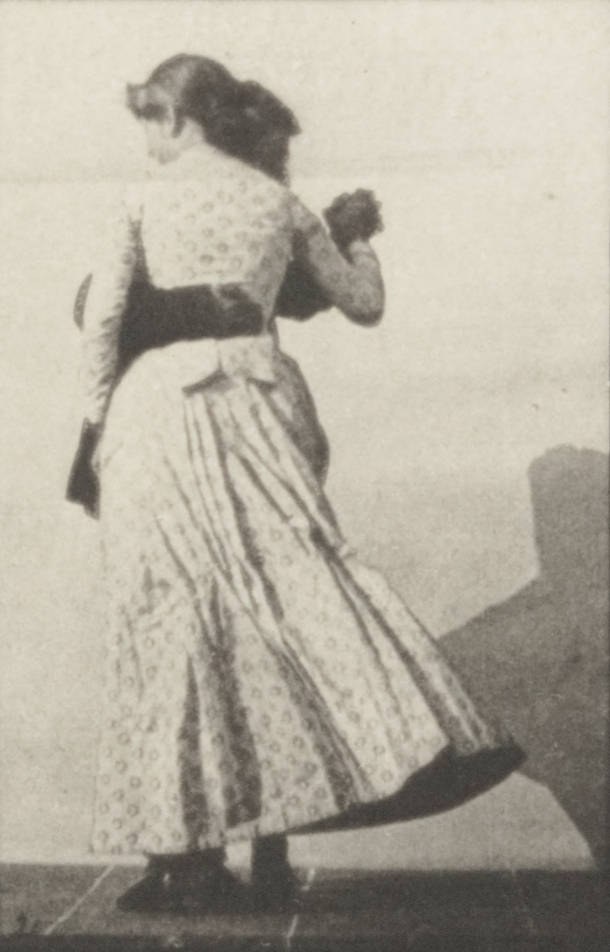
Man and woman dancing a waltz (rbm-QP301M8-1887-197a~21)
Muybridge, Eadweard, 1830-1904
- Source:
- Wikimedia Commons
- Rights:
- Public domain — free to use, share and adapt.
- Recorded as:
- public_domain
Muybridge's waltz sequence is historically rare evidence of how the waltz was actually danced in the 1880s—not the stylized, posed representations found in paintings, but a record of kinetic reality. For dancers and dance historians, it shows the rise, the sway, the moment of extension that defines the waltz's characteristic aesthetic, and it does so with the authority of photography rather than the interpretation of a painter's eye.
What you are looking at
A woman in a light-colored dress with a dark belt at the waist stands in profile, mid-movement. Her body is inclined forward at the torso, weight shifted onto her right leg, left leg extended behind her. Her dark hair is pinned up in the style of the 1880s, and her arms are raised in front of her body in a frame characteristic of ballroom dancing. The photograph is part of a sequence showing consecutive phases of movement—this appears to be a single frame from Muybridge's systematic study of human locomotion. The background is plain and neutral, typical of his studio documentation. The image is a photogravure, rendered in halftones that give it the soft, slightly ethereal quality of late-nineteenth-century photographic printing.
The dancing
The woman carries herself in a closed ballroom frame, though her partner is cropped out of or absent from this particular frame. Her posture shows the characteristic forward incline of the waltz or similar turning dance of the period, with weight committed to her supporting leg and the free leg trailing. Her arms and hands are positioned in the formal closed-dance hold, held forward and slightly to the sides. The tilt of her body and the extension of her leg suggest she is captured mid-pivot or mid-turn—the moment when rotational momentum carries the free leg into extension.
The dance depicted
The catalogue identifies this as a waltz, and the posture, dress, and ballroom hold support this attribution. The waltz was the dominant social dance of the Victorian era and the 1880s in particular. What Muybridge documents here is the characteristic moment of the waltz turn: the rise onto the ball of the supporting foot, the forward sway of the upper body, and the trailing extension of the free leg that creates the illusion of flight. This image is not a stylized artistic interpretation but a kinetic record—one frame in a sequence meant to show the actual mechanics of movement that the eye cannot resolve in real time.
How it was made
This is a photogravure, a process that etches a photographic image onto a steel or copper plate and prints it with the tonal range of an engraving. Photogravure allowed Muybridge to reproduce his serial photographs with fine detail and a wide range of grays, making subtle shifts in body position legible to the viewer. The process was labor-intensive and expensive, limiting circulation to institutional and wealthy private collections. The publication *Animal Locomotion*, from which this plate derives, was sponsored by the University of Pennsylvania and represented the cutting edge of both photographic technology and the scientific study of human movement.
About this work
This is a single frame from Eadweard Muybridge's *Animal Locomotion* (1887), a groundbreaking photographic study of human and animal movement. The image captures a woman dancing a waltz in the moment of a turning phrase—her body tilted, her leg extended, her frame held in the formal ballroom hold. Muybridge's method was to photograph subjects in rapid sequence using electric shutters, then arrange the resulting prints in grids to show the phases of a single action. For the waltz, this approach reveals what choreography and lived experience already knew but had never been so starkly visualized: the moment when a dancer's body achieves the appearance of weightlessness.
The work belongs to the intersection of art, science, and popular culture in the late nineteenth century. It was made for an era fascinated by the mechanical and the biological—by the idea that visible motion could be arrested, analyzed, and reproduced. It was also made for a world in which the waltz itself was becoming codified, standardized, and taught as technique rather than felt as social practice.
How to look at it
This image freezes the moment of greatest lift in the waltz turn—the instant when the dancer's center of gravity is highest and the supporting foot is furthest onto the ball. Notice the forward tilt of the torso and the extension of the free leg; together they create the illusion that the body is about to float free. The photograph is one frame in a sequence, so to read it fully, you need to imagine the motion before and after: the preparation, the rise, this moment of suspension, and the recovery. The formal hold—the arms and frame even though the partner is absent—tells you this is not a spontaneous gesture but a trained, codified movement.
The artist
Eadweard Muybridge (1830–1904) was an English-born photographer and inventor who became famous for his sequential photographs of human and animal movement. In the 1870s and 1880s, he pioneered the use of multiple cameras triggered by electric shutters to capture rapid sequences of motion. His work was driven by both artistic curiosity and scientific ambition—he sought to record movement too fast for the human eye to perceive, and to make visible the mechanics of human action. The *Animal Locomotion* project, carried out with the support of the University of Pennsylvania from 1883 to 1885, was his largest and most systematic work, comprising 781 plates and over 20,000 individual photographs. The project covered not only locomotion (walking, running, jumping) but also dance, sport, and gesture.
The period
The 1880s saw the waltz at the height of its social dominance in Europe and America. It had moved from scandal to respectability over the previous century, and by this period it was the foundation of ballroom dance culture. At the same time, the scientific study of human motion was becoming fashionable; Étienne-Jules Marey in France and Muybridge in America were using photography to arrest and analyze movement that had previously been the domain of painters and anatomists. The waltz itself was undergoing standardization—dance teachers were beginning to codify its technique, to regulate its hold, timing, and rise and fall. Muybridge's photographs appeared at a moment when the waltz was becoming an object of both scientific interest and nostalgic aestheticization.
Where it lives
This plate is part of *Animal Locomotion: an electro-photographic investigation of consecutive phases of animal movements*, compiled and published by Muybridge under the auspices of the University of Pennsylvania in 1887. The plates were printed by the Photo-Gravure Company in Philadelphia. The image derives from the USC Digital Library's digitization of the original publication.
Dance in this work
Questions about this work
Is this a real photograph or a posed reconstruction?
It is a real photograph—a frame from a sequence taken with a fast shutter and electric trigger. However, the subject was posed and the action was deliberate. Muybridge did not capture dancers dancing socially; he asked them to perform specific movements for the camera. What he captured was real movement, but movement performed for documentation, not for social or artistic pleasure.
Why is the partner missing from this image?
Muybridge's interest was in individual locomotion and gesture. For the waltz, he documented the woman's movement—the rise, sway, and extension—as a unit of motion. The partner would have been present during the sitting but may not appear in every frame. The woman's held frame and arm position make clear that she is dancing in hold.
How was this image made?
This is a photogravure—a photographic image transferred onto a copper or steel plate and printed as an intaglio. The process allowed Muybridge to reproduce photographs with the fine tonal gradation of an engraving. Photogravure was ideal for his work because it preserved the subtle gradations of light and shade that show the body's form and position.
How does this compare to how waltzes are danced today?
The fundamental technique—the rise and fall, the forward sway, the turning action—remains the same. However, modern ballroom waltz has become more standardized and athletic. The rise is more pronounced, the frame is more rigid, and the movement is faster. Muybridge's image shows a waltz that is more flowing and less mechanized, closer to the social waltz of the nineteenth-century ballroom.
More dance artwork





