49 works in this view — arrow keys or swipe to move between them.
Dance in Art
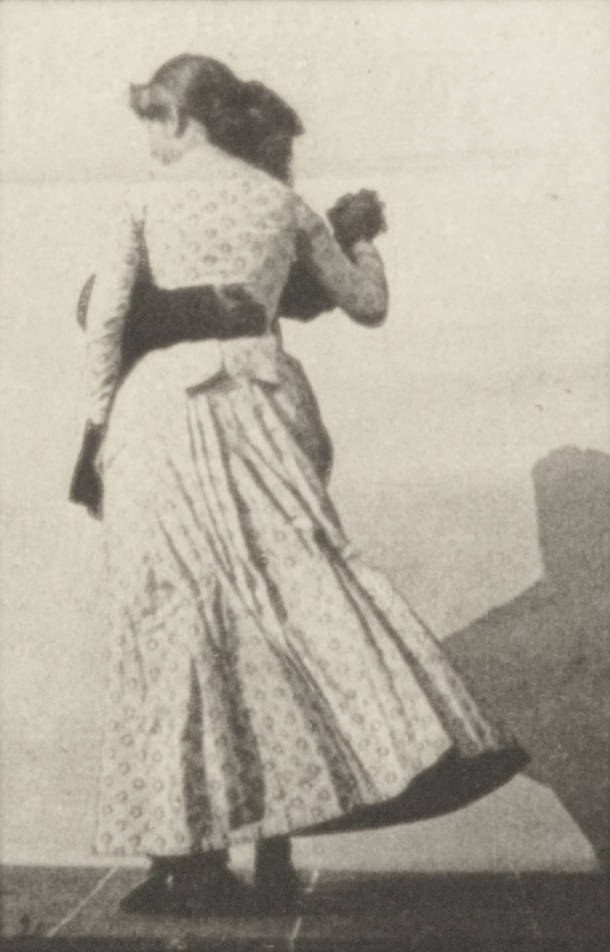
Man and woman dancing a waltz (rbm-QP301M8-1887-197a~20)
Muybridge, Eadweard, 1830-1904
- Source:
- Wikimedia Commons
- Rights:
- Public domain — free to use, share and adapt.
- Recorded as:
- public_domain
This plate is one of the earliest and most systematic photographic records of how the waltz was actually danced, captured with a precision no painting could match. For dancers and dance historians, it is primary evidence of ballroom technique and partnership in the late 19th century, and it shows how photography revolutionized the documentation of movement.
What you are looking at
This is a single photogravure plate from Muybridge's *Animal Locomotion* series, showing a couple in mid-waltz against a plain light background. The woman, wearing a long white dress with a fitted bodice and full skirt, is captured mid-turn; her skirt billows outward with momentum, creating a sculptural volume around her legs. Her dark hair is pinned up in the fashion of the 1880s. The man, in dark formal dress (jacket and trousers), stands close behind and to the side, his posture upright and supportive. The photograph is taken from a three-quarter view that shows both dancers clearly. The lighting is flat and even, typical of Muybridge's studio work, which emphasizes the bodies and their relative positions without shadow or atmospheric depth. The couple occupies the center of the frame; nothing distracts from their movement.
The dancing
The man and woman are in closed ballroom position, with the man's right arm around the woman's waist and her left arm on his shoulder; their other hands are clasped at roughly chest height. Her weight appears to be on her right leg while her left leg extends backward, suggesting she is in the middle of a rise and turn characteristic of waltz. The man's stance is grounded and vertical, providing a stable frame for the woman's traveling movement. Both bodies are upright and aligned; their connection is intimate but formal, governed by ballroom convention. The woman's skirt—the most dynamic element—shows the centrifugal force of her rotation, confirming rapid, continuous turning rather than a static pose.
The dance depicted
This is a waltz, most likely a Viennese Waltz or the ballroom waltz in use during the 1880s. The couple's closed position, the man's leading role, and the woman's characteristic rise and turn are all consistent with the waltz of this period. Muybridge documented this dance as one plate in his systematic study of human and animal movement, and it represents not a performance but an ideal, controlled demonstration of the dance in a studio setting. The waltz was already the dominant social dance of the European and American upper classes by this date, and Muybridge's inclusion of it suggests both its cultural centrality and its suitability for scientific documentation of rhythmic human motion.
How it was made
This is a photogravure—a photo-mechanical printing process that combines photography with etching to produce a finely detailed, reproducible image. Muybridge's originals were sequential photographs taken under controlled studio lighting; this plate was then transferred to a copper plate and printed. Photogravure allowed the delicate gradations of the photograph to survive the printing process more faithfully than earlier methods, and it permitted large-scale publication. The printing process meant this image circulated widely in Muybridge's published volumes, making it accessible to scientists, artists, and the educated public rather than remaining a unique object.
About this work
Muybridge's *Animal Locomotion* was a monumental scientific project begun in the 1870s to document the mechanics of human and animal movement through sequential photography. This plate, one of thousands, freezes a waltz at a moment of rise and turn, showing the couple's formal partnership and the physics of ballroom rotation. The work belongs equally to the history of dance and the history of photography: it is both a record of how the waltz was performed in the 1880s and a landmark in the use of photography to analyze movement.
Muybridge's approach—detached, documentary, studio-based—differs markedly from painted or drawn dance scenes of the period, which typically emphasized social narrative or theatrical spectacle. Here the dance is abstracted into pure movement, lit and framed for clarity. The waltz, already ancient by 1880s standards, becomes an object of scientific study, its elegance validated by its inclusion in a work of unprecedented scope.
How to look at it
Watch the woman's skirt: it tells you the speed and direction of her rotation. The billowed fabric captures a moment of vigorous turning—not a gentle step but an energetic rise. Notice the man's stillness: his role is to provide an unwavering frame for the woman's movement, and his upright posture, unswaying shoulders, and grounded legs show this clearly. The photograph was taken at the moment of maximum extension and rotation, chosen for clarity and dynamism—not at the beginning or end of a figure but at its heart. The studio setting and even lighting, far from being 'unreal,' allow the mechanics of the dance to be read without distraction.
The artist
Eadweard Muybridge (1830–1904) was a British-born photographer who settled in California and became famous for his sequential photography of motion. Beginning in the 1870s, he photographed horses, humans, and animals in movement using multiple synchronized cameras or a rapid-sequence single camera, then published the results in large-format volumes. *Animal Locomotion* (1872–1885, published 1887) was his magnum opus: 781 photographic plates documenting human figures—clothed, partially clothed, and nude—performing everyday actions and dances. The project combined scientific ambition (Muybridge was in dialogue with biomechanics researchers) with artistic interest in the human form. His work influenced artists, athletes, and scientists and established photography as a tool for motion analysis.
The period
The waltz had dominated European and American ballroom culture since the early 19th century, but by the 1880s it was beginning to coexist with newer dances (the polka, the quadrille, eventually the tango). Muybridge's documentation of the waltz in 1884–1885 captures it at a moment of established authority—no longer novel but not yet displaced. Photographically, the 1880s were a moment of rapid innovation: dry-plate photography, faster emulsions, and mechanical shutters made sequential motion studies feasible for the first time. Muybridge's work coincided with the emergence of chronophotography in France (Étienne-Jules Marey) and early cinema, all driven by the same hunger to decompose and understand movement.
Where it lives
This plate is part of Muybridge's *Animal Locomotion: an electro-photographic investigation of consecutive phases of animal movements*, a multi-volume published work issued under the auspices of the University of Pennsylvania. The plates were printed by the Photo-Gravure Company in Philadelphia and published in 1887. Individual plates from this work are now widely held in museum collections and have been digitized.
Dance in this work
Questions about this work
Is this a photograph or a print?
It is a photogravure—a print made by a photo-mechanical process that began with photographs but transferred them to a copper plate for printing. This allowed Muybridge to publish his work in large editions. The image is therefore both: a direct record of a photograph, but existing as a printed object.
Did Muybridge stage this dance, or was it improvised?
Muybridge worked in a studio with hired models and likely gave them specific instructions on what to do. The pose was not improvised but posed for the camera, though the dancers were presumably competent in ballroom dance. His aim was not to capture a spontaneous moment but to document the standard technique.
What makes this waltz different from earlier ones?
The photograph cannot tell you what changed musically or socially, but the posture and technique—the rise, the closed frame, the turning—are consistent with the ballroom waltz of the late 19th century. Muybridge's work is valuable partly because it shows what the 'standard' waltz looked like at the moment it was documented.
Why did Muybridge include social dances alongside anatomy and animals?
Muybridge saw all movement as worthy of scientific study. The waltz, for all its grace, is a mechanical problem: how do two bodies move together in rhythm? His project was to answer that question photographically across all human activity.
More dance artwork





